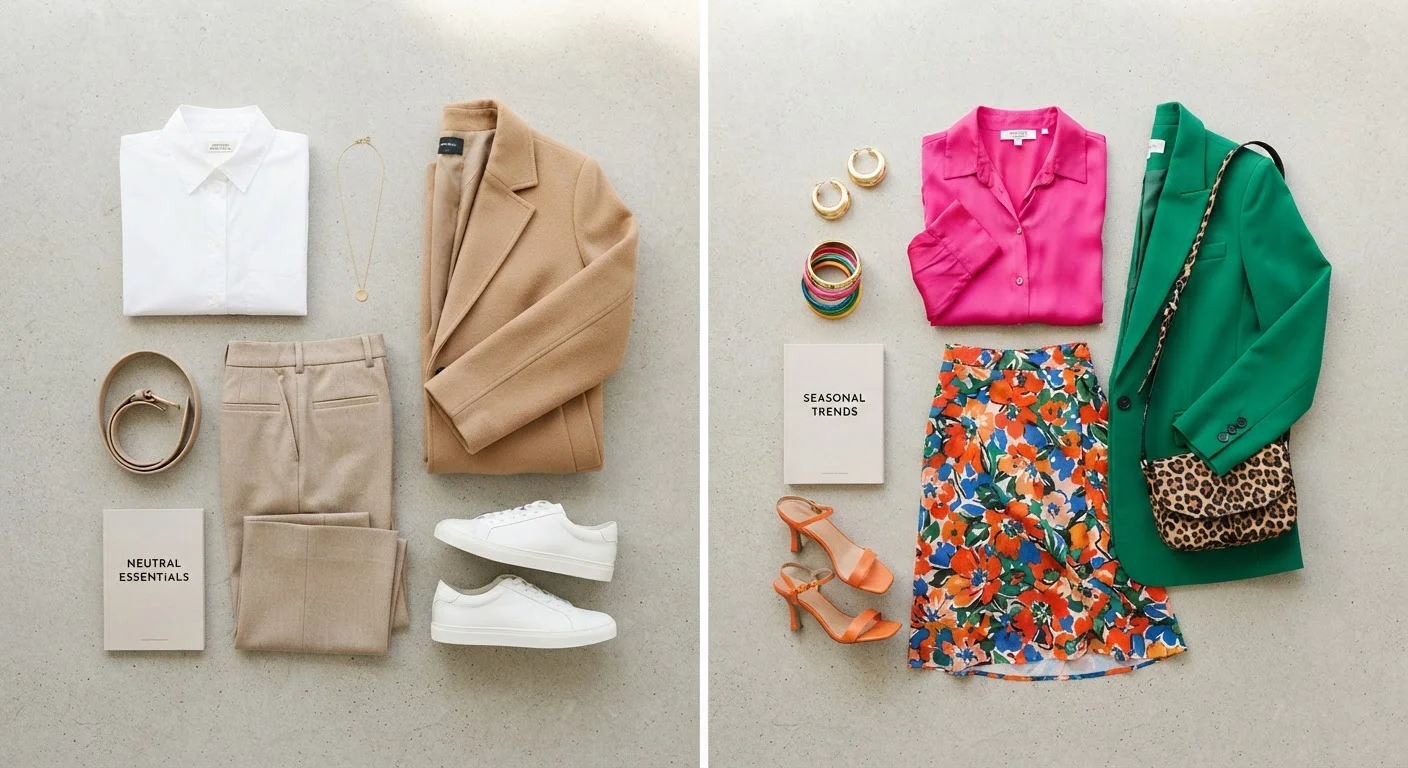
What Each Approach Actually Means
The terms "classic" and "trendy" get used loosely — sometimes as opposites, sometimes as judgments. In practice, they describe two distinct philosophies about what a wardrobe is for.
Classic dressing centres on pieces designed to remain visually relevant across multiple seasons: a well-cut blazer, a straight-leg trouser, a quality leather belt. The emphasis is on proportion, neutral or versatile colour, and construction that holds up over years of wear. The logic is additive — each piece you acquire should work with what you already own.
Trendy dressing treats the wardrobe as a living reflection of the current cultural moment. Pieces are chosen because they're now — whether that means a specific silhouette dominating runways, a colour of the season, or a style motif circulating on social platforms. The emphasis is on vitality and participation rather than permanence.
Neither framework is about spending more or less. Both can be practised on varied budgets, though each carries different financial patterns over time. If you're interested in how personal style works within budget constraints, the principles of classic dressing tend to align naturally with financially intentional approaches.
| Criterion | Classic Dressing | Trendy Dressing |
|---|---|---|
| Wardrobe lifespan | Multi-year, often decade-long | One to two seasons typically |
| Cost-per-wear | Lower over time | Higher as pieces date quickly |
| Versatility | High — works across contexts | Lower — context-specific |
| Self-expression | Subtle, consistent | Immediate, culturally legible |
| Wardrobe size over time | Smaller, deliberate | Tends to grow rapidly |
| Adaptability to life changes | High — pieces flex with context | Lower — tied to specific moments |
| Fashion participation | Limited seasonal engagement | Active, cycle-aligned |
The Long-Term Wardrobe Impact
Over time, the structural difference between these approaches becomes clearest in what your wardrobe looks like — and costs — five years from now.
Classic wardrobes tend to grow slowly but compound well. A trench coat purchased a decade ago still reads as relevant today precisely because it was never keyed to a specific trend cycle. The trade-off is that classic wardrobes can feel static without deliberate curation. Understanding the concept of signature pieces can help classic dressers build a closet that feels personal rather than generic.
Trendy wardrobes evolve rapidly and can reflect genuine personality and cultural awareness. The challenge is accumulation: pieces purchased for their moment-specific appeal often feel jarring just a season or two later, which creates pressure to refresh regularly. This pattern can generate a high volume of low-utility clothing over time.
~30%
Average wardrobe items never worn
Industry estimates from sustainability researchers suggest roughly 30% of wardrobe items go unworn — a pattern more common in trend-heavy closets.
3–5 years
Typical lifespan of quality classic piece
Garment care and quality studies indicate well-constructed basics in natural fibres often remain wearable for three to five or more years with appropriate care.
A middle path — sometimes called a hybrid strategy — involves investing in classic foundations and reserving a portion of your wardrobe budget for selective trend pieces. This lets you participate in fashion's evolving conversation without allowing trend cycles to dictate your entire closet. See how this connects to capsule wardrobe thinking, which formalises a similar intention.
Self-Expression, Identity, and Style Confidence
One of the less practical — but deeply real — dimensions of this choice is what each approach does for how you feel in your clothes.
Classic dressing can build confidence through consistency. When you know a blazer will always land well, you remove a variable from your morning and put cognitive resources elsewhere. This reliability is especially useful during periods of transition, where wardrobe certainty offers a stable anchor. For more on how style intersects with major life shifts, adapting your style through life transitions explores that connection in depth.
Trendy dressing, by contrast, can feel genuinely exhilarating when a piece captures exactly how you feel right now. Fashion scholars and sociologists have long noted the role of dress in communicating identity and group belonging — seasonal trends are one visible mechanism of that communication. The risk is that outsourcing your aesthetic to trend cycles can make personal style feel borrowed rather than built.
It's worth examining where personal aesthetics actually come from — your individual style influences may already tell you which framework you're instinctively more aligned with. Also consider that some commonly repeated rules about dressing — including implied pressure to stay trend-relevant — are more myth than mandate.
Classic and Trendy Aren't Mutually Exclusive
Most real-world wardrobes — including those of professional stylists — blend both approaches. The useful question isn't which to choose entirely, but what ratio works for your life, budget, and identity. Many stylists suggest a rough 80/20 split: foundational classics making up the bulk of a wardrobe, with a small allocation for experimental or trend-forward pieces. This isn't a rule — it's a starting framework to adjust based on how you actually dress.