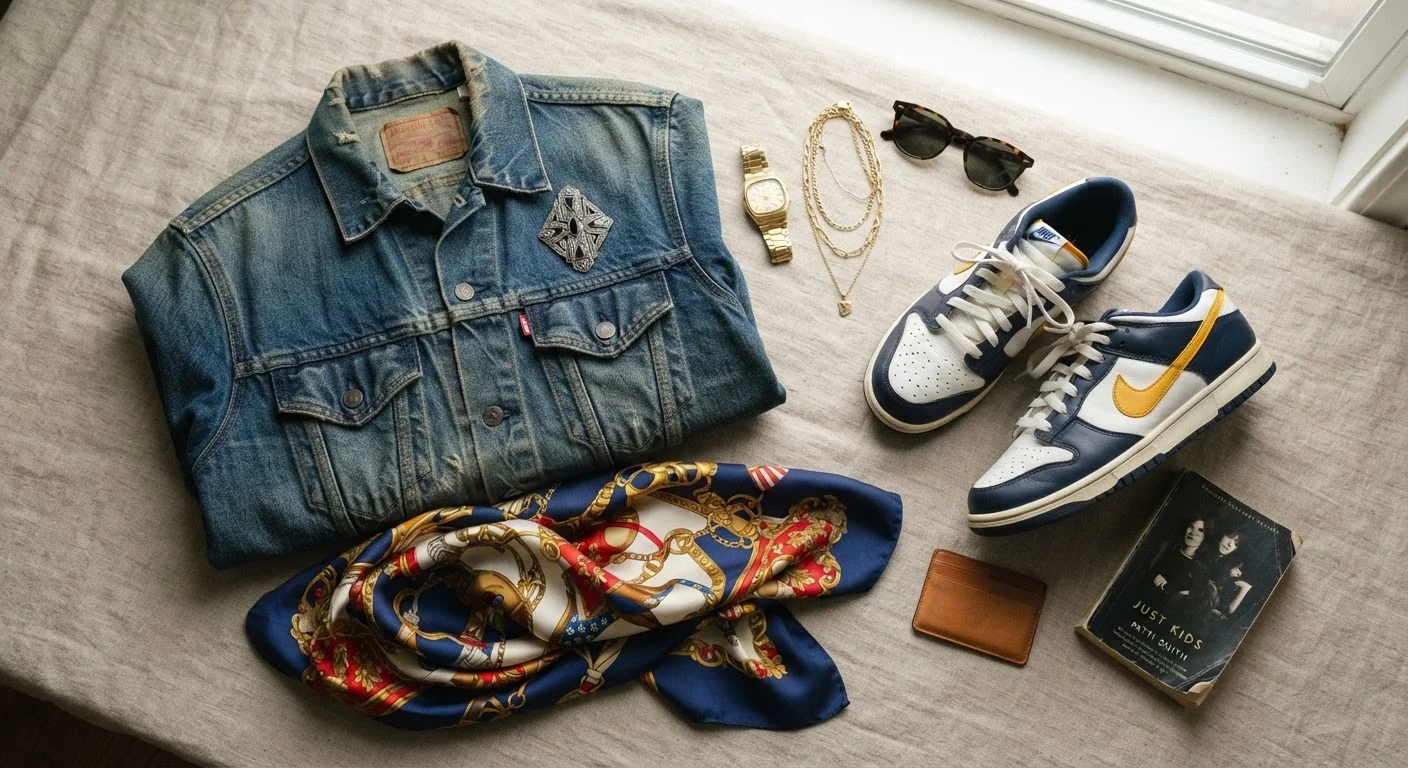
Why Influences Matter More Than Trends
Personal style is rarely invented from scratch. It accumulates — shaped by the images, environments, communities, and ideas that a person encounters over a lifetime. While trends describe what's circulating in the market at a given moment, influences describe the deeper sources that give a style its internal consistency and emotional resonance.
Understanding those sources matters because it shifts style from reactive (following what's available) to intentional (choosing what genuinely reflects you). Whether your aesthetic leans toward utility, ornamentation, minimalism, or dramatic contrast, there's usually a traceable lineage behind it — and knowing that lineage makes it easier to build on it, name it, and evolve it deliberately. For readers looking to put a name to their existing aesthetic, our guide to style archetypes offers a useful practical framework.
Below are seven of the most significant categories of influence that shape how people dress and present themselves.
Subcultural movements
From punk's deliberate destruction of formal dress codes in the 1970s to hip-hop's elevation of athletic and streetwear silhouettes in the 1980s and '90s, subcultures have consistently produced some of the most lasting style vocabulary in fashion. These movements weren't purely aesthetic — they were statements of belonging, resistance, or identity. Goth, mod, grunge, and rave each generated distinct visual languages that designers and everyday wearers continue to reference and reinterpret. If your wardrobe has a strong identity thread — a consistent attitude rather than just a colour palette — a subcultural influence is often at its root.
Subcultural style isn't just clothing — it's a visual language built around shared identity and resistance.
Art history and fine art movements
Art movements have shaped fashion more directly than most people realise. The clean geometry of Bauhaus design informed minimalism's structured silhouettes. Art Deco's symmetry and ornamentation translated into eveningwear embellishment that persists today. Surrealism — championed by figures like Elsa Schiaparelli — introduced unexpected juxtapositions of form and concept that showed up in avant-garde collections for decades. Even impressionism's soft colour relationships influence how stylists approach tonal dressing. Looking at the visual values of an art movement — its use of line, colour, proportion, and mood — often reveals why certain clothing choices feel cohesive or expressive rather than arbitrary.
Art movements give fashion its grammar — the underlying logic of line, proportion, and visual meaning.
Geography and local culture
Where people grow up and live shapes how they dress — sometimes subtly, sometimes profoundly. Climate dictates fabric weight and layering habits. Urban density affects how visible and performative dressing becomes. Regional craft traditions — Japanese indigo dyeing, Scandinavian textile simplicity, West African print work — embed themselves in local aesthetics and persist even as those aesthetics travel globally. The concept of sprezzatura in Italian dressing (studied, effortless elegance) or the French approach to investment basics with minimum trend turnover are geography-rooted philosophies, not just arbitrary cultural preferences. Recognising the geographic thread in your own preferences can help explain your intuitive pull toward particular textures, proportions, or palettes.
Geography quietly shapes every wardrobe — through climate, craft tradition, and local visual culture.
Decade-specific fashion memory
The decade in which a person comes of age aesthetically — usually adolescence through early adulthood — leaves a lasting imprint. This isn't nostalgia for its own sake; it's the result of formative visual exposure during a period of high identity formation. Silhouettes, colour stories, and styling conventions from that era often feel instinctively "right" to someone even years later. This explains generational aesthetic divides as much as it explains individual ones: someone who came of age visually in the mid-'90s will often have a different intuitive response to proportions than someone shaped by the 2010s. Awareness of this imprint helps distinguish between genuine personal taste and default pattern.
The decade you came of age aesthetically often becomes the quiet baseline for what 'right' looks like to you.
Functional and occupational context
Work, sport, and practical necessity have produced some of fashion's most enduring forms. The trench coat originated in military necessity; workwear denim evolved from labour requirements; athletic knitwear moved from team uniforms to high fashion. Utility-first garments — cargo pockets, rubber-soled shoes, technical fabrics — gained aesthetic credibility precisely because their functionality was legible. People whose personal style gravitates toward utilitarian pieces are often drawing on this lineage, whether consciously or not. Understanding the functional origins of clothing items can deepen your relationship to them and help you articulate why they feel authentic rather than merely fashionable.
Some of fashion's most enduring forms began as solutions to practical problems, not aesthetic ambitions.
Media, screen culture, and visual storytelling
Film, television, music videos, and editorial photography have always functioned as style delivery systems. Costume design in particular creates aspirational visual archetypes that enter public consciousness and influence how people think about dress even when they're unaware of the original source. The visual grammar of film noir — structured silhouettes, high contrast — has a clear descendant in contemporary dark academia dressing. Costume-heavy period productions routinely trigger renewed interest in corsetry, structured outerwear, or tailored proportions. Recognising which screens and stories have shaped your visual references is one of the more honest ways to understand the roots of your own aesthetic sensibility.
Screen storytelling creates style archetypes that shape real wardrobes long after the credits roll.
Streetwear and the democratisation of fashion
Streetwear changed the power structure of fashion by repositioning influence away from couture houses and toward community-driven culture. Rooted in skate, surf, and hip-hop communities from the 1980s and '90s onward, streetwear made the case that authenticity and cultural relevance could carry more weight than institutional prestige. Graphic tees, hoodies, sneakers, and caps became legitimate vehicles for aesthetic expression and cultural commentary. The lasting impact isn't just in the garments themselves but in the philosophy: that style authority can come from the ground up, and that wearers — not gatekeepers — define what is meaningful. This democratic principle continues to shape how people engage with personal style today.
Streetwear proved that style authority can come from community rather than from institutional fashion gatekeepers.
Influence Isn't Imitation
Understanding where a style influence comes from doesn't mean wholesale adopting it. Most people's aesthetics are composites — drawing selectively from multiple sources and reinterpreting them through personal context. The goal of tracing influences is self-awareness, not categorisation. Use this knowledge to make more deliberate choices, not to assign yourself a label.
Using Influence as a Starting Point, Not a Destination
Influence is most useful as a lens for understanding, not a box to occupy. The richest personal aesthetics tend to combine references — someone might draw on Japanese craft traditions, 1990s subcultural energy, and utility-first design principles simultaneously, producing a wardrobe that feels entirely their own precisely because the combination is singular.
Map Your Own Aesthetic Origins
Try listing five to ten visual references — films, places, decades, artworks, or communities — that feel instinctively connected to how you dress. Look for patterns: recurring colours, silhouettes, or attitudes. This kind of informal audit often reveals the underlying logic of your wardrobe more clearly than any style quiz.
Style also evolves. The influences that resonate most tend to shift as people move through different environments, relationships, and life stages. What matters is developing enough self-awareness to recognise when a change is organic growth versus chasing someone else's visual language.
If budget is a practical consideration in building on these influences, our article on expressing personal style on a limited wardrobe budget offers grounded, financially realistic strategies. And for readers weighing whether to anchor their wardrobe in enduring pieces versus current trends, classic vs. trendy dressing examines the trade-offs in practical terms.
The thread connecting all these influences is the same: style is ultimately a form of self-knowledge made visible. The more clearly you understand what has shaped your eye, the more deliberately and confidently you can dress.