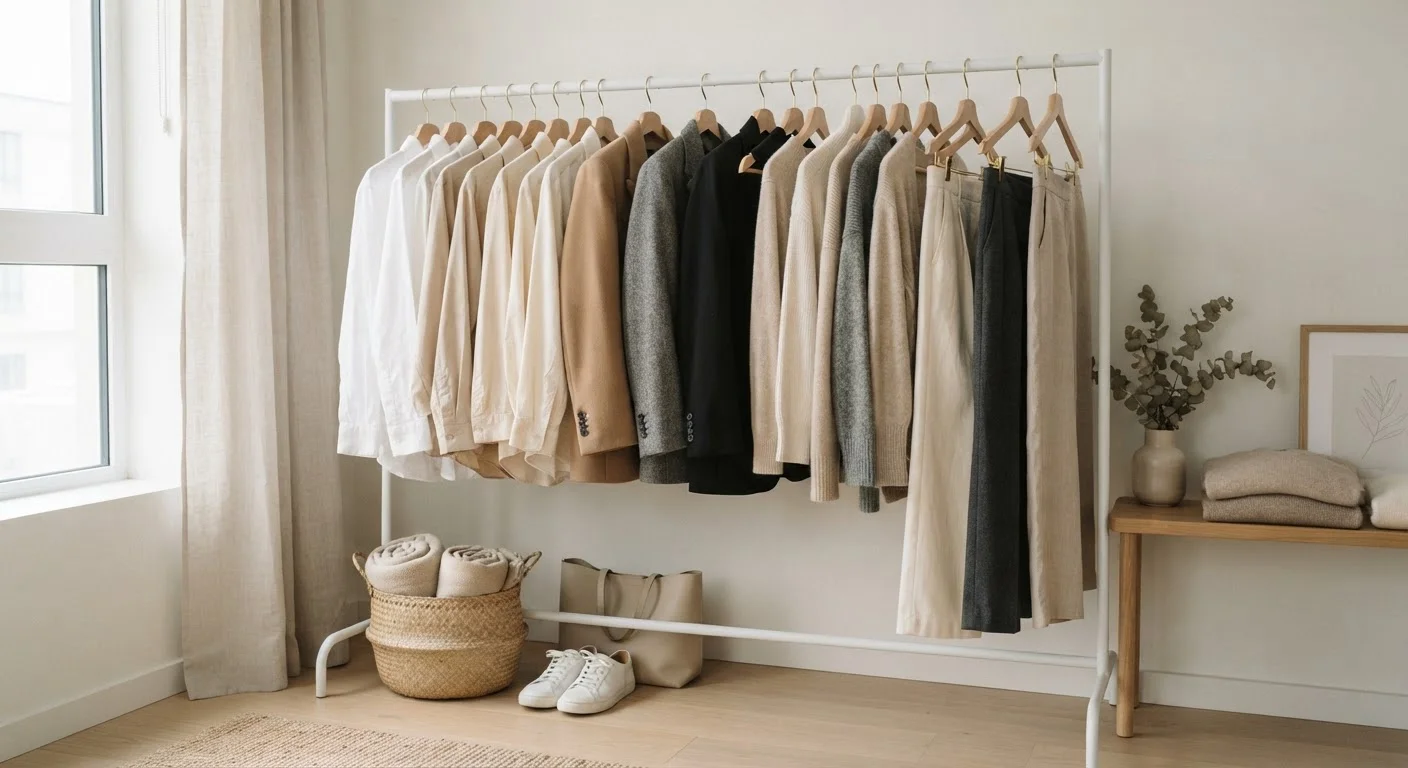
What Is a Capsule Wardrobe, Really?
The term capsule wardrobe was popularized in the 1970s by London boutique owner Susie Faux, who used it to describe a small collection of timeless, high-quality essentials that could be supplemented seasonally. The concept was later amplified when designer Donna Karan applied it to her 1985 collection of seven interchangeable pieces.
At its core, a capsule wardrobe is simply a deliberate, edited closet — one where every item earns its place, works with multiple other pieces, and reflects how you actually live. It is not a minimalist manifesto, a rule about color, or a prescribed list handed down from a style authority. Think of it less as a wardrobe structure and more as a decision-making philosophy: own less, but wear everything you own.
Capsule ≠ Minimalism
A capsule wardrobe does not require you to own as little as possible or to adopt an all-neutral aesthetic. People with bold, eclectic personal styles can and do maintain highly functional capsule wardrobes. The defining characteristic is intentionality — every piece is chosen — not a specific quantity or color palette.
How Many Pieces Does a Capsule Actually Need?
No universally correct number exists — anyone who tells you a capsule must be exactly 33 pieces is describing their capsule, not yours. That said, most style professionals and researchers who have studied wardrobe behavior suggest a functional range of 25 to 50 items, not counting underwear, workout wear, or very occasion-specific pieces like formalwear.
~30
Items most people regularly wear
Wardrobe behavior studies consistently find the majority of wearers rotate a core set of roughly 30 items regardless of closet size.
80%
Of clothes worn only 20% of the time
The so-called 80/20 rule of wardrobe use is widely cited by style researchers and professional organizers observing client closets.
The most useful question isn't "how few?" but "how many do I actually reach for?" If your closet holds 80 items but you rotate 30 of them on repeat, your effective capsule is already 30 pieces. A structured approach helps make that implicit behavior explicit — and intentional.
Which Pieces Belong in a Capsule Wardrobe?
There is no single list, but there are reliable principles. A well-functioning capsule typically includes three layers:
- Foundations: Neutral basics that anchor most outfits — think well-fitted trousers, a crisp white shirt, a versatile dark-wash denim, a tailored blazer, and a classic crewneck or cardigan.
- Workhorses: Pieces that carry the daily load — a reliable everyday bag, comfortable low-profile shoes, a medium-weight jacket suited to your climate, and a dress or two that transitions easily from day to evening.
- Accent pieces: Items that express your specific aesthetic — a bold-print blouse, a statement shoe, a particular color that feels like you. These keep a capsule from feeling like a uniform.
The ratio that tends to work is roughly 70% foundations and workhorses, 30% accent pieces. This gives you maximum combination flexibility while still allowing personal expression. For a deeper dive into how classics and trends coexist, consider how each category serves a different purpose in your wardrobe over time.
Before buying a new piece for your capsule, check that it works with at least three items already in your closet. If you can't make three combinations work, it's likely a gap-filler rather than a true addition.
Versatility is the core metric of a capsule wardrobe. A one-outfit piece, however beautiful, adds complexity rather than function.
Build your neutral palette around one warm or cool undertone — not both. Warm neutrals (camel, ivory, rust) and cool neutrals (charcoal, slate, navy) mix less naturally than pieces within the same undertone family.
Undertone consistency is a common blind spot that causes otherwise interchangeable pieces to clash subtly — a reason many people feel a capsule "doesn't work" even when the logic is right.
Does the Capsule Concept Actually Work for Everyday Life?
For most people, yes — with one important caveat. A capsule wardrobe works when it is built around the life you actually live, not the life you imagine living. If you work from home three days a week, a capsule heavy on office blazers will feel aspirational but useless. If you spend weekends outdoors, a capsule built on delicate silk blouses misses the mark.
The psychological benefit is real and documented in behavioral research on decision fatigue: fewer low-stakes daily choices conserve mental energy for higher-stakes decisions. Style editors frequently note that clients who edit their closets report feeling less stressed getting dressed, even when they initially resisted paring down.
Don't Build for an Imagined Life
A capsule wardrobe built around who you wish you were — the person who attends gallery openings, lunches at fine restaurants, or travels constantly — will sit unworn and create guilt rather than ease. Honest self-inventory about how you actually spend your time each week is the most important step before selecting any piece. Style follows life, not the reverse.
The capsule also travels well. The same interchangeability that works on a Monday morning works in a carry-on bag. See how experienced travelers apply similar logic in our guide to building a versatile travel wardrobe.
“The goal is not to have fewer clothes. The goal is to have no clothes you don't wear. Those are very different problems.”
— Erin Boyle, Author of 'Small Space Living' and writer on intentional home and wardrobe editing
How to Start Building Yours
The most common mistake is starting by shopping. Start instead by auditing what you already own. Pull everything out, assess what you actually wear, and identify genuine gaps before spending a dollar. Our wardrobe audit checklist walks through exactly this process, step by step.
Once you have clarity on what you own, you can approach any gaps strategically. If you're starting closer to zero, our guide on building a wardrobe from scratch covers the foundational sequence most effectively. And if budget is a constraint — as it is for most people — expressing personal style on a limited budget offers grounded, practical strategies that don't require spending more to dress better.
The capsule wardrobe is ultimately a tool for confidence, not a trend. When your closet reflects your actual life, your real aesthetic, and pieces you genuinely reach for, getting dressed stops being a problem to solve every morning and becomes something closer to effortless.
Start With One Category at a Time
Rather than overhauling your entire wardrobe at once, begin with the category you dress for most — workwear, casual weekend wear, or eveningwear. Getting one category to feel cohesive builds the confidence and clarity to tackle the rest. Trying to edit everything simultaneously tends to lead to decision paralysis and abandoned projects.