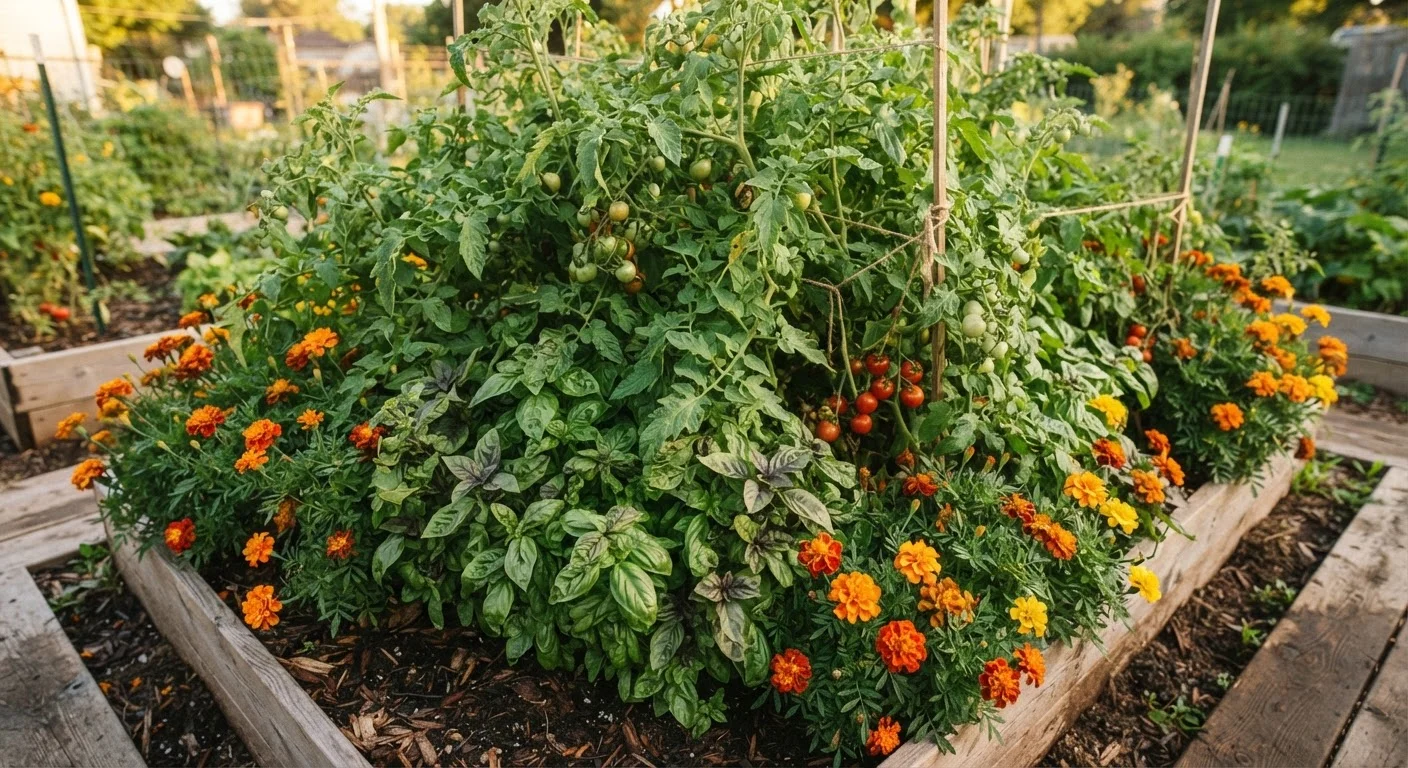
The Science Behind the Tradition
Companion planting has been practised for centuries, but not all traditional advice holds up under scrutiny. Researchers have confirmed that some plant interactions are genuine and measurable — while others appear to be garden myth passed down through generations of well-meaning growers.
The mechanisms that do have scientific support include:
- Nitrogen fixation: Legumes such as beans and peas host bacteria in their root nodules that convert atmospheric nitrogen into a form plants can use. Neighbouring crops — particularly heavy feeders like corn — can benefit from this enriched soil.
- Pest disruption: Certain plants emit volatile chemical compounds that confuse or repel specific insects. French marigolds (Tagetes patula), for example, have demonstrated effectiveness against root-knot nematodes in peer-reviewed studies.
- Beneficial insect attraction: Flowering companions can draw in predatory and parasitic insects that keep pest populations in check. Our article on plants that attract pollinators explores this in more depth.
Where the evidence is weaker, benefits tend to be indirect — for instance, tall plants providing shade that reduces moisture loss for shorter neighbours, rather than any chemical interaction.
Why Evidence Varies So Widely
Companion planting is difficult to study rigorously because garden conditions — soil type, climate, pest species, plant variety — differ so much from site to site. A pairing that works reliably in one study may not replicate under different conditions. When reviewing claims, look for studies that specify plant varieties, spacing, and measurement methods before treating results as universal.
Pairings With Strong Evidence
A handful of companion combinations appear consistently in both traditional practice and controlled research:
The Three Sisters
Indigenous farming traditions across North America cultivated corn, climbing beans, and squash together — a system with genuine complementary logic. Corn provides a structure for beans to climb; beans fix nitrogen that feeds corn and squash; squash leaves spread wide, shading the soil to suppress weeds and retain moisture. This polyculture has been validated in agricultural research as improving overall yields compared to monocropping each plant separately.
Marigolds and Vegetables
French marigolds are among the most researched companion plants. Studies have shown that growing them near susceptible crops can reduce soil-dwelling nematode populations over a season. They also attract hoverflies and other beneficial insects. Note that the effect on nematodes requires dense planting over multiple weeks — a single marigold border is unlikely to be sufficient.
Brassicas and Nasturtiums
Nasturtiums are often planted near cabbages and kale as a trap crop — aphids tend to colonise them preferentially, which can divert pest pressure away from vegetables. The evidence here is observational rather than experimental, but many gardeners report reliable results.
≈30%
Yield improvement in Three Sisters polyculture
Research on traditional polyculture systems suggests that corn-bean-squash combinations can outperform monocrops in total land productivity, though results vary by variety and climate.
75%+
Nematode reduction with dense marigold planting
Some controlled studies have found that dense plantings of French marigolds maintained across a growing season can significantly reduce soil nematode populations compared to unplanted controls.
Common Claims That Deserve Scepticism
Some of the most widely repeated companion planting advice is based on very thin evidence:
- Basil repelling tomato pests: The idea that basil improves tomato flavour or deters insects is pervasive but poorly supported by controlled studies. Growing basil nearby is not harmful, but expecting measurable pest control may lead to disappointment.
- Garlic repelling aphids broadly: While garlic contains sulphur compounds with some antimicrobial properties, evidence that proximity to growing garlic deters aphids in open gardens is weak. Garlic sprays are a separate matter.
- Roses and garlic: A popular pairing in older gardening books, but systematic evidence for reduced black spot or aphid damage is limited.
This does not mean these combinations are worth avoiding — they simply should not be counted on as reliable pest management strategies. Good soil health and appropriate watering will generally do more for plant vigour than any companion pairing alone.
Run Your Own Informal Trials
Divide a bed in two: plant a companion pairing on one side and a control planting (without the companion) on the other, keeping everything else identical. Track pest incidence, plant size, and yield at the end of the season. Over a few years, your own plot will give you more reliable guidance than any general companion planting chart.
Plants That Actively Hinder Each Other
Companion planting is not just about beneficial pairings — it is equally important to understand which plants suppress one another. Some incompatibilities are well-documented:
- Fennel
- Fennel releases compounds through its roots and leaves that inhibit germination and growth in many common vegetables, including tomatoes, peppers, and beans. It is generally advisable to isolate fennel from the main vegetable plot.
- Onions and alliums near legumes
- Onions, garlic, and other alliums can impede the growth of beans and peas when planted in close proximity. The effect is more pronounced in tight spacings.
- Walnut trees
- Black walnut trees produce juglone, a compound toxic to many plants including tomatoes, blueberries, and rhododendrons. Any planting within the root zone — which can extend well beyond the canopy — should account for this.
If you are starting a new vegetable plot and planning layout, our first-timer's vegetable garden guide covers site selection and plant placement in practical detail.
Putting It Into Practice
Applying companion planting effectively means treating it as one layer of a broader growing strategy rather than a standalone solution. A few practical principles:
- Start with well-supported pairings before experimenting with less-documented combinations. The Three Sisters and marigold-vegetable combinations are good starting points.
- Consider spatial relationships carefully. Plants need to be close enough to interact but not so close that they compete. In raised beds, managing companion spacing is generally more precise.
- Keep records. Because garden conditions vary so widely — soil composition, microclimate, pest pressure — noting what works in your specific plot over multiple seasons is more useful than following any general guide uncritically.
- Combine with solid fundamentals. Healthy, well-fed soil supported by home composting and appropriate mulching creates the conditions in which companion benefits are most likely to be expressed.
Companion planting rewards curious, observant growers. Approach it with realistic expectations and you will find it a genuinely useful addition to your gardening toolkit — even if it is not the magic system that some sources suggest.