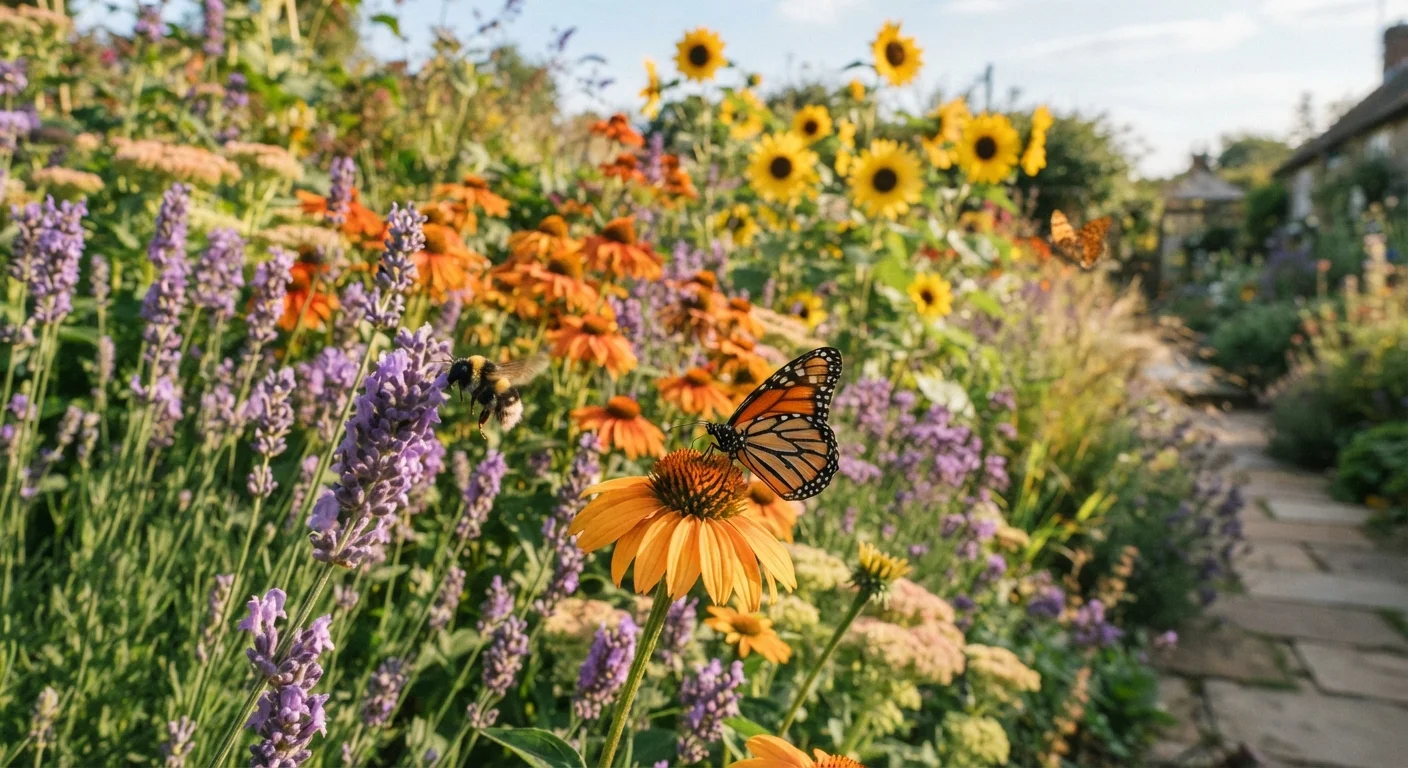
Why Pollinators Belong in Every Garden Plan
Pollinators — bees, butterflies, moths, hummingbirds, and even some beetles — transfer pollen between flowers, enabling plants to produce fruit, seeds, and new growth. The USDA estimates that pollinators contribute to roughly one-third of the food Americans eat, including many fruits, vegetables, and nuts. Yet populations of native bees and monarch butterflies have declined significantly over recent decades, partly due to habitat loss.
Your garden can be part of the solution. Choosing plants that provide reliable nectar and pollen — ideally across a long flowering window — turns even a modest yard into meaningful habitat. The list below covers well-regarded options, what each one offers, and how to use them effectively. For help deciding which species to commit to long-term, consider reading about annual vs. perennial plants before you shop.
Choose Native Species When Possible
Native plants have co-evolved with local pollinators over thousands of years, meaning their bloom timing, flower shape, and nectar composition are often precisely matched to native bee and butterfly species. Where possible, prioritize locally native selections within each plant genus — your local cooperative extension office can advise on the best native species for your specific region and soil type.
Eight Plants That Consistently Attract Pollinators
Purple Coneflower (Echinacea purpurea)
Purple coneflower is a native North American perennial that blooms from midsummer into fall, providing nectar for bees and butterflies precisely when many other plants have finished. Its raised central cone offers a stable landing platform for larger insects, and the seed heads that remain after blooming attract goldfinches through winter. It tolerates dry conditions once established and suits most US hardiness zones.
Coneflower's long bloom window fills a critical late-season gap for foraging pollinators.
Lavender (Lavandula angustifolia)
Few plants attract as broad a range of bee species as lavender. Its flower spikes produce abundant nectar and are highly visible against garden backgrounds. Lavender prefers well-drained soil and full sun, thriving in warmer, drier regions such as the Southwest and Pacific Coast, though cold-hardy varieties extend its range into colder climates. Its fragrance also acts as a deterrent to some garden pests, adding a secondary benefit.
Lavender draws more diverse bee species per square foot than almost any other garden plant.
Milkweed (Asclepias spp.)
Common milkweed and its relatives are the sole host plants for monarch butterfly caterpillars, making them irreplaceable in any pollinator-focused garden. Adult monarchs, along with swallowtails, skippers, and native bees, readily feed on the nectar-rich flower clusters. Native milkweed species — including Asclepias tuberosa (butterfly weed) and Asclepias incarnata (swamp milkweed) — are preferred over non-native varieties, which may disrupt monarch migration patterns.
Without milkweed, monarch butterflies cannot complete their life cycle — it is genuinely irreplaceable.
Bee Balm (Monarda didyma)
Bee balm is a native perennial with tubular red, pink, or purple flowers particularly suited to hummingbirds, as well as long-tongued bumblebees and sphinx moths. It blooms in midsummer and prefers moist, partly shaded spots — useful for areas where sunnier pollinator plants struggle. Good air circulation around plants reduces its susceptibility to powdery mildew, which is its main maintenance consideration.
Bee balm is one of the best choices for attracting hummingbirds alongside bees and moths.
Borage (Borago officinalis)
Borage is an annual herb whose star-shaped blue flowers are particularly attractive to honeybees and bumblebees. It blooms prolifically from early summer and self-seeds readily, meaning a single planting can return for years with minimal effort. Beyond pollinator support, its edible flowers are used in salads and cooking, making it a practical dual-purpose addition. It grows quickly, filling gaps in new beds while longer-lived plants establish.
Borage self-seeds generously, providing recurring pollinator support with almost no replanting effort.
Goldenrod (Solidago spp.)
Goldenrod is one of the most ecologically valuable native plants in North America, supporting over 100 species of bees and numerous butterfly species. It blooms in late summer and fall when many other nectar sources have ended, making it critical for pollinators building reserves before winter. Often mistakenly blamed for hay fever (ragweed, which blooms simultaneously, is the actual culprit), goldenrod's heavy pollen is carried by insects rather than wind.
Goldenrod supports over 100 native bee species and blooms precisely when most other flowers have faded.
Anise Hyssop (Agastache foeniculum)
Anise hyssop is a short-lived native perennial producing dense purple flower spikes from midsummer onward. It is particularly favored by bumblebees and attracts painted lady butterflies and skippers as well. It tolerates heat and drought better than many other pollinator plants and thrives in full sun. Its anise-scented foliage is generally left alone by deer, making it a practical choice in areas where deer browsing is a problem.
Anise hyssop combines drought tolerance with exceptional appeal to bumblebees and painted lady butterflies.
Sunflower (Helianthus annuus)
Open-faced sunflower varieties — those with accessible, pollen-covered centers — are outstanding for generalist bees, including native sweat bees and bumblebees. Single-petaled varieties are significantly more useful to pollinators than fully double-flowered ornamentals, whose dense petals block access to pollen. Sunflowers are easy to grow from seed, tolerate poor soil, and provide seed resources for birds after flowering ends, extending their habitat value into autumn.
Single-petaled sunflowers outperform double varieties because pollinators can actually access the pollen.
Mulching Around Pollinator Plants
While mulch helps retain moisture and suppress weeds, be mindful that some native ground-nesting bees require bare or lightly covered soil to build nests. Leaving small unmulched patches near your pollinator plantings can provide critical nesting habitat. See our reference on mulch types and application rates for guidance on balancing soil health with wildlife-friendly practices.
Pairing these plants thoughtfully with neighbors that share their growing conditions can amplify their impact. Our guide to companion planting explains which combinations have genuine support behind them.
Making Your Pollinator Garden Work Harder
Selecting the right plants is only the first step. To sustain pollinator activity throughout the season, consider the broader habitat you're creating. Group plants in clusters of at least three to five of the same species — this makes blooms easier for insects to locate and reduces the energy they spend foraging. Avoid hybrid flowers bred for larger petals or unusual colors, as these are often sterile or produce little accessible pollen.
Water matters too. A shallow dish with pebbles and clean water gives bees a safe place to drink without drowning. Reducing or eliminating broad-spectrum pesticide use — especially during flowering periods — protects the visitors you're working to attract. If you want to extend your garden's ecological value further, the trade-offs of letting part of your garden go wild are worth examining. A less-managed corner can provide nesting sites for ground-dwelling bees and overwintering habitat for beneficial insects. For larger design decisions about how your outdoor space functions as a whole, see our guidance on designing an outdoor space you'll actually use.