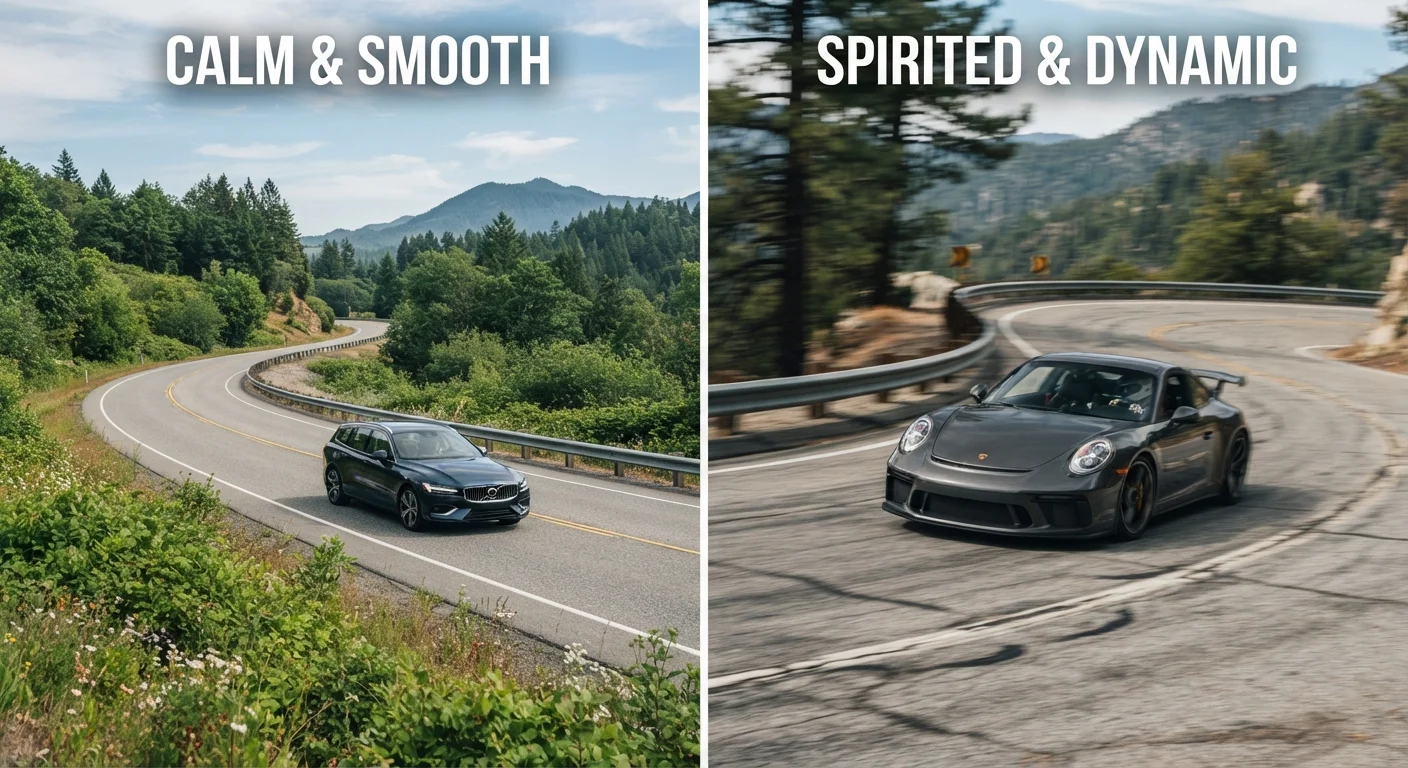
Defining the Two Styles
Eco-driving is the deliberate practice of operating a vehicle in ways that minimize fuel consumption and emissions. Its core techniques include anticipating traffic flow to avoid unnecessary stops, accelerating gradually, shifting to higher gears early in manual vehicles, and maintaining a steady speed using momentum rather than constant throttle input.
Performance driving, by contrast, prioritizes exploiting a vehicle's mechanical potential — responsive acceleration, precise cornering, and confident braking. While this style is most at home on a track or an open road, elements of it appear in everyday driving: overtaking decisively, maintaining higher cruise speeds, and pushing through corners with intention.
These approaches aren't always mutually exclusive. Smooth, controlled inputs are actually a hallmark of skilled performance drivers too. The real divergence lies in objectives: one targets efficiency and economy; the other targets capability and engagement. Understanding how road type changes your ideal technique is essential context for both styles.
Fuel Use and Running Costs
The fuel consumption gap between the two styles can be substantial. Hard acceleration from a standstill, high-speed cruising, and frequent braking cycles all increase fuel demand significantly compared to smooth, anticipatory driving. Aerodynamic drag rises sharply with speed — a vehicle traveling at 75 mph uses considerably more fuel per mile than one at 60 mph, making highway speed choices one of the most impactful fuel variables a driver controls.
Up to 30%
Potential fuel savings from eco-driving
The U.S. Department of Energy estimates aggressive driving can lower fuel economy by 15–30% on the highway compared to smoother techniques.
~50%
Aerodynamic drag increase from 55 to 75 mph
Aerodynamic drag increases roughly with the square of speed, meaning fuel required to overcome it rises sharply at higher cruise speeds.
Eco-driving techniques — coasting to decelerate rather than braking, reducing idling time, and avoiding unnecessary cold-start trips — can meaningfully cut fuel bills over time. For drivers choosing between fuel types, how each engine type responds to driving style is worth understanding, as hybrids in particular reward low-throttle inputs with regenerative braking gains.
Mechanical Wear: What Each Style Costs Your Car
Driving style is one of the most significant factors determining how quickly key components degrade. Brake pads and rotors wear faster under repeated hard braking; tires experience accelerated wear from aggressive cornering and sharp acceleration; and drivetrain components — clutch, gearbox, differential — all absorb more stress under performance-oriented inputs.
| Eco-Driving | Performance Driving | |
|---|---|---|
| Fuel Consumption | Minimized through smooth inputs | Higher, especially at speed |
| Brake Wear | Reduced via engine braking and coasting | Accelerated by frequent hard braking |
| Tire Wear | Low — gradual acceleration and cornering | Higher — aggressive cornering and launches |
| Engine and Drivetrain Stress | Moderate, consistent loads | Peak loads, frequent heat cycling |
| Safety Margin | Higher — anticipatory, more stopping distance | Context-dependent — lower if misapplied |
| Driver Engagement | Lower — prioritizes efficiency | High — vehicle capability is the goal |
Eco-driving's reliance on engine braking and coasting reduces heat and friction in the braking system. Gradual acceleration keeps engine loads moderate, reducing stress on the transmission and mounts. A fuller breakdown of these effects is covered in our guide to how driving style affects mechanical wear, which maps specific driver behaviours to the components most at risk.
The 'Lookahead' Habit Pays Off
Training yourself to read traffic 10–15 seconds ahead — rather than reacting to the car directly in front — is the single most effective eco-driving habit. It reduces unnecessary braking, smooths acceleration cycles, and keeps momentum working for you rather than against you. This same habit also gives you more time to respond to hazards, making it a genuine safety benefit as well.
Safety Implications of Each Approach
Eco-driving's emphasis on lookahead and smooth inputs aligns well with defensive driving principles. Anticipating traffic changes means more stopping distance is preserved. Moderate speeds reduce both stopping distance and the severity of any collision. These habits prove especially valuable in poor weather — a point expanded in our article on adapting your driving to rain, fog, and ice.
Performance driving carries higher margins for error if applied inappropriately. High cornering speeds, aggressive lane changes, and late braking points require exceptional vehicle awareness and road conditions that rarely exist in ordinary traffic. When these techniques bleed into everyday driving without proper discipline, they contribute to the kinds of risk behaviours examined in research on aggressive driving and its documented safety consequences.
The key distinction is context. Performance driving on an appropriate venue, with proper safety measures, is a legitimate pursuit. Applied to congested roads or mixed traffic, the risk calculus changes entirely.
Choosing Your Approach
For most drivers, most of the time, eco-driving habits offer straightforward benefits — lower fuel costs, reduced wear, and improved safety margins — with no meaningful downside. The techniques are learnable and transferable across virtually any vehicle, including EVs where smooth inputs also maximize range. If you drive an electric vehicle, what everyday EV life actually looks like is useful context for how these habits translate to battery-powered driving.
Performance driving, meanwhile, is a legitimate and rewarding skill set when pursued thoughtfully. Track days and advanced driver training programs offer environments where those techniques can be developed safely. Bringing sharper reflexes, better vehicle control, and broader mechanical understanding back to everyday roads — without bringing inappropriate speeds — is actually a mark of a well-rounded driver.
The practical answer for most people is a blended approach: eco-driving as the default, with the awareness and vehicle control that performance training instills kept in reserve for moments when they're genuinely needed.