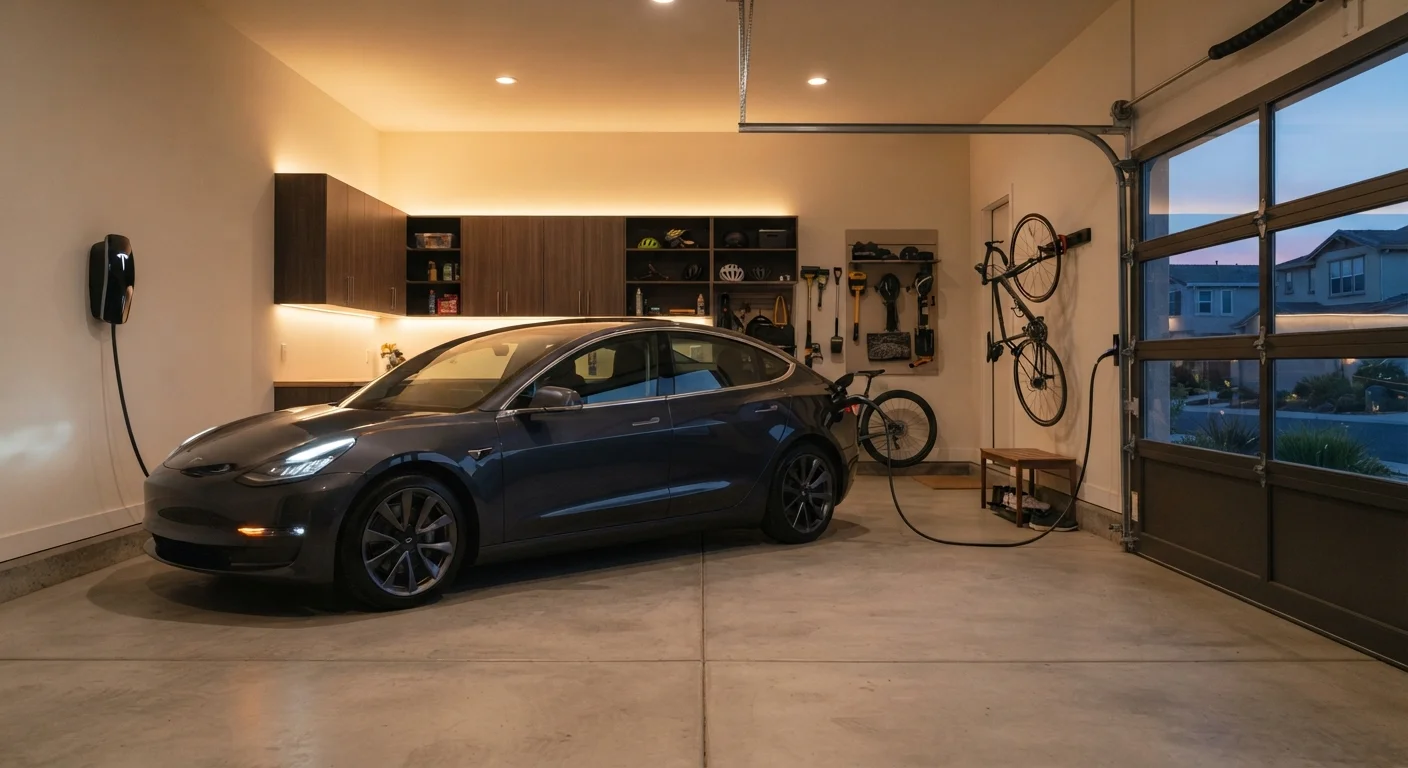
The Charging Routine: How Daily Life Actually Changes
The biggest mental shift for new EV owners isn't range — it's reversing the fuelling habit. Instead of stopping at a station once a week, most EV drivers plug in at home each evening and wake up to a full charge. For anyone with a driveway or garage, this quickly becomes effortless routine.
A standard home wallbox charger (typically 7 kW) will replenish the average EV battery overnight in most circumstances. Drivers without off-street parking face a meaningfully different situation: relying on public chargers for every top-up adds friction and cost that shouldn't be underestimated. If you're in this position, it's worth reading whether a plug-in hybrid might suit your setup better before committing to a fully electric vehicle.
Workplace charging, where available, provides a useful secondary option — but coverage remains patchy depending on employer and location.
Charging Speed: What the Numbers Mean
EV chargers are rated by power output (kW). A standard home outlet (Level 1) adds roughly 3–5 miles of range per hour — useful for top-ups, impractical as a primary method. A dedicated home wallbox (Level 2, typically 7 kW) can fully charge most EVs overnight. Public DC fast chargers (50 kW and above) can add significant range in 20–40 minutes. These distinctions matter when evaluating whether an EV fits your specific situation.
Running Costs and Maintenance: The Numbers That Surprise People
Electricity is generally cheaper per mile than petrol or diesel, though the exact margin depends on your tariff, home energy rates, and how much you rely on public rapid chargers (which cost considerably more per kWh than home charging). Many EV drivers find that charging overnight on an off-peak tariff keeps per-mile costs noticeably low.
~37 miles
Average US daily driving distance
According to the Federal Highway Administration, the average American drives around 37 miles per day — well within the range of most current EVs.
~30–50%
Typical maintenance cost reduction vs. ICE
Studies from organisations including Consumer Reports have estimated that EV owners spend considerably less on maintenance than internal combustion engine vehicle owners over comparable periods.
Maintenance costs are a genuine advantage. EVs have far fewer moving parts than internal combustion engines — no oil changes, no timing belts, no exhaust systems to service. Brake wear is also reduced because regenerative braking (which converts kinetic energy back into battery charge) does much of the slowing work. The core maintenance habits that still apply include tyre checks, cabin filter replacements, and coolant inspections — but the overall service burden is lighter.
Battery degradation is a long-term consideration. Most modern EV batteries retain the majority of their capacity over many years under normal use, but conditions like frequent rapid charging and extreme heat can accelerate wear.
Lower per-mile fuel cost vs. petrol or diesel
Home overnight charging, especially on off-peak electricity tariffs, typically costs significantly less per mile than filling up with petrol or diesel.
Reduced maintenance burden and fewer service visits
No oil changes, no spark plugs, and regenerative braking reduces pad wear — EV owners generally spend less on routine servicing.
Smooth, quiet driving experience
Instant electric torque provides responsive acceleration, and the absence of engine noise makes for a noticeably quieter cabin on daily commutes.
Home charging means starting each day fully charged
Plugging in overnight eliminates the weekly petrol station stop and means your vehicle is always ready for a full day's driving.
Lower tailpipe emissions during operation
EVs produce no direct exhaust emissions, which contributes to improved local air quality — a meaningful benefit in urban environments.
Range Anxiety and Long Trips: The Honest Picture
Range anxiety — the fear of running out of charge — is real but often overstated for drivers with predictable routines. If your daily round trip is well within your vehicle's range and you charge at home, anxiety rarely materialises in practice. The US average daily driving distance is well under 40 miles, which is within the reach of virtually every current EV.
Long-distance trips are a different matter. Public fast-charging networks have expanded considerably in recent years, but coverage, reliability, and wait times vary. Planning a multi-state drive means mapping charger locations in advance, factoring in 20–40 minute charging stops, and accepting that range estimates drop in cold weather or at highway speeds. Tools built into most modern EVs and smartphone apps can help with this planning.
For a broader comparison of powertrain options and what each means for drivers who cover longer distances, this breakdown of electric, hybrid, and hydrogen vehicles offers useful context. And for an unvarnished look at infrastructure realities, the challenges that don't always appear in brochures is worth reviewing.
Requires reliable home or workplace charging access
Drivers without off-street parking face a significantly more difficult ownership experience, depending entirely on public infrastructure for every charge.
Long-distance trips demand advance planning
Public fast-charging networks are improving but remain uneven in coverage and reliability, making spontaneous long journeys less straightforward.
Real-world range falls short of advertised figures
Cold weather, motorway speeds, and heavy loads can reduce effective range by 20–30% compared with official estimates, catching new owners off guard.
Higher upfront purchase cost in many segments
Even as prices have fallen, comparable EVs often carry a higher sticker price than petrol equivalents, which affects the payback calculation for lower-mileage drivers.
Battery degradation affects long-term range
Frequent rapid charging and exposure to extreme temperatures can accelerate battery wear over time, gradually reducing the usable range of older vehicles.
Is EV Daily Driving Right for Your Lifestyle?
The honest answer depends on three factors: where you park, how far you drive, and how often you take long trips. EV ownership is remarkably smooth for drivers who can charge at home, cover typical commuting distances, and plan road trips thoughtfully. It requires more adaptation for those without reliable charging access or who frequently drive several hundred miles at a stretch.
Driving style also plays a role. Smooth acceleration, gentle braking, and sensible speed management all extend real-world range — habits covered in detail in this guide to eco-driving vs. performance driving. The rules and habits that shape safe, efficient road use apply equally to EV drivers as to anyone else.
If you're on the fence, spending time with a real-world EV — whether through a test drive, a short-term rental, or talking to current owners in your area — will give you more useful data than any specification sheet.