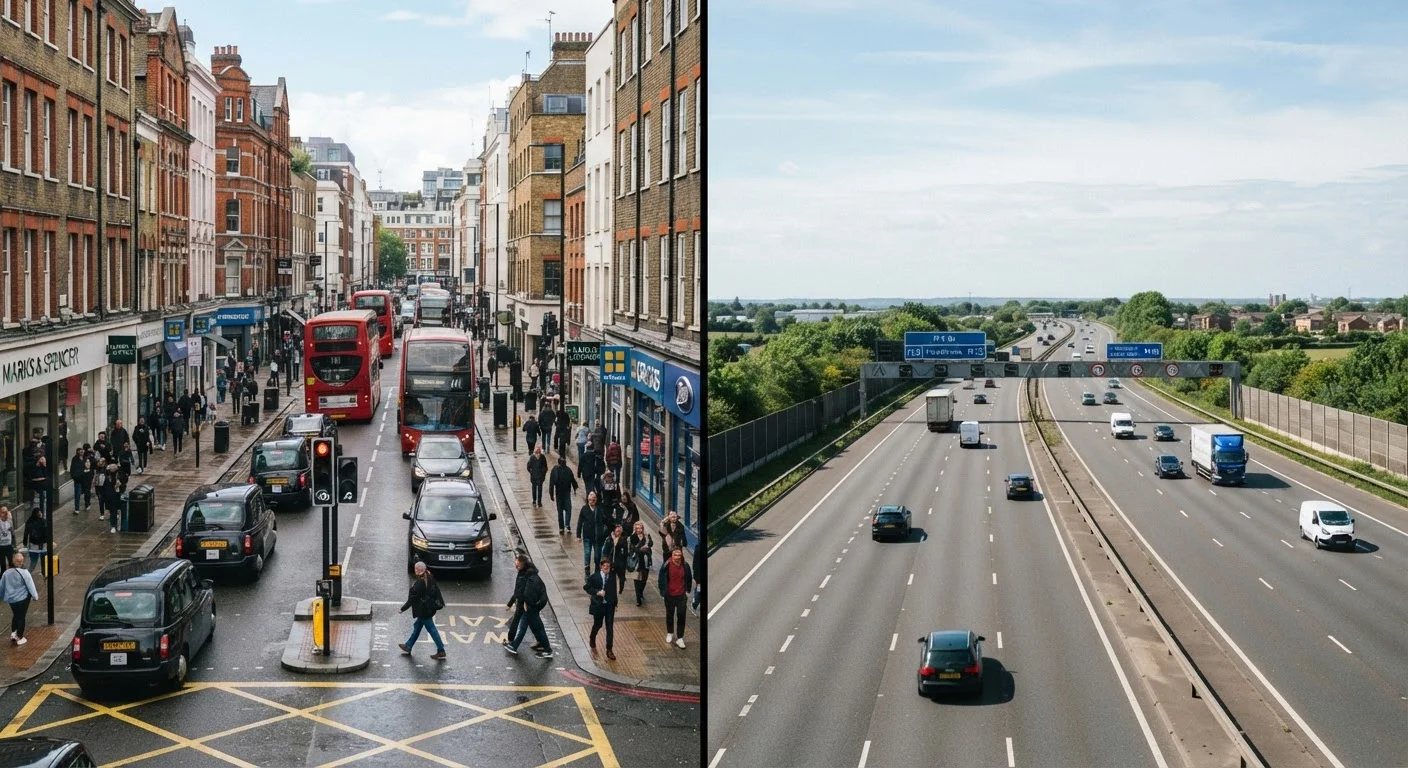
Why the Same Road Skills Don't Work Everywhere
Most drivers develop a dominant style shaped by whichever roads they use most often. A daily city commuter becomes efficient at reading junctions and tracking pedestrians; a regular motorway driver grows comfortable with sustained speed and lane management. The problem arises when each driver enters the other's environment without consciously switching modes.
Urban and motorway roads are not simply fast and slow versions of the same challenge. They differ in hazard type, decision frequency, braking demands, and the cognitive load placed on the driver. Understanding how and why your technique must shift is one of the most practical things you can do for road safety — and it applies equally to experienced drivers as to new ones.
For those new to high-speed roads, see our guide to motorway driving for new licence holders for a dedicated introduction to joining, lane discipline, and emergencies.
Urban Driving: Managing a High-Hazard, Low-Speed World
City driving is characterised by high decision frequency at relatively low speeds. Hazards are close, unpredictable, and varied — a cyclist pulling out from a parked car, a pedestrian stepping off a kerb, a bus pulling away from a stop. Effective urban technique centres on short-range scanning, anticipatory braking, and maintaining awareness of all road users, not just other vehicles.
Key habits that matter most in urban environments:
- Scanning close to mid-range: In city traffic, the relevant hazard zone is within 50–100 metres. Fixating too far ahead causes drivers to miss pedestrians and cyclists at the periphery.
- Gentle, progressive braking: Frequent stops make smooth brake application both safer and better for the vehicle. Harsh braking increases rear-end collision risk and accelerates pad wear.
- Positioning and lane discipline: Urban roads have more junctions, bus lanes, cycle lanes, and turning traffic. Maintaining correct lane position reduces conflict at merges and turns. Roundabouts are a particular source of confusion — especially for drivers whose usual environment is motorway or rural.
- Speed relative to visibility: On narrow urban streets, speed should reflect your stopping distance within your visible clear road — not simply the posted limit.
Engine Choice and Urban Efficiency
Fuel type and engine choice can significantly affect how a vehicle performs in stop-start urban conditions. Hybrid and electric powertrains, for example, recapture energy during braking — making them particularly efficient in city environments. If your driving is predominantly urban, this is a practical factor worth weighing when considering your next vehicle.
Fuel type and engine choice can significantly affect how a vehicle performs in stop-start urban conditions. Petrol, diesel, and hybrid engines each have distinct urban performance profiles worth considering if you drive primarily in cities.
Motorway Driving: Managing Speed, Distance, and Fatigue
Motorway driving looks simpler than city driving — fewer junctions, clearer lanes, no pedestrians — but this apparent simplicity is deceptive. The primary risks shift from complexity to sustained inattention, following distance errors, and fatigue. At 70 mph, a vehicle covers roughly 103 feet per second. A two-second lapse in attention represents more than 200 feet of uncontrolled travel.
| Criterion | Urban Driving | Motorway Driving |
|---|---|---|
| Typical speed range | 10–40 mph | 50–70+ mph |
| Primary hazard type | Pedestrians, cyclists, junctions | Tailgating, fatigue, merging traffic |
| Scanning distance | 50–100 metres | 300+ metres |
| Decision frequency | Very high — multiple per minute | Lower but higher-stakes |
| Recommended following gap | 2 seconds minimum | 2–4 seconds (more in wet) |
| Fatigue risk | Low — stimulation is frequent | High — monotony accelerates fatigue |
| Lane discipline complexity | Bus lanes, cycle lanes, turns | Keep right except to pass |
Effective motorway technique focuses on:
- Extending the scanning horizon: At speed, your hazard detection zone must stretch much further ahead — 300 metres or more. Early awareness of braking traffic ahead is the single most valuable skill on a motorway.
- Maintaining safe following distance: The two-second rule is a minimum in dry conditions; in rain or poor visibility that gap should increase substantially. See how weather changes braking distance and steering response for guidance on wet and adverse conditions.
- Lane discipline: Motorway lanes are not equal. In the US, keeping right except to pass is a common statutory requirement in many states. Unnecessary lane occupation creates overtaking pressure and disrupts traffic flow.
- Managing fatigue: Monotony is a real physiological hazard. Many road safety bodies recommend taking a break every two hours on sustained motorway journeys. Fatigue impairs reaction time and decision quality at least as significantly as moderate alcohol consumption, according to long-standing transport research.
Smart motorway systems — variable speed limits, all-lane running — add an additional layer of rules to understand. How smart motorway infrastructure works and its limitations is worth reading before you encounter them unprepared.
Making the Transition: Switching Between Environments
The transition between road types is where technique lapses most commonly occur. Drivers joining a motorway after extended city driving may underestimate the speed of approaching traffic. Drivers exiting motorways after long high-speed runs frequently carry excess speed into urban environments — a phenomenon sometimes called speed adaptation lag.
Practical steps that help bridge the gap:
- After joining a motorway, consciously push your scanning horizon further ahead rather than defaulting to close-range city habits.
- After leaving a motorway, recheck your speedometer. Your perceived sense of speed recalibrates slowly — 40 mph can feel like 20 mph for several minutes after sustained high-speed driving.
- Before long motorway journeys, check your vehicle's tyre pressures, fluid levels, and lights. The consequences of a mechanical failure at motorway speeds are significantly greater than in urban traffic. Routine car maintenance is an area worth reviewing if your vehicle hasn't been recently serviced.
For a broader look at the subtle cues experienced drivers use in any environment, reading a road: what experienced drivers notice that beginners miss offers practical insight into hazard perception beyond the obvious.