The Number That Matters Most
Most drivers have seen the sticker on the inside of their car door but never stopped to read it. That label lists the recommended tyre pressure for your specific vehicle — a number determined by engineers based on the car's weight, suspension design, and intended handling characteristics. It is not a suggestion; it is the operating parameter your tyres were designed around.
The pressure printed on the tyre sidewall is different. That figure — often 44 or 51 PSI — is the maximum the tyre can safely hold, not a target. Inflating to maximum typically means an overinflated, dangerously stiff tyre. Always follow the door jamb figure, which usually falls between 30 and 36 PSI for most passenger vehicles. For a broader look at tyre care basics, including tread depth and rotation schedules, our dedicated guide covers the full picture.
~1 PSI
Pressure lost per 10°F temperature drop
This widely cited rule of thumb from tyre industry guidance illustrates why seasonal checks are essential for maintaining safe inflation levels.
25%
Pressure drop that triggers US TPMS warning
Federal safety standards require TPMS systems to alert drivers when any tyre reaches 25% below the recommended cold inflation pressure.
0.3%
Fuel economy loss per 1 PSI underinflation
The U.S. Department of Energy estimates that underinflated tyres can reduce fuel economy by around 0.2–0.3% per PSI below recommended levels.
What Happens When Pressure Is Wrong
Underinflation is the more common and more consequential problem. When a tyre runs low on air, its sidewalls flex more than intended with every rotation. That flexing generates heat — and heat is the primary driver of tyre failure and blowouts. An underinflated tyre also increases rolling resistance, which means your engine burns more fuel to maintain speed. Handling suffers too: steering feels vague, braking distances lengthen, and the tyre wears unevenly along the outer edges.
Overinflation creates a different set of problems. An overinflated tyre balloons slightly, meaning only the center of the tread contacts the road. This reduces grip, makes the ride harsher, and causes the center of the tread to wear faster than the edges. Overinflated tyres are also more vulnerable to punctures from road debris because there is less give to absorb impact.
Check Pressure When Tyres Are Cold
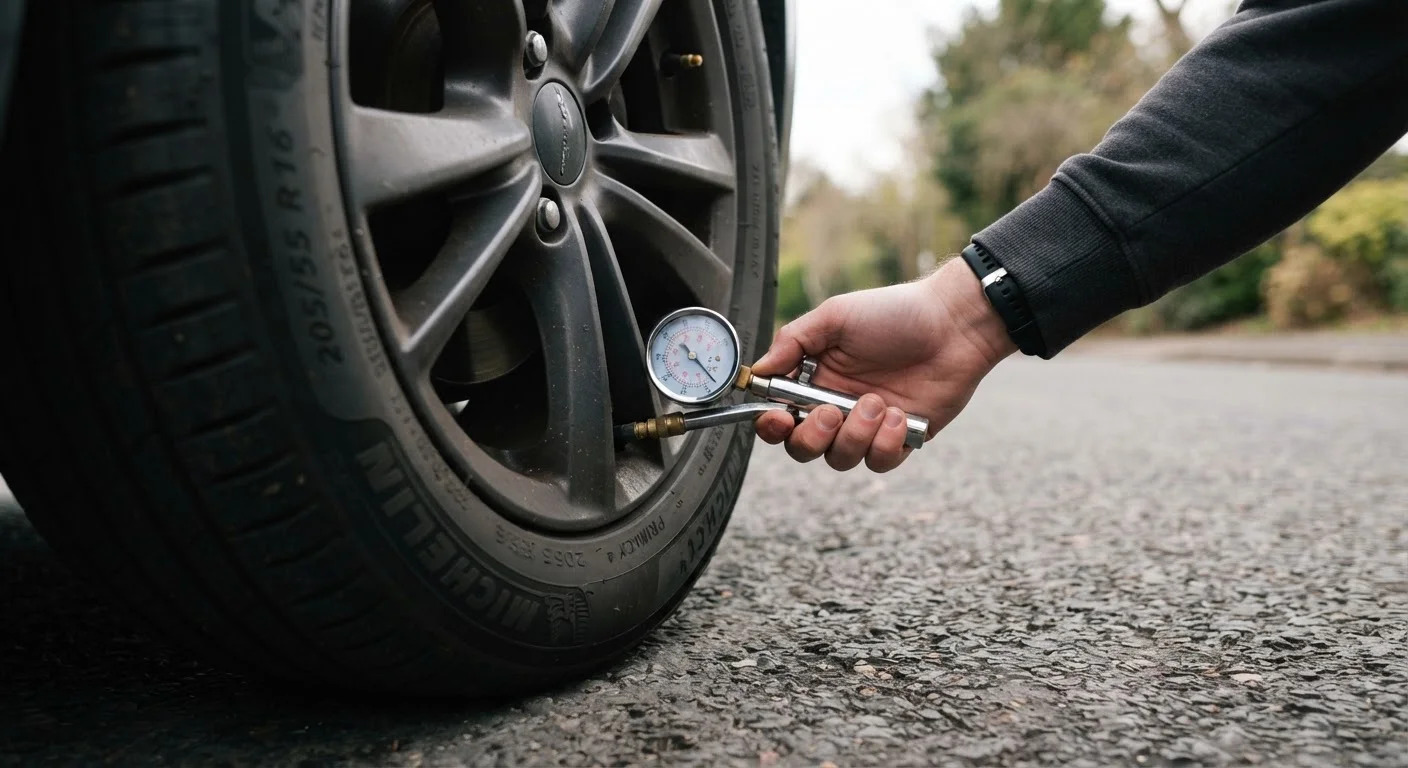
For an accurate reading, check tyre pressure before driving or after the car has been stationary for at least three hours. Heat from driving temporarily raises PSI, which can make an underinflated tyre appear acceptable. A quality dial or digital gauge gives a more reliable reading than the built-in gauges on many petrol station air pumps.
Temperature plays a direct role: pressure drops approximately 1 PSI for every 10°F of temperature decrease. A tyre correctly inflated in summer may be meaningfully underinflated by winter — one reason seasonal maintenance checks consistently include tyre pressure as a top priority.
Reading Your TPMS and When to Act
Most vehicles manufactured after 2008 in the US are equipped with a Tyre Pressure Monitoring System (TPMS). The system triggers a dashboard warning light — typically a cross-section of a tyre with an exclamation point — when pressure in any tyre drops roughly 25% below the recommended level. That threshold matters: by the time the light comes on, the tyre is already meaningfully underperforming.
The TPMS light is one of the warning signals worth understanding in context. Our article on dashboard warning lights explains what the TPMS symbol looks like alongside other common indicators and what each urgency level means. Do not treat the TPMS as a substitute for monthly manual checks — sensors can malfunction, and the system only flags significant drops, not gradual drift.
When you check pressure manually, do so when tyres are cold — meaning the car has been parked for at least three hours or driven less than a mile at low speed. Driving heats the air inside the tyre and temporarily raises the reading, which can lead you to believe pressure is adequate when it is not. For a deeper understanding of how pressure, tread wear, and blowout risk interact, see our explainer on tyre pressure and blowout risk.
TPMS Is a Safety Net, Not a Maintenance Tool
The TPMS light alerts you to a significant pressure problem, but it is not designed for routine maintenance. A tyre can be 8–10 PSI underinflated — enough to affect handling and fuel efficiency noticeably — without triggering the warning. Manual monthly checks remain the most reliable way to stay within the optimal pressure range.