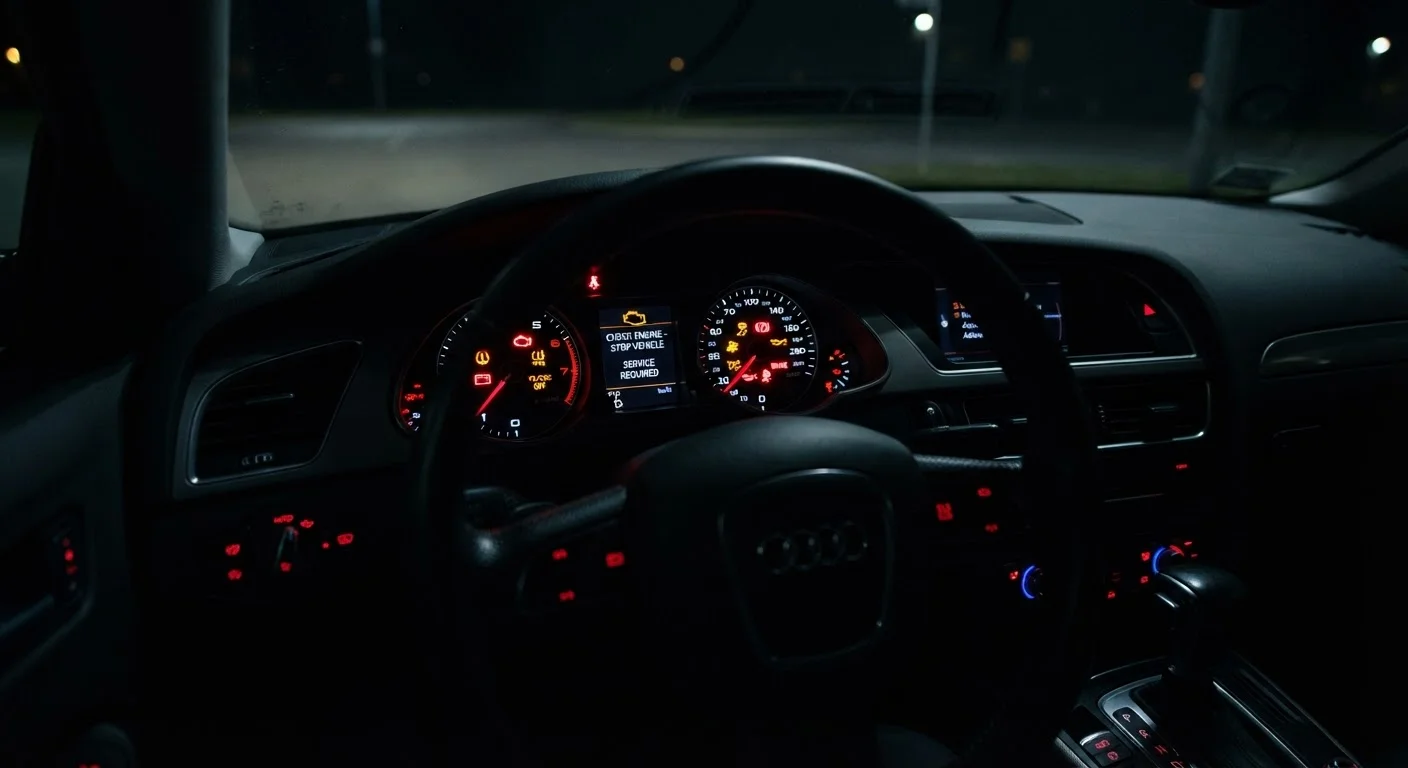
How Dashboard Warning Lights Work
Modern vehicles are equipped with an onboard diagnostics system that continuously monitors dozens of sensors throughout the car. When a sensor detects a reading outside its acceptable range, it triggers a warning light on your instrument cluster. Think of the dashboard as your car's communication panel — each symbol is a coded message about a specific system.
Warning lights generally fall into three color categories:
- Red: Urgent — stop safely as soon as possible or pull over immediately.
- Amber/Yellow: Caution — attention required soon; schedule a check promptly.
- Green or Blue: Informational — a system is active, not necessarily a problem.
Knowing which color you're looking at is the fastest first step toward understanding how urgently you need to respond. For a deeper decode of individual symbols, see our guide to what warning lights are actually telling you.
| Warning Light Colors | Red (urgent), Amber (caution), Green/Blue (informational) |
| Onboard Diagnostics Standard | OBD-II required on all US passenger cars sold from 1996 onward (US EPA / NHTSA) |
| TPMS Mandate | Required on all new US light vehicles from September 2007 (NHTSA FMVSS No. 138) |
| Most Common MIL Trigger | Loose or faulty gas cap (evaporative emission leak) |
| Engine Damage Risk | Severe internal damage possible within minutes of low oil pressure |
| Number of Monitored Systems | Modern vehicles monitor 50+ individual sensor circuits |
The Most Common Warning Lights Explained
While vehicles vary by make and model, the following symbols appear on the vast majority of passenger cars sold in the US and carry standardized meanings.
MIL (Malfunction Indicator Lamp)
The standardized term for the check engine light. It illuminates when the vehicle's onboard computer logs a fault code related to the engine, transmission, or emissions system.
OBD-II
On-Board Diagnostics, second generation. A standardized system built into all US passenger vehicles from 1996 onward that monitors vehicle systems and stores diagnostic trouble codes accessible by a scan tool.
TPMS
Tire Pressure Monitoring System. A sensor-based system that alerts the driver when one or more tires fall below a safe pressure threshold, typically 25% below the recommended PSI.
Catalytic Converter
An exhaust system component that converts harmful combustion byproducts into less harmful emissions. Engine misfires can overheat and permanently damage the catalytic converter.
Alternator
A generator driven by the engine that recharges the battery and powers electrical systems while the vehicle is running. A failing alternator is a common cause of battery warning lights.
ABS (Anti-lock Braking System)
A safety system that prevents wheels from locking during hard braking, maintaining steering control. A dedicated ABS warning light signals a fault in this system separate from standard brake warnings.
Check Engine Light (MIL)
The Malfunction Indicator Lamp — often depicted as an engine outline — is one of the most misunderstood lights on any dashboard. A steady amber check engine light typically signals a non-emergency fault such as a loose gas cap, a faulty oxygen sensor, or an emissions-related issue. A flashing check engine light, however, suggests an active misfire that can damage the catalytic converter and warrants pulling over promptly and having the vehicle inspected. Do not ignore a flashing MIL.
Oil Pressure Warning
This red symbol — resembling an old-fashioned oil can — indicates that oil pressure has dropped dangerously low. Low oil pressure can cause severe engine damage within minutes. Pull over safely, switch off the engine, and check your oil level. If oil is adequate and the light remains on, do not continue driving; contact a qualified mechanic. Our car fluid checks guide walks through how to read your dipstick correctly.
Battery / Charging System
A battery-shaped icon in red signals that the vehicle's charging system is not maintaining adequate voltage. This could point to a failing alternator, a worn drive belt, or a battery nearing the end of its life. You may have limited driving time before the car loses power entirely. Our article on battery health and starting failures covers what causes batteries to deteriorate.
Tire Pressure Monitoring System (TPMS)
An amber symbol showing a tire cross-section with an exclamation point means one or more tires have dropped below the recommended pressure threshold. Under-inflated tires reduce fuel efficiency, affect handling, and increase blowout risk. Check and adjust pressures when you see this light. For context on why tire pressure matters to safety, see tyre pressure, tread, and blowout risks.
Temperature Warning
A thermometer icon submerged in liquid indicates the engine is overheating. Pull over immediately, turn off the engine, and allow it to cool before inspecting coolant levels. Never open a hot radiator cap. Overheating can warp cylinder heads and cause irreversible damage if ignored.
Brake System Warning
A circle with an exclamation mark inside parentheses — or the word BRAKE — can signal low brake fluid, a detected fault in the ABS system, or that the parking brake is engaged. If the parking brake is off and the light persists, treat it as urgent and have your brakes professionally inspected before continuing to drive.
Your Owner's Manual Is the Definitive Reference
Symbol shapes can vary between manufacturers — what looks like a generic exclamation mark on one car may indicate a completely different system on another. Always cross-reference an unfamiliar light with your vehicle's owner's manual, which provides model-specific definitions. If you don't have a physical copy, most automakers provide digital versions through their official websites.
When to Act Immediately vs. Schedule a Check
Not every warning light demands you pull over on the spot, but all of them deserve a response within a defined timeframe.
| Light | Color | Response |
|---|---|---|
| Oil Pressure | Red | Stop immediately |
| Temperature (Overheating) | Red | Stop immediately |
| Brake System | Red | Stop immediately if brake feel changes |
| Battery / Charging | Red | Drive to nearest safe stop |
| Check Engine (flashing) | Amber | Pull over, do not continue driving |
| Check Engine (steady) | Amber | Schedule inspection within days |
| TPMS | Amber | Check pressures at next opportunity |
Before any long trip, a proactive inspection can catch problems before a warning light ever appears. Our pre-long-journey car check provides a practical pre-departure walkthrough. Newer vehicles also use driver-assist warning lights; for those, see our guide to driver-assist technology acronyms.
77%
US drivers have had a warning light illuminate
Survey data consistently shows the majority of American drivers encounter at least one dashboard warning light annually.
~$400
Average cost of ignoring a check engine light
Industry estimates suggest deferred check engine repairs routinely cost significantly more than prompt diagnosis and repair.
1 in 4
Vehicles on US roads have under-inflated tires
According to NHTSA data, roughly one in four light vehicles is driven with at least one significantly under-inflated tire.