Why the Alphabet Soup Matters
Open a new-car brochure and you'll encounter a dense string of acronyms — AEB, ACC, LKA, BSW, RCTA — often listed as standard safety features. These are not marketing buzzwords. Each abbreviation refers to a specific electronic system designed to reduce crash risk or driver workload. Understanding what each one actually does helps you evaluate whether a vehicle truly meets your safety needs, and helps you use the technology correctly once you own it.
Driver-assist systems are generally grouped into two categories: warning systems (which alert you but don't intervene) and active systems (which can steer, brake, or accelerate on your behalf). The distinction matters because it affects how much trust you should place in each one. For a broader look at how automakers package and label features on newer models, see what automakers mean when they call a car new.
| AEB Mandate (U.S.) | Required as standard on nearly all new passenger vehicles (NHTSA final rule, 2023) |
| Primary sensor types | Radar, forward-facing cameras, ultrasonic sensors |
| Two system categories | Warning only vs. active intervention |
| Key limitation | No system replaces an alert, attentive driver (NHTSA consumer guidance) |
The Core Acronyms Decoded
Below is a plain-language breakdown of the most common driver-assist systems you'll encounter on new vehicles sold in the U.S.
AEB — Automatic Emergency Braking
A system that detects an imminent forward collision using radar or camera data and automatically applies the brakes if the driver does not respond in time. It is designed to reduce impact severity, not necessarily prevent every collision.
ACC — Adaptive Cruise Control
An evolution of conventional cruise control that uses sensors to maintain a driver-set following distance from the vehicle ahead. It automatically adjusts speed to match traffic flow but does not steer.
LKA — Lane Keeping Assist
A warning or corrective system that detects unintended lane departures using a forward-facing camera and either alerts the driver or applies a gentle steering correction to guide the vehicle back into its lane.
LCA — Lane Centering Assist
A more active steering-intervention system than LKA that continuously adjusts steering input to keep the vehicle centered in a detected lane. It is not the same as autonomous driving and requires driver supervision.
BSW — Blind Spot Warning
A system using side and rear radar sensors that alerts the driver — typically via a mirror indicator light or audible tone — when a vehicle enters the blind spot area, usually during a lane-change attempt.
RCTA — Rear Cross-Traffic Alert
Uses rear-facing sensors to detect vehicles approaching from the side while the car is reversing. It warns the driver with a visual or audible alert and, in some vehicles, can apply automatic braking.
FCW — Forward Collision Warning
A warning-only system that detects a rapidly closing gap to the vehicle ahead and alerts the driver through audible, visual, or haptic cues. Unlike AEB, it does not apply the brakes automatically.
TSR — Traffic Sign Recognition
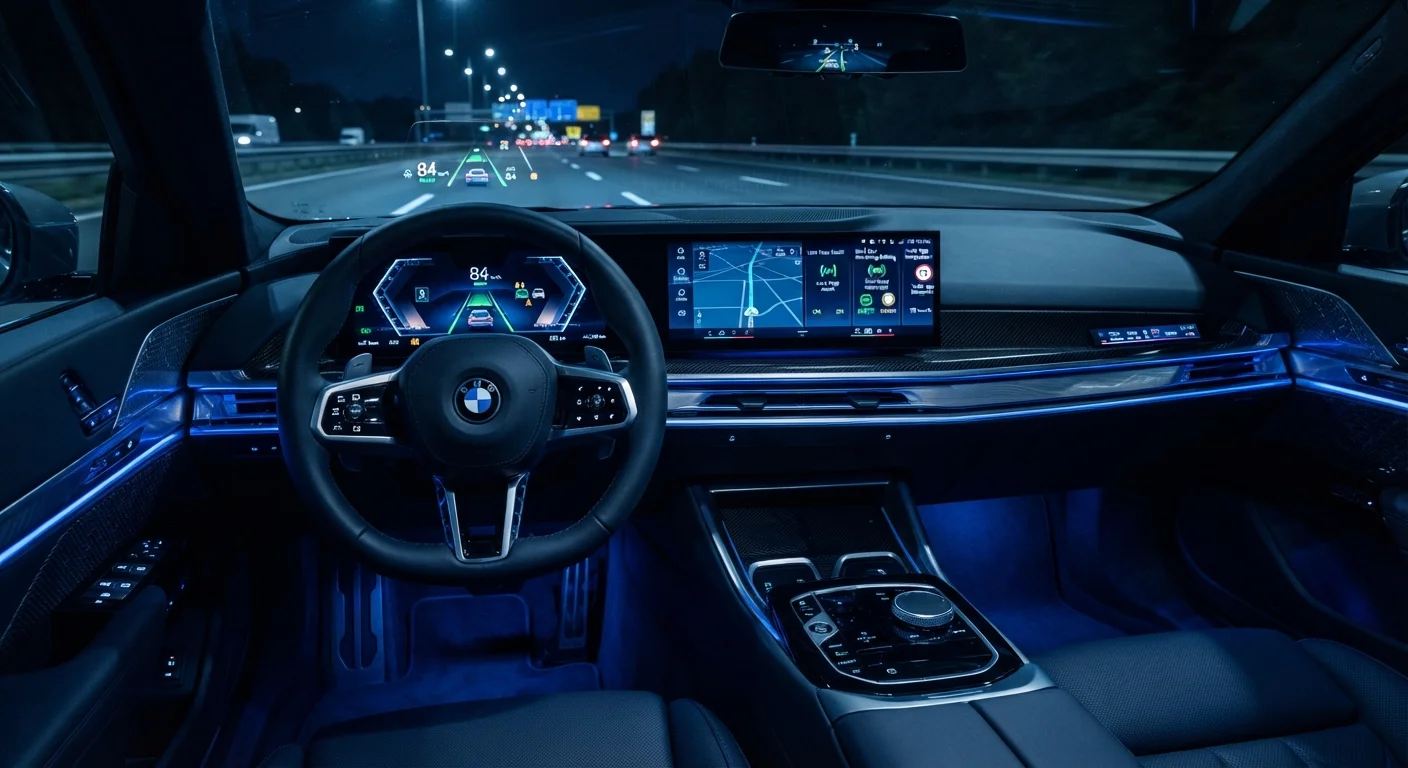
A camera-based system that reads road signs — including speed limits and stop signs — and displays the detected information on the instrument cluster or heads-up display. Accuracy varies by road conditions and sign visibility.
Most of these systems rely on a combination of forward-facing cameras, radar sensors, and ultrasonic detectors mounted around the vehicle. When a sensor malfunctions or a warning light activates, you may see a dashboard indicator that looks unfamiliar. Our guide to what your car's warning lights are actually telling you can help you identify those alerts.
Active Systems: What Can Actually Take Control
The most significant shift in modern safety technology is the move from passive alerts to active intervention. Three systems account for the majority of real-world benefit:
- AEB (Automatic Emergency Braking) is now federally mandated as standard equipment on nearly all new passenger vehicles in the U.S. under a 2023 National Highway Traffic Safety Administration (NHTSA) ruling, with full compliance phased in through 2029. It applies the brakes autonomously if an imminent collision is detected and the driver hasn't responded.
- ACC (Adaptive Cruise Control) uses radar to maintain a set following distance from the car ahead, automatically speeding up or slowing down within a range you define. It does not steer — that requires a separate system.
- LCA (Lane Centering Assist), sometimes combined with ACC into what manufacturers call a hands-free or driver assistance mode, uses camera data to keep the vehicle centered in a lane. Despite marketing language, these systems are not autonomous driving — they require an alert, engaged driver at all times.
~360,000
Crashes AEB estimated to prevent annually (U.S.)
According to NHTSA's regulatory impact analysis supporting the 2023 AEB mandate for passenger vehicles.
~1 in 3
New vehicles with standard AEB before the mandate
IIHS data from model-year 2019 showed fewer than one-third of new vehicles included AEB as standard equipment at that time.
If you're new to driving or developing habits around these systems, vehicle maintenance for new drivers covers the fundamentals of keeping both you and your car in good condition.
Limitations and What the Tech Won't Do
Every driver-assist system has clearly documented operational limits. AEB typically does not function effectively below certain speeds or in heavy rain. LKA can be confused by faded lane markings or tight curves. BSW (Blind Spot Warning) may not detect fast-approaching cyclists or very small vehicles. These limitations don't make the systems useless — they make reading your owner's manual essential.
Driver Attention Is Still Required
No driver-assist system currently sold to consumers constitutes full self-driving capability. Systems like LCA and ACC are classified as SAE Level 2 automation at most, meaning the human driver must remain engaged and ready to take control at any moment. Relying on these systems as a substitute for attention is dangerous and, in many states, could have legal consequences.
Crash-test programs such as NHTSA's New Car Assessment Program (NCAP) and the Insurance Institute for Highway Safety (IIHS) evaluate how well these systems perform in standardized scenarios. Understanding those ratings gives you an objective measure beyond marketing claims. See how NCAP and crash-test ratings work for a detailed explanation of the testing methodology.
Driver-assist technology is one piece of a broader connected-vehicle landscape. For context on how software updates can change a vehicle's features after purchase, how over-the-air updates are reshaping modern cars is worth reading alongside this guide.