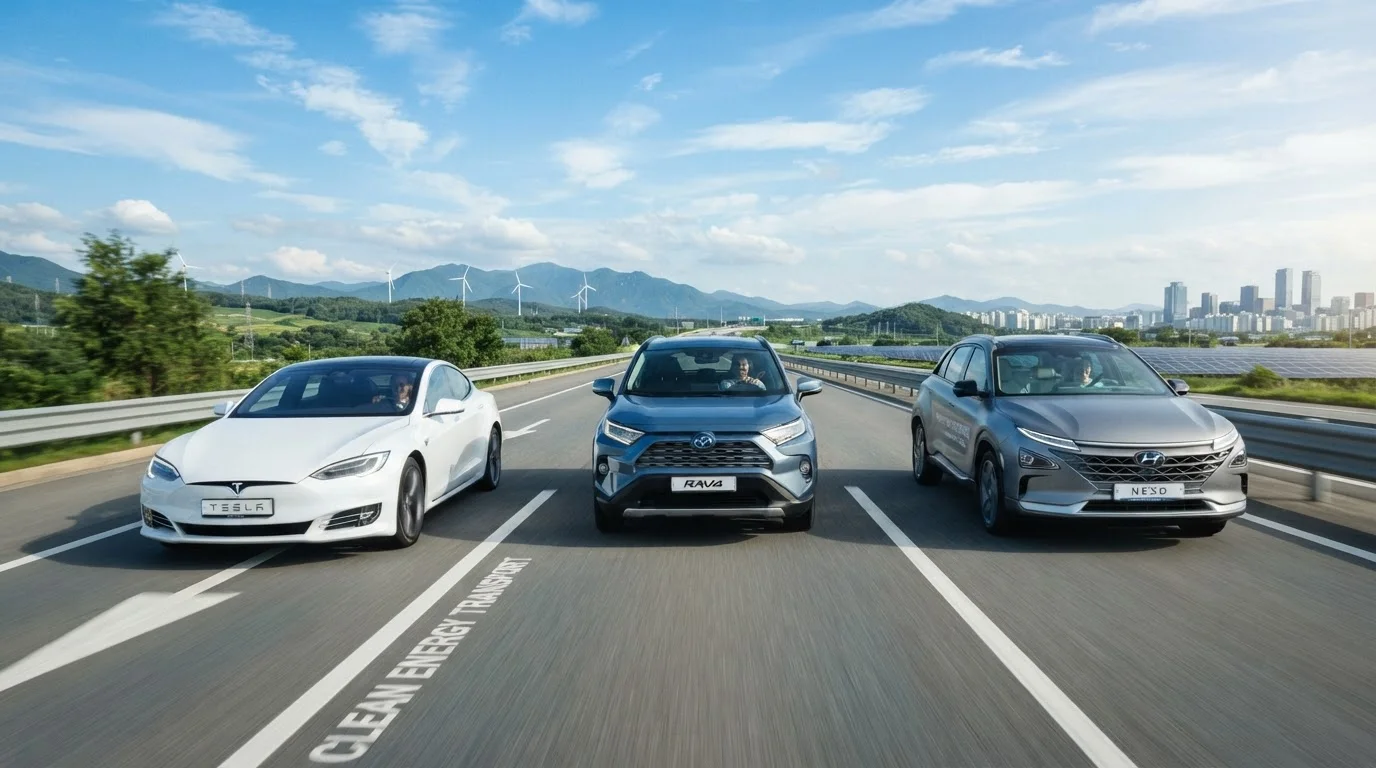
Why Powertrain Choice Matters More Than Ever
Choosing a new vehicle today means navigating a powertrain landscape that looks fundamentally different from even a decade ago. Automakers are simultaneously releasing battery electric, hybrid, and hydrogen fuel cell models — often in the same model year. Understanding what separates these three approaches is essential before stepping into a showroom. For a broader look at how automakers frame new releases, see what automakers actually mean when they call a car "new".
Each powertrain reflects a different answer to the same core challenge: how to move a vehicle efficiently while reducing dependence on fossil fuels. The right answer depends heavily on where you live, how you drive, and what infrastructure exists around you.
| Battery Electric (BEV) | Hybrid / Plug-In Hybrid (HEV/PHEV) | Hydrogen Fuel Cell (FCEV) | |
|---|---|---|---|
| Tailpipe Emissions | Zero | Reduced (PHEVs near-zero short trips) | Zero (water vapor only) |
| Refueling / Recharging Time | 20–60+ minutes (DC fast charge) | Minutes (gasoline); hours (plug-in charge) | 3–5 minutes |
| Infrastructure Availability | Growing; uneven rural coverage | Gas stations everywhere; charging expanding | Very limited; mostly California |
| Typical Range | 200–300+ miles (EPA est.) | HEV unlimited; PHEV 20–50 mi electric | 300–400 miles |
| Maintenance Complexity | Low (no oil changes) | Moderate (retains combustion engine) | Low to moderate |
| Cold Weather Performance | Noticeably reduced range | Less affected (gas backup) | Moderate impact |
Battery Electric Vehicles: The Dominant Alternative
Battery electric vehicles (BEVs) run entirely on electricity stored in large onboard battery packs. They produce no tailpipe emissions and require no gasoline. Charging can happen at home using a standard outlet or a dedicated Level 2 charger, or at public DC fast-charging stations that can add substantial range in 20–45 minutes depending on the vehicle and charger.
Range has improved considerably across the segment, with many current models offering 200–300+ miles per charge under EPA-estimated conditions. However, real-world range varies with temperature, driving speed, and load — cold weather in particular reduces battery efficiency noticeably.
Plan Your Charging Before You Buy
Before committing to a battery electric vehicle, assess your daily routine honestly. Confirm whether your home allows Level 2 charger installation, identify public charging options near your workplace, and map out any frequent long-distance routes. Driving patterns and charging access are more important than range specs alone when evaluating real-world EV ownership.
The charging network in the US has expanded significantly, though coverage remains uneven between urban and rural areas. Drivers without access to home charging — those in apartments or dense urban environments — face a more complicated ownership experience. For a detailed comparison of BEVs against plug-in hybrids, compare the real-world trade-offs between BEVs and PHEVs before making a decision.
Hybrid and Plug-In Hybrid: The Bridge Technology
Hybrid electric vehicles (HEVs) combine a gasoline engine with an electric motor and a self-charging battery. The electric component assists during acceleration and low-speed driving, improving fuel efficiency without requiring the driver to plug in. Standard hybrids cannot travel meaningful distances on electricity alone.
Plug-in hybrids (PHEVs) add a larger battery that can be charged externally, allowing 20–50 miles of pure electric range in most models before the gasoline engine takes over. For drivers with short daily commutes, a PHEV can operate mostly on electricity while still providing the security of a gasoline backup for longer trips.
Both hybrid types retain conventional maintenance needs — oil changes, exhaust systems, and transmission service still apply. If you're weighing engine and fuel decisions more broadly, this comparison of petrol, diesel, and hybrid engines covers how each performs across different driving patterns.
~8%
US new vehicle sales that were fully electric
According to industry sales tracking data, battery electric vehicles accounted for approximately 7–8% of new US vehicle sales in 2023.
60,000+
Public EV charging outlets in the US
The US Department of Energy's Alternative Fuels Station Locator tracked over 60,000 public EV charging outlets nationally as of recent reporting periods.
~60
Hydrogen fueling stations in the US
As of recent counts, the vast majority of US hydrogen stations are concentrated in California, severely limiting nationwide FCEV usability.
Hydrogen Fuel Cell Vehicles: Promising but Limited
Hydrogen fuel cell electric vehicles (FCEVs) generate electricity onboard by combining hydrogen with oxygen, emitting only water vapor. They refuel at hydrogen stations in roughly 3–5 minutes — a significant practical advantage over battery charging times. FCEVs drive like electric vehicles: quiet, smooth, and with strong low-end torque.
The critical barrier is infrastructure. Hydrogen fueling stations in the US are concentrated almost entirely in California, with very limited coverage elsewhere. This makes FCEVs a practical choice for only a narrow segment of the current US market. Automakers and governments continue to invest in hydrogen infrastructure, particularly for commercial trucking and fleet applications, but consumer availability remains limited.
Verify Hydrogen Access Before Purchasing an FCEV
Hydrogen fuel cell vehicles are a practical option only where fueling stations exist. Before considering an FCEV, confirm that operational hydrogen stations are accessible in your region — not just planned or under construction. Relying on a sparse or unreliable hydrogen network could leave you without a practical way to refuel, which is a significant ownership risk outside established coverage areas.
Understanding your powertrain also ties directly into long-term car maintenance considerations — electric and hydrogen vehicles have fewer moving parts than combustion engines but introduce new service requirements around batteries, electric motors, and high-voltage systems.
How to Think About Your Own Situation
No powertrain is universally superior. A BEV suits a driver with reliable home charging and a predictable daily route. A PHEV suits someone covering varied distances who isn't ready to give up gasoline flexibility entirely. An FCEV suits a narrow audience today — primarily those in California with access to hydrogen stations.
Powertrain choice intersects with body style decisions, since not every powertrain is available in every vehicle category. It also carries financial implications worth evaluating with a qualified professional, including federal tax incentives, insurance costs, and projected fuel savings that vary by individual circumstances.
Responsible vehicle ownership in the current market means understanding not just what a car costs to buy, but what it costs to charge or fuel, insure, maintain, and eventually replace — across whichever powertrain you choose.