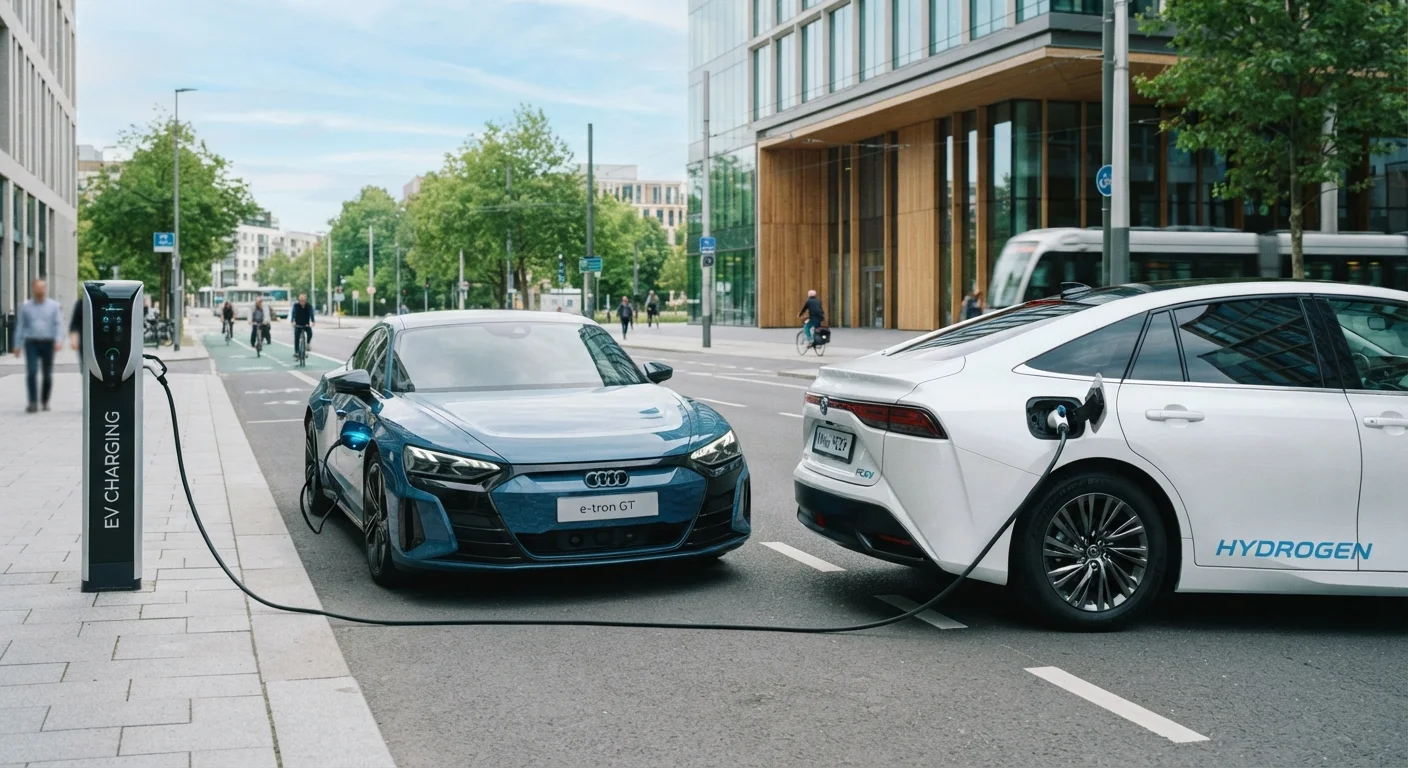
How Each Powertrain Actually Works
A Battery Electric Vehicle (BEV) is powered entirely by one or more electric motors fed by a large onboard battery pack. There is no combustion engine — when the battery is depleted, the vehicle must be plugged in and recharged before continuing. BEVs typically offer real-world ranges between 150 and 350 miles depending on the model, battery size, driving conditions, and climate.
A Plug-In Hybrid Electric Vehicle (PHEV) pairs a smaller electric battery and motor with a conventional petrol engine. The electric range is usually between 20 and 50 miles — enough to cover many daily commutes on electricity alone — before the combustion engine takes over. PHEVs can be refuelled at any petrol station, making them functionally similar to a conventional car when the battery is empty.
For a broader look at where these powertrains sit alongside other emerging options, see Electric, Hybrid, and Hydrogen: The Powertrain Choices Shaping the New Car Market.
| Criterion | BEV | PHEV |
|---|---|---|
| Power source | Electric only | Electric + petrol engine |
| Typical electric range | 150–350 miles | 20–50 miles |
| Tailpipe emissions | Zero | Zero on electric, some on petrol |
| Home charging required | Essential for convenience | Important to maximise benefit |
| Refuelling flexibility | Charging only | Charging or petrol station |
| Maintenance complexity | Lower (fewer components) | Moderate (dual drivetrain) |
| Long-trip convenience | Requires planning | Seamless with petrol fallback |
| Typical purchase price | Generally higher upfront | Generally lower than BEV |
Real-World Costs and Running Differences
BEVs generally cost less per mile to run because electricity is cheaper than petrol on a per-unit energy basis in most US regions. Maintenance is also simpler — no oil changes, fewer brake replacements due to regenerative braking, and fewer mechanical components overall. However, purchase prices for BEVs tend to be higher upfront.
PHEVs can be very economical for drivers who charge consistently — primarily using the electric range for commutes while relying on petrol for longer trips. However, studies have shown that PHEV fuel efficiency suffers significantly when drivers fail to charge regularly, with real-world fuel consumption sometimes exceeding comparable non-hybrid vehicles when driven predominantly on the combustion engine.
20–50 mi
Typical PHEV electric-only range
Most current PHEVs on the US market cover between 20 and 50 miles on battery power before the combustion engine activates.
~3–4×
Energy cost advantage of electricity over petrol
The US Department of Energy estimates that driving on electricity typically costs roughly one-quarter to one-third the per-mile equivalent of petrol, though rates vary by region and utility.
80%
US daily driving trips under 50 miles
Federal Highway Administration data consistently shows that the large majority of US vehicle trips fall well within the electric range of most BEVs and many PHEVs.
For an honest assessment of day-to-day BEV ownership — including charging habits and long-trip realities — see Electric Vehicles as Daily Drivers: What Life Actually Looks Like. And for the BEV trade-offs that don't always make the marketing materials, Owning a New EV: The Realities That Don't Always Make It Into the Brochure is worth reading alongside this comparison.
Charging Access: The Most Important Variable
Neither a BEV nor a PHEV delivers its intended benefits without reliable access to charging. Drivers with a dedicated home charger — even a standard Level 2 (240V) unit — get the most from both vehicle types. Overnight charging restores a BEV fully for the next day and ensures a PHEV always begins each trip with a full electric range.
Drivers in apartment buildings, dense urban areas, or older properties without dedicated parking face a genuine challenge. Relying exclusively on public fast-charging adds time and unpredictability to BEV ownership. For PHEV drivers in the same situation, the electric range goes largely unused, meaning the vehicle functions more like a conventional hybrid — reducing its emissions and cost advantages substantially.
Workplace and Public Charging as a Supplement
For drivers without home charging, workplace Level 2 chargers can partially substitute — providing a daily top-up for PHEVs and partial recharging for BEVs. Public DC fast-charging networks continue to expand across the US, but availability remains uneven outside major metropolitan corridors. Checking charger density along your typical routes before purchasing is a practical step that many buyers overlook.
If your circumstances fall between clear-cut categories, the Vehicle Ownership hub covers broader guidance on managing and understanding your vehicle choices over time.
Which Transition Suits Your Driving Life?
The decision between a BEV and a PHEV is less about which technology is superior and more about matching a powertrain to specific circumstances. Consider these key factors honestly:
- Daily mileage: If most days involve under 50 miles of driving, either option can work electrically. If you regularly exceed 150 miles in a single day, a BEV requires more charging planning, while a PHEV handles it automatically.
- Home charging: Without a home charger, neither type performs as intended. A PHEV without home charging still runs on petrol; a BEV without home charging relies entirely on the public network.
- Long-distance travel frequency: Occasional road trips are manageable in a BEV with planning. If long, unplanned journeys are routine, a PHEV provides more flexibility without the logistical overhead.
- Environmental priorities: A BEV charged on clean electricity carries a lower lifecycle carbon footprint than a PHEV used in mixed combustion-and-electric mode.
For drivers already familiar with choosing between combustion powertrains, Petrol vs Diesel vs Hybrid: Choosing the Right Engine for How You Drive provides useful context for how driving habits shape fuel-type suitability.