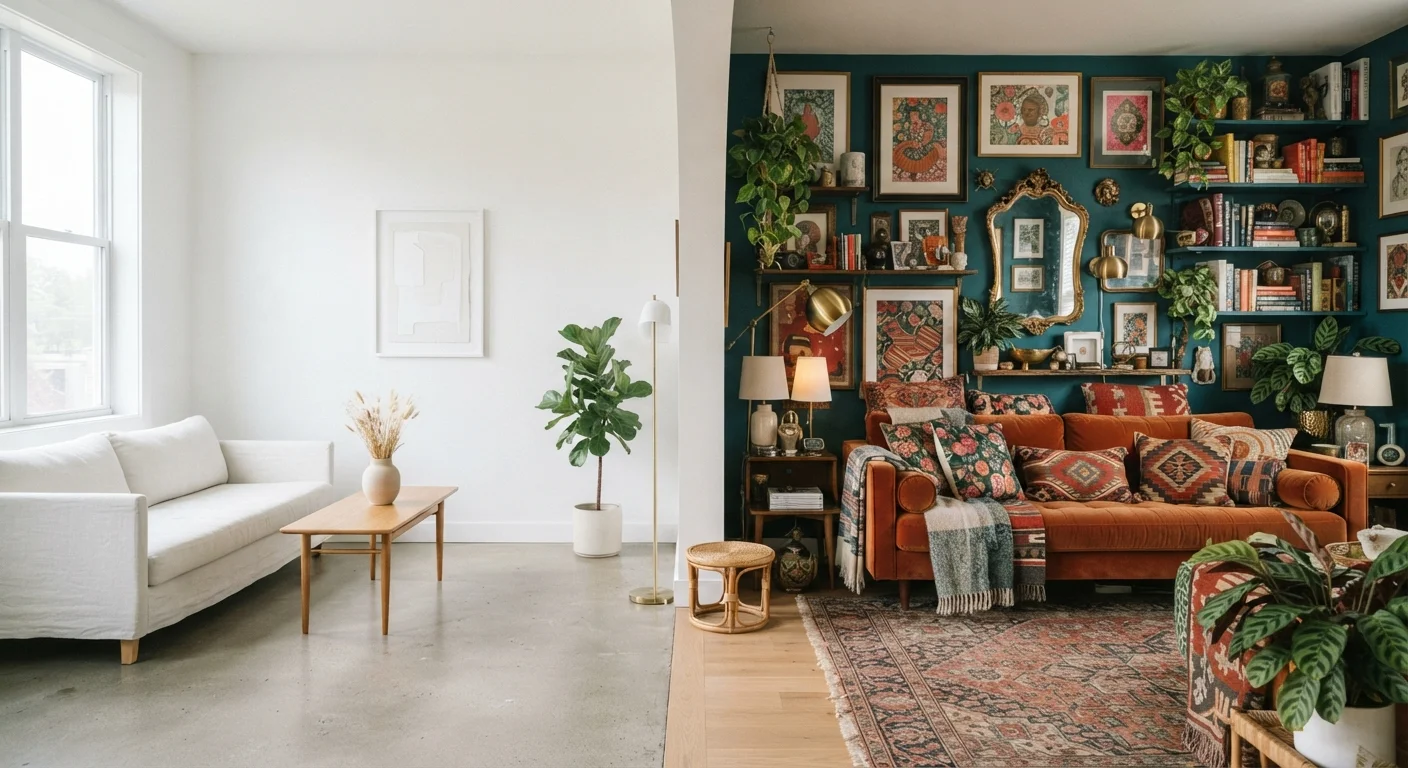
The Core Philosophy Behind Each Approach
At its foundation, minimalism is rooted in the idea that a space should contain only what is necessary and intentional. Furniture is chosen for clear purpose, surfaces are kept clear, and color palettes tend toward neutrals or a single restrained hue. The goal is an environment where nothing competes for attention — where calm is built into the architecture of the room itself.
Maximalism takes an opposing stance: abundance is not clutter, it is expression. Rich layering of pattern, color, and objects from different periods or cultures is handled with deliberate curation rather than random accumulation. The philosophy holds that a home should reflect the full personality of its inhabitants, and that visual complexity, done thoughtfully, creates warmth and meaning rather than chaos.
Both schools of thought have deep cultural and historical roots. Minimalism draws heavily from Japanese wabi-sabi aesthetics and mid-century Scandinavian design, while maximalism echoes the opulent interiors of Victorian England and the pattern-rich traditions of many global design cultures. For a broader look at how geography and culture shape interior styles, see our overview of global design movements.
| Criterion | Minimalist Interiors | Maximalist Interiors |
|---|---|---|
| Core value | Restraint and intentionality | Expression and abundance |
| Color palette | Neutral, limited range | Bold, layered, diverse |
| Furniture approach | Few, carefully chosen pieces | Mixed styles and eras welcomed |
| Wall treatment | Sparse or bare | Gallery walls, rich surface coverage |
| Maintenance demand | Less to clean, but must stay tidy | More surfaces to maintain |
| Suitability for small spaces | Generally advantageous | Requires more careful editing |
| Cultural/emotional expression | Subtle, through quality | Direct, through layering and objects |
How Each Philosophy Translates Into a Real Room
A minimalist room typically works with a limited furniture footprint — a sofa, a coffee table, and perhaps a single accent chair, with generous floor space left intentionally open. Walls may be left bare or host one carefully chosen piece. Storage is integrated and concealed. The eye has room to rest.
A maximalist room uses that same floor plan differently: layered rugs anchor the seating area, shelving holds curated books and objects, and artwork may cover significant wall space. Textiles — throws, cushions, curtains — introduce pattern and texture simultaneously. Lighting choices, including table lamps and pendants, add further layers. The eye has much to explore.
Execution quality matters enormously in both styles. Poorly executed minimalism can feel cold and uninviting; poorly executed maximalism can feel genuinely chaotic. Minimalism demands that each remaining object be considered carefully — one ill-proportioned chair reads loudly in an otherwise spare room. Maximalism demands a unifying logic — a shared color family, a recurring motif, or a consistent material — to prevent a layered room from feeling merely messy. Many common assumptions about what makes a room work well deserve scrutiny; interior design myths that keep rooms looking off addresses several of these directly.
72%
Americans who say home environment affects mood
According to survey data compiled by the American Institute of Architects, a strong majority of US adults report that their home's design directly influences how they feel day-to-day.
1 in 3
Homeowners blending two or more design styles
Houzz's annual US renovation research has consistently found that most homeowners identify with a mix of styles rather than a single defined aesthetic.
Practical Factors That Influence Which Style Fits Your Household
Design preference is personal, but practicality shapes what is actually livable. Several real-world factors tend to influence which philosophy suits a given household:
- Household size and composition: Families with young children or pets often find strict minimalism difficult to maintain. Maximalism's layered approach can more easily absorb the visual presence of toys, gear, and wear-and-tear.
- Space constraints: Smaller rooms can feel oppressive under too many objects. Minimalist principles — selective furniture, clear sightlines — generally make compact spaces feel larger.
- Maintenance bandwidth: Maximalist interiors require consistent dusting, organization, and curation. Minimalist spaces have fewer surfaces and objects to maintain, though each must stay orderly to preserve the effect.
- Budget and acquisition habits: Minimalism typically involves investing more in fewer, higher-quality pieces. Maximalism can accommodate a mix of price points but requires discipline to avoid purchasing without purpose.
Sustainability considerations intersect with both philosophies, too. A minimalist approach that buys less can reduce consumption, while maximalism practiced through vintage and secondhand acquisition also supports a lower environmental footprint. Sustainable interior design principles are compatible with either aesthetic when approached thoughtfully.
It is also worth noting that the binary between the two is not fixed. Many households land somewhere between these poles — applying minimalist restraint to furniture while allowing maximalist expression through art and textiles, for instance. Understanding what you value in each philosophy is more useful than committing rigidly to a label. For more on identifying your own aesthetic vocabulary, style archetypes offer a practical reference point.
Neither Style Requires a Complete Overhaul
Shifting toward minimalism does not mean discarding everything you own, and embracing maximalism does not require filling every surface overnight. Both philosophies can be adopted gradually — starting with a single room or even a single wall. Incremental changes allow you to test what genuinely feels right for how you live before committing to a broader redesign.