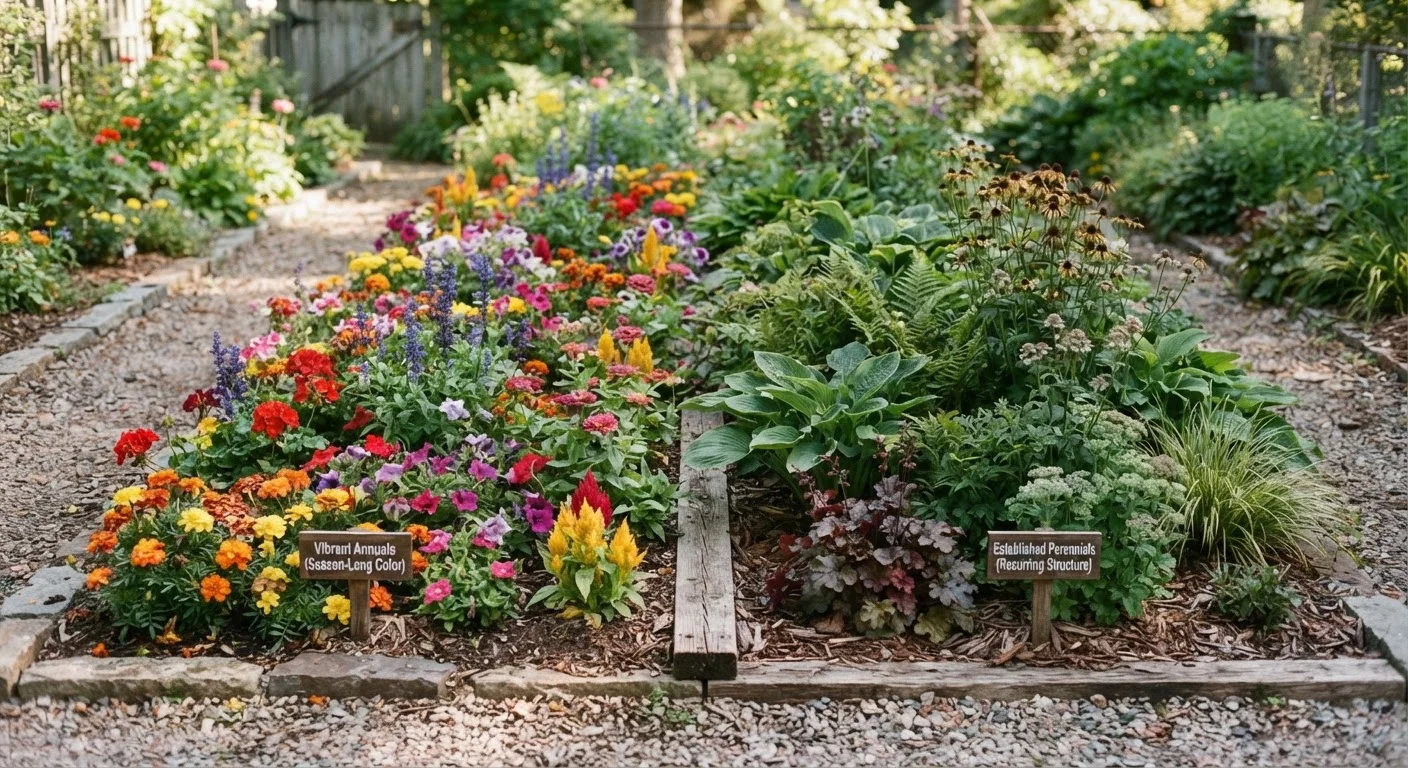
What Separates Annuals from Perennials
The terms refer simply to a plant's life cycle. An annual germinates, flowers, sets seed, and dies within a single growing season. A perennial lives for three or more years, typically dying back to the ground each winter and regrowing from its root system when temperatures warm.
A third category — biennials — completes its cycle over two years, flowering in the second season before dying. Foxglove and hollyhock are common examples, though they often self-seed so reliably they behave like perennials in practice.
It's worth noting that "annual" and "perennial" are not fixed botanical categories — they're relative to climate. Impatiens, for instance, behave as perennials in frost-free zones but are grown as annuals across most of the United States. Always check how a plant performs specifically in your USDA Hardiness Zone.
Half-Hardy Annuals and Tender Perennials
Some plants sold as annuals in US nurseries are actually tender perennials — plants that survive frost-free winters but die in cold climates. Geraniums (Pelargonium) and coleus are common examples. Gardeners in warmer USDA zones (9–11) may be able to overwinter these plants outdoors or bring them inside, effectively treating them as perennials. Always check the plant label and your local zone before assuming a plant is a true annual.
Head-to-Head: Key Differences at a Glance
Understanding where annuals and perennials diverge across practical gardening factors helps you plan with confidence rather than guessing at the garden center.
| Criterion | Annual Plants | Perennial Plants |
|---|---|---|
| Life span | One growing season | Three or more years |
| Replanting required | Every year | Rarely (after establishment) |
| Bloom duration | Season-long, continuous | Weeks to months per season |
| Upfront cost | Lower per plant, recurring | Higher per plant, one-time |
| Garden flexibility | High — redesign each year | Lower — plants are long-term |
| Establishment time | Immediate impact | 2–3 years to peak performance |
| Maintenance level | Seasonal planting required | Periodic dividing and cutting back |
For a closer look at how plant choice interacts with bed design, see our guide on raised beds vs. in-ground planting — your growing setup can influence which plant types thrive.
Making the Most of Each Plant Type
Annuals shine when you need reliable color throughout the season. Because they invest all their energy into flowering rather than root development, they tend to bloom prolifically. This makes them ideal for containers, window boxes, or front-of-border spots where visual impact matters most.
Perennials, by contrast, often take two to three years to reach their full size and flowering potential — a principle sometimes summarized as "sleep, creep, leap." During establishment, they may underwhelm, but patience pays off in long-term garden structure and reduced maintenance.
Many experienced gardeners use annuals to fill the gaps between young perennial clumps, maintaining color while the permanent plants mature. This pairing also supports biodiversity: mixing flowering types extends the bloom window available to pollinators. For more on strategic plant pairings, explore companion planting principles to see which combinations offer genuine benefits.
2–3 yrs
Time for perennials to reach full bloom potential
Horticulturists commonly describe perennial establishment using the phrase 'sleep, creep, leap' — minimal growth in year one, moderate spread in year two, and vigorous performance from year three onward.
~35%
Share of US home gardens using mixed annual-perennial plantings
National Gardening Association surveys have consistently found that mixed planting strategies are among the most common approaches adopted by home gardeners across the US.
If you're planning a fuller outdoor environment around your plantings, designing an outdoor space for year-round use offers guidance on integrating planting zones with seating, shade, and traffic flow.
Choosing the Right Mix for Your Garden
There's rarely a reason to choose exclusively one type. A well-balanced approach typically involves:
- Perennials as the backbone — planted in clusters for seasonal rhythm and structural consistency
- Annuals as seasonal accents — filling gaps, edges, and containers for continuous color
- Native perennials where possible — they're adapted to local conditions, often requiring less water and fewer inputs once established
Before committing to a planting scheme, consider your maintenance tolerance honestly. Perennials require less replanting but often need dividing every few years to stay healthy. Annuals demand seasonal replanting but rarely need ongoing intervention beyond watering and deadheading.
If you're curious about reducing garden effort further, letting part of your garden go wild explores the trade-offs of a less managed approach — particularly relevant for naturalistic perennial plantings.
No single combination suits every gardener. Let your zone, your schedule, and your aesthetic goals drive the decision — and expect to refine your mix as you learn what thrives in your specific conditions.