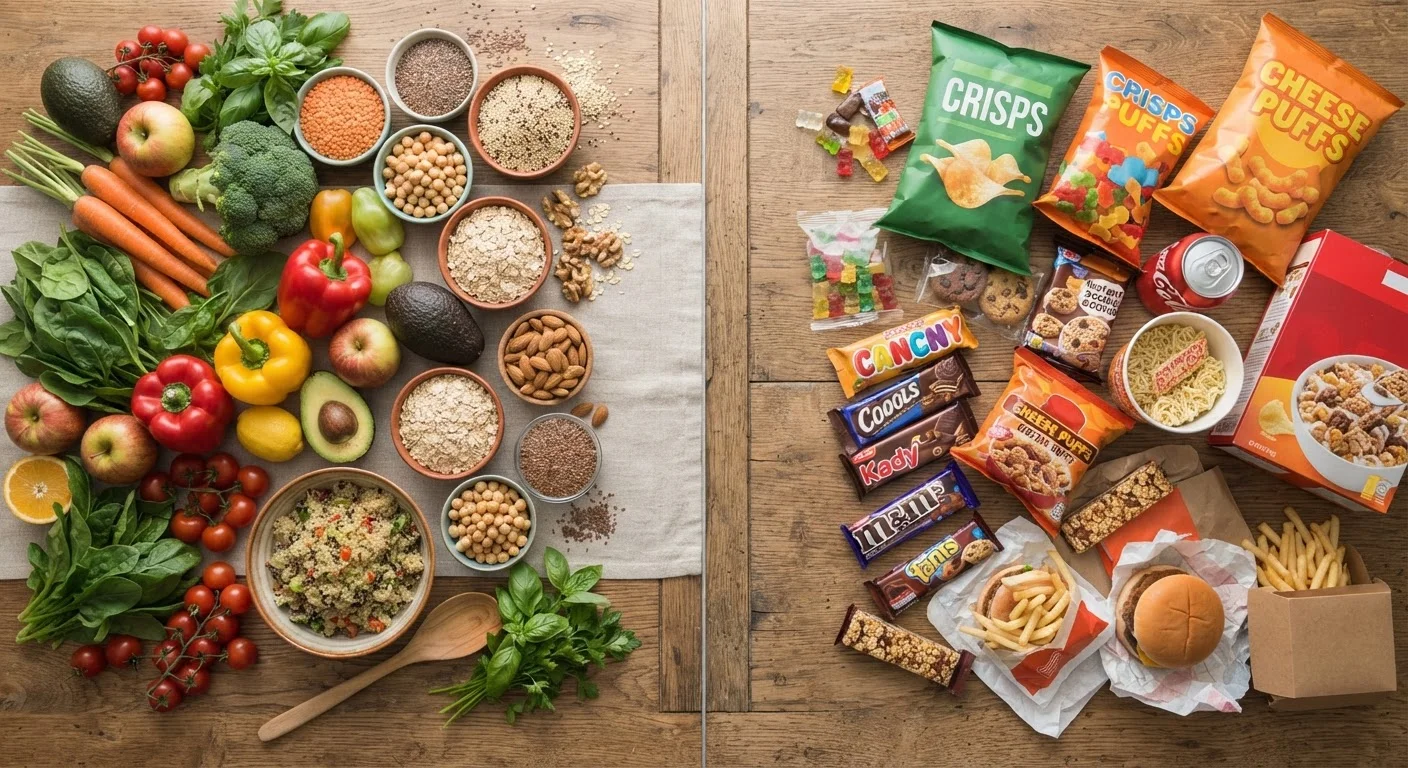
What 'Processed' Actually Means
The word processed carries a lot of baggage in nutrition conversations, often treated as shorthand for unhealthy. But in a technical sense, processing refers to any deliberate change made to a food before it reaches your plate — and that definition is surprisingly broad.
Washing, cutting, freezing, fermenting, canning, pasteurizing: all of these count as processing. By that standard, bagged salad greens, plain Greek yogurt, and rolled oats are technically processed foods. The NOVA food classification system, developed by researchers at the University of São Paulo, organizes foods into four groups based on the extent and purpose of industrial processing — a framework widely used in nutrition research to clarify the spectrum.
At one end sit unprocessed or minimally processed foods: fresh fruit, vegetables, eggs, plain nuts, and dried legumes. In the middle are processed culinary ingredients (olive oil, flour, salt) and processed foods (canned tomatoes, cheese, smoked fish) made by combining group-one foods with salt, sugar, or preservation methods. At the far end are ultra-processed foods — industrially formulated products containing additives, flavor enhancers, and ingredients rarely found in a home kitchen, like hydrogenated oils, emulsifiers, and artificial colorings.
Understanding this spectrum helps reframe the conversation. For a deeper look at how nutrition messaging can get tangled, see why healthy eating feels so confusing.
| Criterion | Whole Foods | Processed Foods |
|---|---|---|
| Definition | Unaltered or minimally altered from natural state | Any food changed before consumption — wide range |
| Fiber content | Generally high and intact | Often reduced; very low in ultra-processed varieties |
| Micronutrient density | High — vitamins, minerals preserved | Variable; may be fortified but often depleted |
| Added sugars & sodium | Absent or minimal | Often elevated, especially in ultra-processed foods |
| Shelf life & convenience | Shorter shelf life; more prep required | Longer shelf life; ready-to-eat options widely available |
| Cost & accessibility | Can be higher cost; seasonal variability | Often more affordable and consistently available |
| Health research associations | Linked to lower chronic disease risk | Ultra-processed linked to higher risk; lightly processed largely neutral |
Where Whole Foods Fit In
Whole foods are foods that remain close to their natural state — think an apple versus apple-flavored gummies, or a chicken breast versus a chicken nugget. They tend to retain their full complement of fiber, micronutrients, and naturally occurring compounds like polyphenols and antioxidants.
Research consistently links diets high in whole foods — particularly vegetables, fruits, legumes, whole grains, nuts, and seeds — with reduced risk of cardiovascular disease, type 2 diabetes, and certain cancers. Fiber content is one key mechanism: it supports gut health, slows glucose absorption, and promotes satiety. Micronutrient density is another — whole foods deliver vitamins and minerals in forms the body recognizes and uses efficiently.
57%
Share of US calories from ultra-processed foods
Research published in BMJ Open estimated that ultra-processed foods account for more than half of daily caloric intake among US adults.
10g+
Daily fiber gap for most US adults
The Dietary Guidelines for Americans notes that most adults consume well under the recommended 25–38 grams of fiber daily, a gap often linked to low whole food intake.
4 groups
NOVA classification categories
The NOVA system, developed at the University of São Paulo, categorizes all foods into four processing levels to support clearer nutrition research and public health communication.
That said, "whole food" is not a certified label or regulated term. Marketing language can blur the line. A granola bar loaded with oats and nuts may appear wholesome but still contain substantial added sugars. Reading nutrition labels carefully is one of the most practical skills for cutting through that ambiguity.
The Real Problem with Ultra-Processed Foods
Not all processed foods are the concern — ultra-processed foods are. This category includes packaged snacks, sugary cereals, reconstituted meat products, instant noodles, and many ready-to-eat meals. They are engineered for palatability: high in added sugar, refined salt, and saturated or trans fats, while typically low in fiber and micronutrients.
Large prospective studies, including research published in journals such as The BMJ and JAMA Internal Medicine, have found associations between high ultra-processed food consumption and increased risk of obesity, metabolic syndrome, cardiovascular events, and all-cause mortality. While these are observational associations — not proof of direct causation — the consistency across populations strengthens the signal.
Added sugars deserve particular mention. Understanding the difference between natural and added sugars can help you spot where sugar appears under dozens of different names on an ingredients list. Ultra-processed foods often contain multiple forms of added sugar simultaneously.
Minimally Processed Can Still Be Nutritious
Not every processed food is a nutritional compromise. Canned beans, frozen spinach, plain yogurt, and pasteurized milk are processed — yet they remain nutritious, affordable, and practical staples. The concern in nutrition research centers on ultra-processed products, not this broad middle category. Focusing on ingredient lists rather than the word 'processed' alone gives a more accurate picture of what you're eating.
Nutritional needs also shift across life stages — what matters most in a child's diet differs from an older adult's. Nutrition across the lifespan offers a useful reference point for how processing and food quality interact with age-specific requirements.
This article is for general informational and educational purposes only and is not a substitute for professional medical or dietary advice. Consult a qualified healthcare provider or registered dietitian for guidance specific to your health needs.