Why Nutrition Headlines Keep Contradicting Each Other
One week, eggs are a heart disease risk. The next, they are a nutritional powerhouse. Coffee causes cancer; coffee prevents cancer. Fat is the enemy; fat is essential. If you have ever felt whiplashed by nutrition coverage, you are not imagining the contradiction — you are accurately observing how nutrition research reaches the public.
Several structural factors drive this confusion. First, much nutrition research relies on observational studies — large surveys asking people what they eat and then tracking health outcomes over time. These studies can identify associations but cannot prove that a specific food caused a specific outcome. Second, individual studies are often reported as breakthroughs before they have been replicated or placed in broader context. A single small study involving a novel dietary pattern will generate far more headlines than the steady accumulation of evidence confirming something already known.
Third, the food environment is commercially charged. Advocacy groups, supplement companies, and diet-book authors all have financial stakes in how nutrition is framed — and they fund research, issue press releases, and cultivate media relationships accordingly. Separating independent science from commercially motivated messaging requires deliberate attention.
Single studies deserve skepticism, not panic
When a new nutrition finding makes headlines, it typically represents one data point in a much larger body of research. Nutrition scientists and public health bodies evaluate evidence across dozens or hundreds of studies before updating formal guidance. Reacting to any individual headline by overhauling your diet is rarely warranted — and can itself become a source of stress and confusion.
This is not a reason to distrust nutrition science entirely. It is a reason to look for the weight of evidence across many studies rather than reacting to any single finding. Registered dietitians and public health bodies synthesize this evidence over time — that synthesis is generally far more reliable than any individual headline.
What Nutrition Science Actually Agrees On
Beneath the noise, a meaningful consensus exists. Major health organizations — including the World Health Organization and the U.S. Dietary Guidelines Advisory Committee — align on several durable principles:
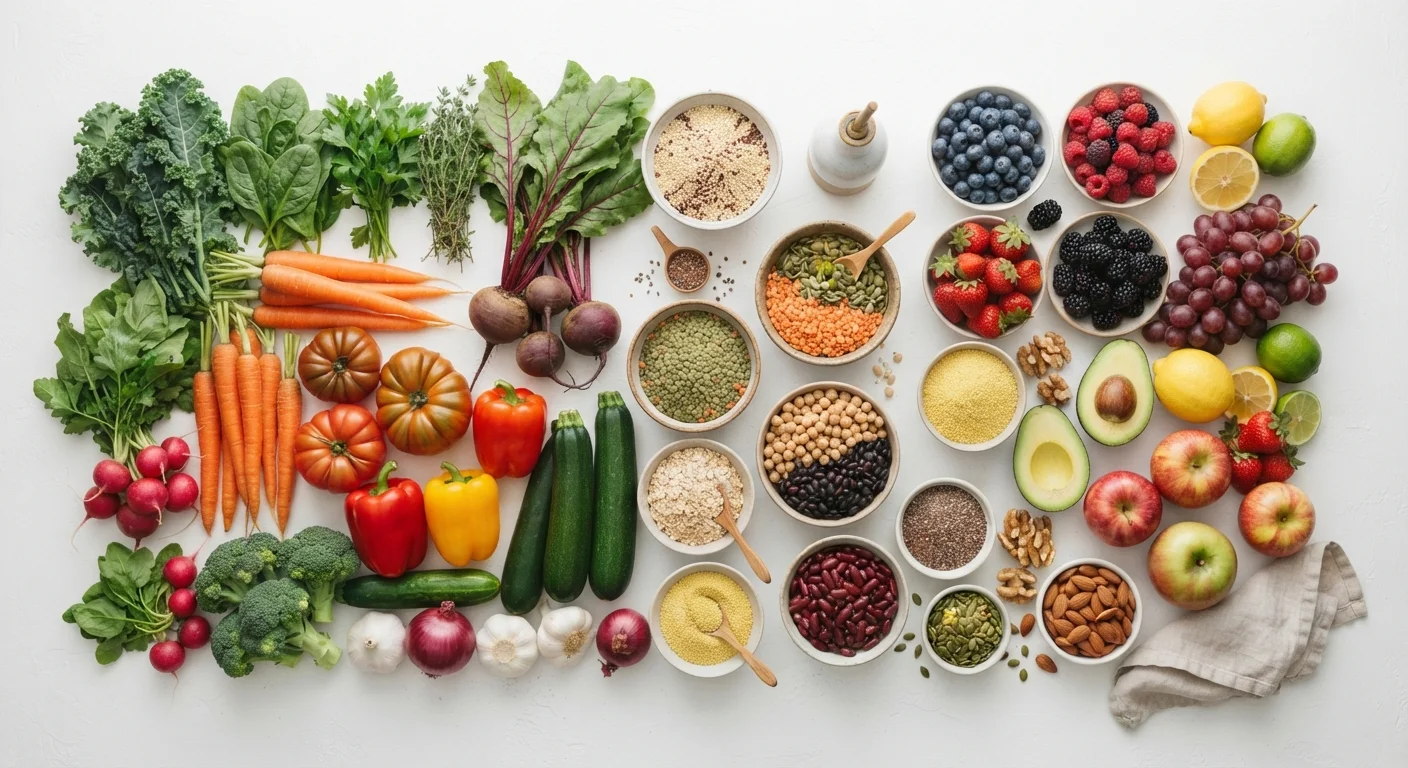
- Vegetables, fruits, legumes, and whole grains should form the foundation of most diets. The evidence supporting these food groups across dozens of health outcomes is extensive and long-standing.
- Ultra-processed foods — those heavily modified with additives, refined ingredients, and formulations designed for overconsumption — are consistently linked to poorer health outcomes in large-scale research. Understanding the processed food spectrum helps clarify what this actually means in practice.
- Dietary fibre is widely under-consumed in the United States, and its role in digestive health, blood sugar regulation, and cardiovascular health is well-supported. Fibre and your gut covers this in depth.
- Variety across food groups is more reliably beneficial than hyper-focusing on single superfoods or eliminating entire categories.
These are not exciting conclusions, which partly explains why they are underreported compared to dramatic new findings. But they are the most evidence-backed framework available for everyday eating decisions.
Use dietary patterns, not single foods, as your guide
Rather than asking whether a specific food is healthy, ask what your overall eating pattern looks like across a typical week. Research consistently shows that dietary patterns — not individual foods — are the strongest predictors of long-term health outcomes. A varied, mostly whole-food pattern is a far more reliable target than chasing any single superfood.
Key Concepts Every Curious Eater Should Know
A handful of foundational concepts make it far easier to evaluate new nutrition claims without confusion or anxiety.
Observational study
A type of research that tracks what people do in real life and looks for patterns — but cannot prove that one thing directly caused another.
Randomized controlled trial (RCT)
A study design where participants are randomly assigned to different conditions (e.g., one diet vs. another). Considered stronger evidence because it controls for other variables.
Effect size
How large a difference a factor actually makes. A statistically significant result can still represent a very small real-world impact.
Ultra-processed food
Foods that have been industrially formulated with ingredients and additives not typically found in home cooking, often engineered to encourage overconsumption.
Dietary pattern
The overall combination of foods someone eats regularly — considered more meaningful for health than whether any single food is 'good' or 'bad.'
Replication
When independent researchers repeat a study and find similar results. Replicated findings carry significantly more weight than a single study.
Understanding these distinctions arms you against common manipulation. When a headline announces that a specific nutrient "causes" disease, you can ask: was this an observational study or a controlled trial? Was the effect size meaningful? Has it been replicated? Those questions shift you from reactive to analytical — a far more useful position when navigating nutrition information.
It also helps to recognize that popular nutrition myths persist not because the science supports them, but because they are simple, repeatable, and often commercially useful to someone.
A More Grounded Approach to Eating Well
Stability in your approach to food does not require certainty about every nutrition debate. It requires anchoring to what is well-established and holding the rest lightly.
A practical framework:
- Build meals around whole foods most of the time. This does not mean perfection — it means making vegetables, fruits, whole grains, legumes, nuts, and quality proteins the default rather than the exception.
- Limit ultra-processed food without demonizing it. Treating food as morally charged tends to create unhelpful cycles of restriction and guilt. Frequency and proportion matter more than absolute avoidance.
- Stay curious, not reactive. When a new nutrition headline appears, pause before changing your diet. Check whether the source is independent, whether the study is observational or controlled, and whether the finding contradicts or supports the broader evidence base.
- Recognize that your needs are individual. Age, health status, activity level, medications, and genetics all shape how your body responds to food. What works well for someone else may not be optimal for you. Common nutrition habit pitfalls are worth understanding regardless of where you are starting from.
- Consult a registered dietitian for personalized guidance, particularly if you have a chronic condition, are managing weight, or are navigating significant dietary changes.
Eating well is less about optimizing every meal and more about building consistent habits over time. Practical strategies for busy weeks can help make that consistency realistic even when life gets demanding.
This article is for general informational and educational purposes only and does not constitute medical or nutritional advice. Please consult a qualified healthcare professional or registered dietitian for guidance specific to your health situation.