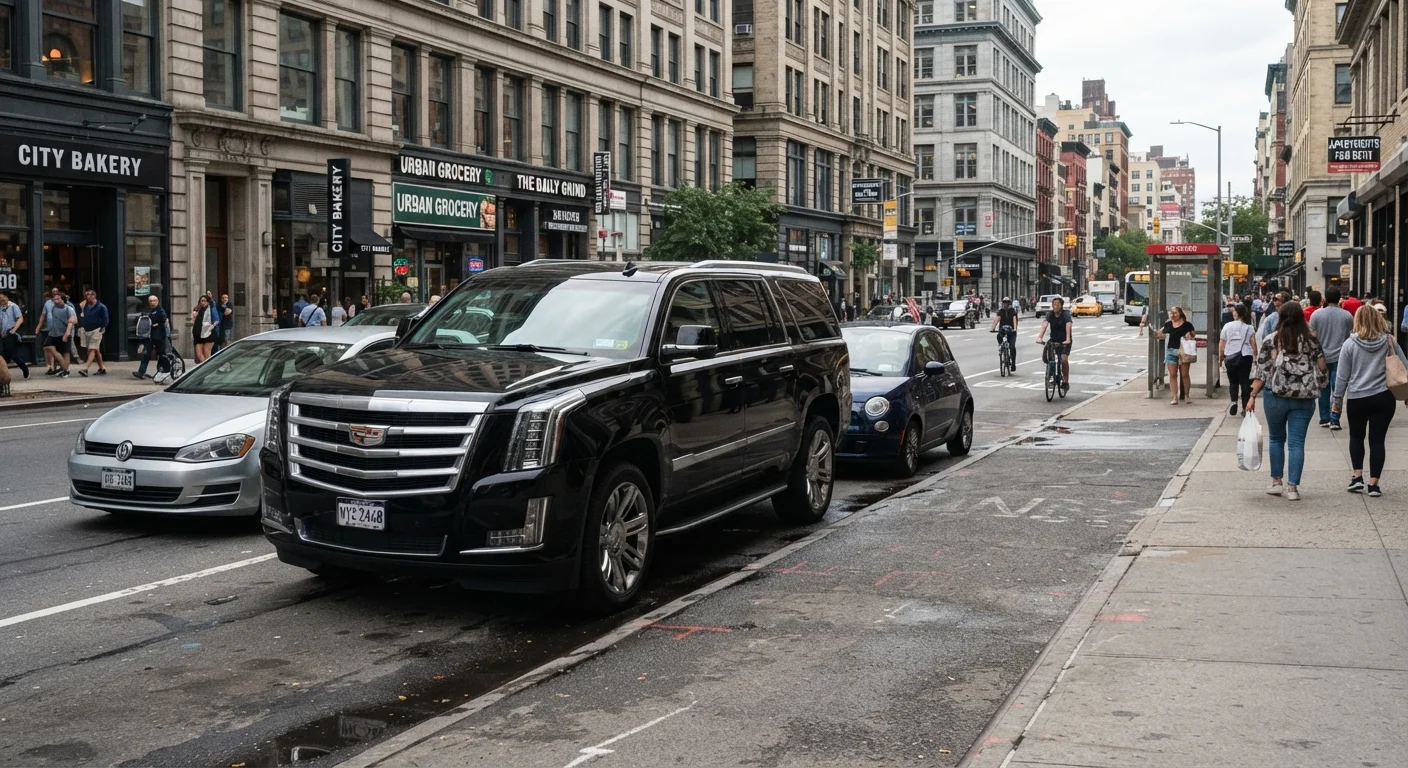
Decades of Creeping Growth
If you placed a 1990 mid-size sedan next to its current nameplate equivalent, the difference in sheer bulk would be striking. The average new light vehicle sold in the United States has grown considerably in all key dimensions over the past three decades. Wheelbases are longer, cabins are taller, and curb weights have climbed well past what earlier generations of the same models carried.
This is not the result of a single decision. It reflects a slow accumulation of market forces, regulatory requirements, and engineering choices — each generation of a model arriving slightly larger than the last to justify its "new" status and meet updated requirements. To understand what automakers actually mean when they describe a vehicle as redesigned, see our article on how carmakers define a car as "new".
~1,000 lbs
Average weight added to full-size pickups since the 1990s
Industry analyses tracking curb weight trends show full-size trucks have added roughly 1,000 pounds on average over the past three decades.
~4 inches
Width increase in average midsize SUV since early 2000s
Dimensional comparisons across consecutive model generations show midsize SUVs have grown roughly four inches wider over roughly two decades.
~75%
Share of U.S. new vehicle sales that are trucks, SUVs, or crossovers
U.S. market data consistently shows light trucks and SUVs account for roughly three-quarters of new passenger vehicle sales.
What's Driving the Size Trend
Three broad forces explain most of the growth:
- Consumer demand for SUVs and trucks. The market shift away from traditional sedans toward crossovers, SUVs, and full-size pickup trucks is the single largest contributor. These body styles are inherently larger, and their dominance in U.S. sales has pulled the overall average upward substantially.
- Federal crash-safety standards. Meeting modern frontal, side, and rollover crash requirements generally requires stronger — and heavier — structural components. Automakers add mass to achieve the ratings that consumers and fleet buyers expect.
- Feature and comfort expectations. Larger infotainment screens, more rows of seating, expanded cargo capacity, and integrated storage all require interior volume, which pushes exterior dimensions outward.
Electric powertrains add a layer of complexity. Battery packs are among the heaviest single components in any vehicle, meaning many of the newest EVs are significantly heavier than their gasoline counterparts. For a fuller picture of how different powertrains are shaping today's market, see our overview of electric, hybrid, and hydrogen powertrain options.
“The growth in vehicle size and weight has real consequences beyond the vehicles themselves — for road design, for parking infrastructure, and for the safety of everyone who shares public space with these vehicles.”
— David Zipper, Visiting Fellow, Harvard Kennedy School (transportation policy researcher and journalist)
Real-World Implications for Everyday Drivers
Size growth is not simply an abstract measurement — it has tangible consequences for people who drive, park, and share roads with these vehicles.
Visibility and Blind Spots
Taller hood lines and thicker A-pillars, both byproducts of modern safety structures, create larger blind zones at the front of vehicles. This is particularly relevant for pedestrian safety at crosswalks and in parking lots, where smaller pedestrians — including children — can be obscured.
Urban Parking and Infrastructure
Parking garages, street spaces, and drive-throughs were largely designed around vehicle dimensions common in earlier decades. A vehicle that is two to three inches wider than a 1990s model may technically fit a standard space but leaves far less margin on either side. Some drivers of full-size trucks and large SUVs routinely find older multi-story parking structures effectively inaccessible.
Pedestrian and Cyclist Risk
Safety researchers have noted that heavier vehicles with higher front ends transfer more energy in pedestrian collisions than lighter, lower vehicles. While occupant protection within the larger vehicle improves, the risk profile for other road users shifts in the opposite direction.
Adjust Your Driving Habits for Larger Vehicles
If you've recently moved to a larger vehicle, take time to learn its actual exterior dimensions before driving in tight urban environments. Walk around the vehicle with a tape measure once — knowing your exact width and overhang helps you judge clearance more accurately. Use any available camera and sensor systems as a supplement to your own spatial awareness, not a replacement for it.
If you're new to driving larger vehicles, building disciplined habits early — including regular mirror checks and understanding your vehicle's true dimensions — matters considerably. Our guide on vehicle maintenance and habits for new drivers covers the fundamentals that apply regardless of vehicle size.
What This Means Going Forward
Vehicle size trends are deeply embedded in both market economics and regulatory frameworks, which means a rapid reversal is unlikely. However, some forces may moderate further growth. Urban planning discussions increasingly focus on designing streets and parking for a range of vehicle types rather than assuming continued upscaling. Some city governments have begun reconsidering how infrastructure is sized and how road space is allocated.
For individual drivers, the key is understanding that a larger vehicle brings genuine capability trade-offs alongside its benefits: more cargo room and crash-protection mass on one hand, reduced urban maneuverability and higher energy consumption on the other. Staying informed about how your specific vehicle's dimensions compare to older standards — and how that affects the infrastructure around you — helps set realistic expectations.
Technology is also evolving alongside size. Software features such as automated parking assist and surround-view camera systems are increasingly standard on large vehicles, partly to compensate for the real-world difficulty their dimensions create. For a look at how software is reshaping the modern car experience, see our piece on how over-the-air updates are changing what a current vehicle means.
Regulatory Context: CAFE and Vehicle Footprint
The U.S. Corporate Average Fuel Economy (CAFE) standards set efficiency targets on a vehicle-footprint basis, meaning larger vehicles face a lower miles-per-gallon target than smaller ones. This structure has been critiqued by some researchers as reducing the regulatory incentive to limit vehicle size, since a manufacturer can comply more easily by building bigger rather than more efficient vehicles. The EPA and NHTSA review and update these standards periodically.