Why Road Markings Cause More Confusion Than Road Signs
Most drivers can recall a handful of road marking rules from their driving test — but retention fades quickly once the test is passed. Unlike signs, which are elevated and deliberately attention-grabbing, road markings sit below eye level and blend into routine scenery. The result is a widespread habit of guessing meanings rather than recalling them accurately.
That gap matters because road markings carry legal weight. Crossing a solid white center line or stopping on yellow zigzags isn't a minor style choice — it can result in a citation or, more seriously, a collision. Understanding what's actually painted on the road is a foundational part of safer driving, and it connects directly to the broader skill of reading a road that separates experienced drivers from beginners.
The myth-versus-fact pairs below address the markings drivers most frequently misinterpret.
Myth
A solid white center line just means you should be cautious about overtaking — it's more of a warning.
Fact
A solid white center line is a legal prohibition. You must not cross or straddle it to overtake.
The distinction between broken and solid white center lines is legally significant. A broken line means overtaking is permitted when it is safe to do so. A solid line — regardless of how clear the road ahead appears — means overtaking is prohibited. Many drivers treat solid lines as a strong advisory, but enforcement agencies treat them as a rule. Double white lines where your side is solid and the other is broken mean the prohibition applies to you but not to traffic coming the other way.
Myth
Yellow zigzag lines mean you cannot park there, but stopping briefly to drop someone off is fine.
Fact
Yellow zigzag lines prohibit stopping entirely during their operative hours, including momentary stops to drop passengers.
Zigzag lines exist to keep sight lines clear for pedestrians and drivers approaching crossings. Even a brief stop to let a passenger out obstructs those sight lines and creates a hazard. Near schools, operative hours are often school-day specific; near pedestrian crossings, the prohibition generally applies at all times. The markings are enforceable, and local authorities increasingly use camera systems to detect violations.
Myth
You can enter a yellow box junction as long as you intend to clear it before traffic comes.
Fact
You may only enter a box junction if your exit is already clear before you reach the box — intention is not enough.
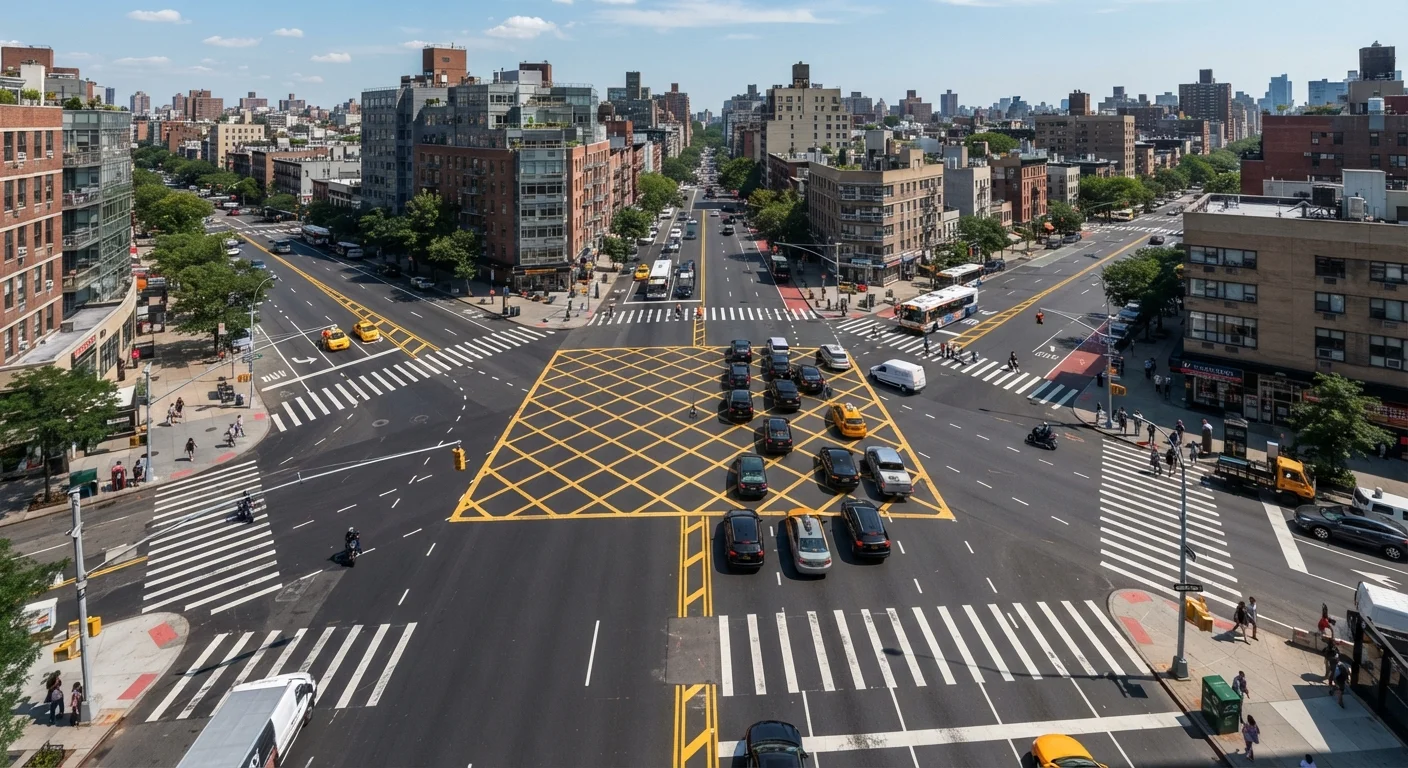
The rule is based on your exit being clear at the moment of entry, not on your expectation that it will clear. If traffic is queued beyond the box, you must wait behind the box until the queue moves and your exit becomes unobstructed. The right-turn exception is narrow: you may wait inside the box when turning right if oncoming traffic or pedestrians are the only reason you cannot complete the turn.
Myth
A painted speed number on the road surface means the speed limit has just changed at that point.
Fact
Speed numerals painted on the road are reminders of an existing limit, not the point at which a new limit begins.
The legal change of speed limit occurs at the roadside sign, not at the road surface numeral. Surface markings are supplementary aids painted in advance of junctions or after a limit change to reinforce awareness. Relying on surface numerals alone to judge where a limit begins can lead drivers to misread when enforcement applies, particularly in areas where signage and surface markings are spaced apart.
Myth
Edge lines on the left side of a road are just lane guidance — they don't signal anything specific.
Fact
A broken white edge line signals that a hazard, restriction, or junction is nearby; the pattern carries specific meaning.
Edge lines (sometimes called fog lines) run along the left side of lanes. A continuous edge line marks the boundary of the carriageway. When the edge line becomes broken — shorter marks, shorter gaps — it is alerting drivers to a side road, lay-by entry, or other feature ahead. Recognising this pattern allows drivers to anticipate changes in the road environment rather than reacting to them at the last moment.
The Markings That Carry the Biggest Legal Consequences
Several road markings are commonly treated as suggestions when they are, in fact, enforceable restrictions. Yellow zigzag lines outside schools and near pedestrian crossings are a no-stopping zone at any time, not simply a no-parking area. Stopping on them — even briefly to drop a passenger — is illegal during their operative hours.
Box junctions (the yellow hatched grids at busy intersections) are another source of persistent confusion. The rule is precise: you must not enter the box unless your exit road is clear. Queuing traffic inside the box blocks crossing traffic and creates gridlock. The only exception is when you are turning right and are prevented from completing the turn solely by oncoming vehicles.
Box Junctions Are Actively Enforced
In many cities, yellow box junctions are monitored by traffic cameras that automatically detect vehicles stopping inside the box. Fines are issued without a police officer being present. Do not enter a box junction based on the assumption that the queue will move — wait until your exit is physically clear.
For parking-specific markings such as yellow lines and loading bays, the rules carry their own nuances — see parking rules that catch drivers off guard for a detailed breakdown.
Speed-related road markings — including the large numerals painted directly on road surfaces in speed-limit transition zones — are also widely misread. A painted number on the road is a reminder, not a new limit; the actual change in limit is typically signalled by a roadside sign. For full context on how speed limits interact with road markings and signage, the speed limits and variable limits reference guide is a useful companion read.
~30%
Drivers unable to correctly identify road marking rules
A UK road safety survey conducted by the RAC Foundation found that a significant proportion of drivers could not correctly define common road markings when tested outside of a formal exam context.
2x
Higher collision risk at misread junctions
Road safety research consistently links junction misreading — including failure to observe stop and give-way markings — to a disproportionate share of urban collisions compared to open-road incidents.
Applying This Knowledge Every Time You Drive
Road markings work as a system. Center line markings, edge markings, and surface symbols are designed to be read in sequence as you approach a junction or hazard. A broken white center line indicates normal conditions; as lines become longer and the gaps shorter, a hazard is approaching. A solid double white line means the restriction is at its strictest — no crossing, no overtaking, regardless of what you can see ahead.
Treating each marking as part of a visual language, rather than isolated paint, is the mindset shift that improves road reading over time. Roundabout lane markings follow the same logic — clear rules exist about which lane to use and when to signal, though many drivers improvise. The rules drivers get wrong at roundabouts article addresses that specific scenario in full.
Road Markings Are Legal Requirements, Not Advice
A common misconception is that road markings are guidance rather than enforceable rules. In the US, road markings are defined within the Manual on Uniform Traffic Control Devices (MUTCD) and carry legal standing under state traffic codes. Ignoring solid center lines, box junction rules, or no-stopping zones can result in citations — and more importantly, in preventable collisions.
Refreshing your understanding of road markings periodically — particularly if you drive in unfamiliar regions or on motorways with smart systems — is a straightforward habit that reduces risk and keeps you on the right side of enforcement.