Why Parking Rules Trip Up Even Experienced Drivers
Most drivers can identify a double yellow line, but far fewer know exactly what it permits — or when a loading exemption applies. Parking regulations combine national rules with locally imposed restrictions, and the gap between assumption and legal reality is where fines accumulate. Understanding what markings and signs actually mean is the first step toward avoiding costly mistakes.
| Primary governing authority | State and municipal law |
| Most common parking violation | Expired meter / overtime parking (Urban transportation studies, general findings) |
| Standard fire hydrant clearance | 15 feet (most US states) (Varies by jurisdiction) |
| Temporary restriction notice period | Typically 72 hours in advance (Common municipal standard) |
| Blue curb requirement | Valid disabled placard or license plate (Federal ADA provisions, enforced locally) |
Parking law in the US is primarily governed at the state and municipal level, meaning rules can differ significantly from one city to the next. That said, several common restriction types appear almost universally, and misreading any of them carries real consequences — from fixed penalty notices to towing.
For a broader look at how road markings inform driver behaviour, see what road markings actually mean.
Curb Colors, Line Markings, and What They Prohibit
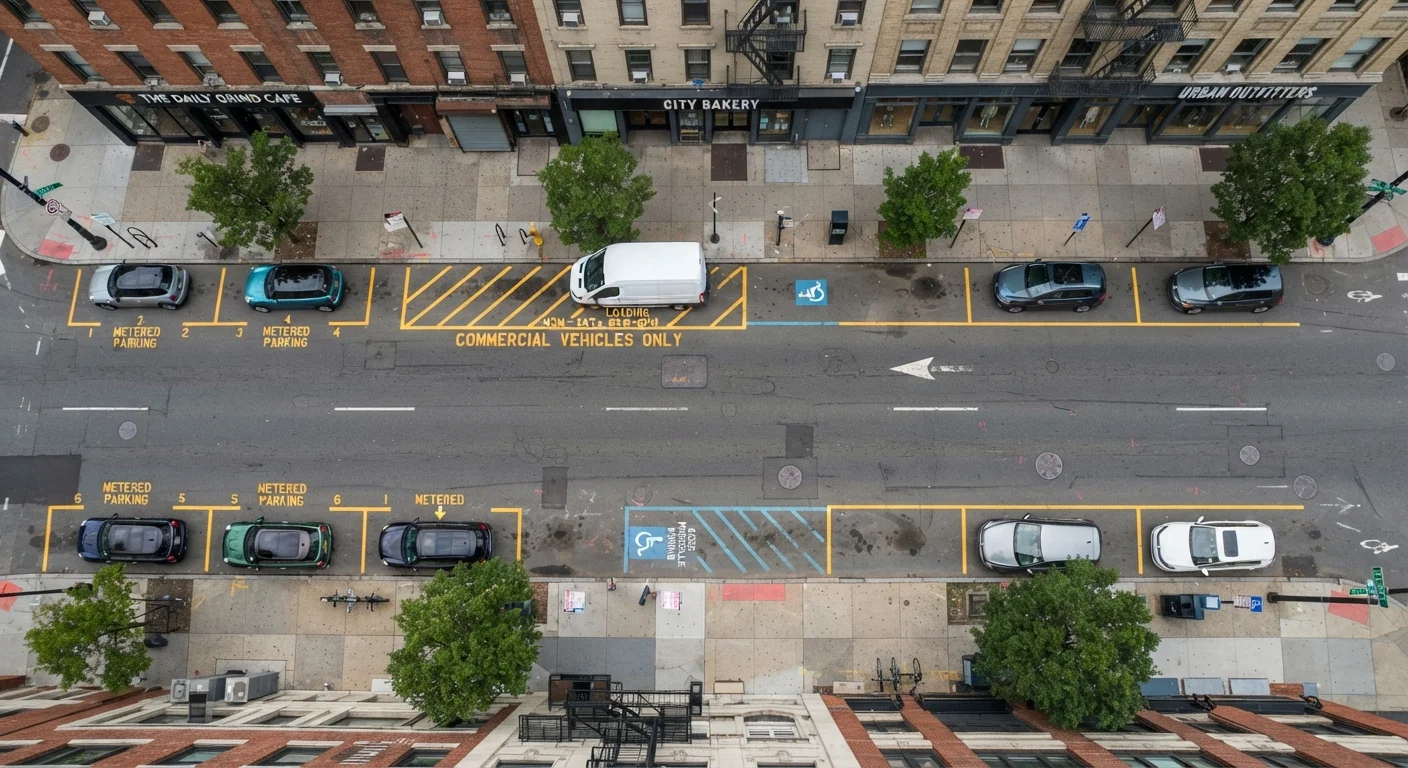
Painted curbs are among the most misunderstood parking signals. Each color carries a specific, legally defined meaning, though the exact schedule may vary by municipality:
- Red curb: No stopping, standing, or parking at any time.
- Yellow curb: Loading and unloading only, typically with a time limit. Drivers must remain with the vehicle in many jurisdictions.
- White curb: Passenger loading and unloading only — often enforced to the minute at transit hubs or airports.
- Blue curb: Reserved for vehicles displaying a valid disabled parking placard or license plate.
- Green curb: Short-term parking permitted, usually 10–30 minutes as posted.
Loading zone
A designated area where vehicles may stop briefly to load or unload goods or passengers. Time limits and vehicle-type restrictions vary by location and are typically posted on adjacent signage.
Temporary no-parking order
A short-term restriction posted by a local authority, often for construction or civic events. Vehicles in violation during the posted window are subject to immediate towing.
Street sweeping restriction
A scheduled no-parking period that allows street-cleaning equipment to operate. Enforcement occurs during the posted window regardless of whether a sweeper is present.
Dropped kerb (curb cut)
A section of curb lowered to allow vehicle or pedestrian access across the sidewalk, typically at driveways. Parking in front of a dropped kerb is prohibited in most jurisdictions.
In areas without painted curbs, posted signs govern restrictions. A common error is assuming a space is unrestricted because no curb paint is visible — always check nearby signage before leaving your vehicle.
Signs, Time Windows, and the Street-Cleaning Trap
Parking signs are often stacked, amended, or partially obscured, making them genuinely difficult to parse. The standard format lists the restriction type, the days it applies, and the hours of enforcement. A sign reading "No Parking 8AM–6PM Mon–Fri" permits parking outside those hours — but only if no other sign contradicts it.
Street-sweeping restrictions are a significant source of citations. These are often enforced aggressively, and the sweeper schedule typically takes priority over other posted times. The restriction is in effect even if no sweeper appears that day.
Check for Temporary Posting Updates
Many cities now post temporary no-parking orders digitally through municipal apps or websites, in addition to physical signs. If you regularly park in the same urban area, checking these resources before overnight parking can prevent an unexpected tow. Physical signs remain the legal standard, but digital alerts offer a useful early warning.
Temporary no-parking orders — commonly posted for construction, filming, or utility work — are another frequent surprise. These are posted with advance notice, usually 72 hours, and enforcement begins the moment the posted time window opens. Vehicles left in a temporary restriction zone are among the most commonly towed in urban areas.
Understanding how urban environments shape driving decisions more broadly is covered in urban versus motorway driving technique.
Dropped Kerbs, Fire Hydrants, and Intersection Rules
Some of the most ticketed parking violations involve distances and obstructions rather than explicit signs:
- Fire hydrants: Most US jurisdictions prohibit parking within 15 feet of a fire hydrant. This applies even when no marking is painted on the curb.
- Intersections and crosswalks: Parking within 20–30 feet of an intersection is commonly prohibited. The exact distance varies by state, so checking local code matters.
- Driveways and dropped kerbs: Blocking a driveway — including your own — is illegal in most areas and a leading cause of towing complaints.
- Bus stops and transit zones: These are often marked with a combination of curb paint and signage. Stopping, even briefly, in a bus stop can result in an immediate citation in many cities.
15 ft
Minimum clearance from fire hydrant
Standard distance required under most US state vehicle codes; some municipalities set a greater distance.
72 hrs
Typical advance notice for temp restrictions
Most cities require temporary no-parking signs to be posted at least 72 hours before enforcement begins.
Drivers who regularly navigate city streets can benefit from developing awareness of these spatial rules as part of their overall hazard perception. Reading a road the way experienced drivers do covers how to integrate these cues into everyday driving.