National Speed Limits at a Glance
In the United States, speed limits are set at the state and local level rather than by a single federal mandate. However, posted limits follow broadly understood categories that drivers can use as a practical reference framework.
| Typical Interstate Highway Limit | 65–80 mph (Varies by state; up to 85 mph on specific Texas toll roads) |
| Standard Residential Street Limit | 25 mph (Common default; local ordinances may set lower limits) |
| Typical School Zone Limit | 15–25 mph (Active during school hours or when children are present) |
| Work Zone Enforcement | Fines often doubled (Many states impose elevated penalties; workers need not be present) |
| Variable Limit Legal Status | Legally binding in most states (Same enforceability as static posted signs where deployed) |
On Interstate highways, limits typically range from 65 to 80 mph depending on the state, with rural stretches in states such as Texas and Utah permitting up to 85 mph on specific designated roads. Urban freeways commonly carry 55–65 mph limits. Undivided rural roads are generally posted at 55 mph, while residential streets often default to 25 mph — sometimes lower where local ordinances apply.
Where no speed limit sign is posted, most states impose a statutory speed limit — a legally defined default for that road type. Always verify the applicable default for any state you are driving through, as they differ. For a deeper look at how driving technique should shift with road type, see Urban Driving vs. Motorway Driving.
Special Speed Zones Explained
Certain locations carry legally enforced reduced limits regardless of the surrounding road's standard posting. Drivers must recognise the signs and understand exactly when each zone activates.
Statutory Speed Limit
A default speed limit set by state law that applies on a given road type when no posted sign indicates otherwise. It varies by state and road classification.
Variable Speed Limit (VSL)
An electronically displayed speed limit that changes based on real-time traffic, weather, or incident conditions. In most deploying states it carries the same legal force as a static sign.
Advisory Speed
A recommended speed for a specific condition or curve, typically shown in yellow. It is not a legally enforceable maximum but reflects the safe operating speed engineers determined for that location.
Reasonable and Prudent Standard
A legal principle requiring drivers to travel at a speed appropriate for current conditions regardless of the posted limit. Exceeding what is safe for conditions can constitute a violation even below the posted maximum.
Work Zone Speed Limit
A reduced limit that applies throughout a designated construction or maintenance zone, beginning at the first warning sign. It is enforceable whether or not workers are present.
School Zones
School zone limits — typically 15 to 25 mph — are active during school arrival and dismissal hours, and in some states whenever children are visibly present. Signs usually display the hours of enforcement; flashing yellow beacons confirm when the reduced limit is in effect. Fines in active school zones are commonly doubled or tripled under state law.
Work Zones (Construction Zones)
Work zone speed limits apply from the first warning sign through the end-of-zone sign, even when no workers are physically present. Enforcement is often heightened in these areas, and many states impose elevated fines or mandatory license-point penalties for violations.
Hospital and Emergency Zones
Several jurisdictions designate reduced-speed zones near hospitals or emergency facilities, particularly where pedestrian traffic from those facilities is high. These are less universally standardised, so posted signs are the definitive reference.
Understanding road markings and signage alongside posted limits gives drivers a fuller picture of legal obligations at any given point.
Variable and Advisory Speed Limits
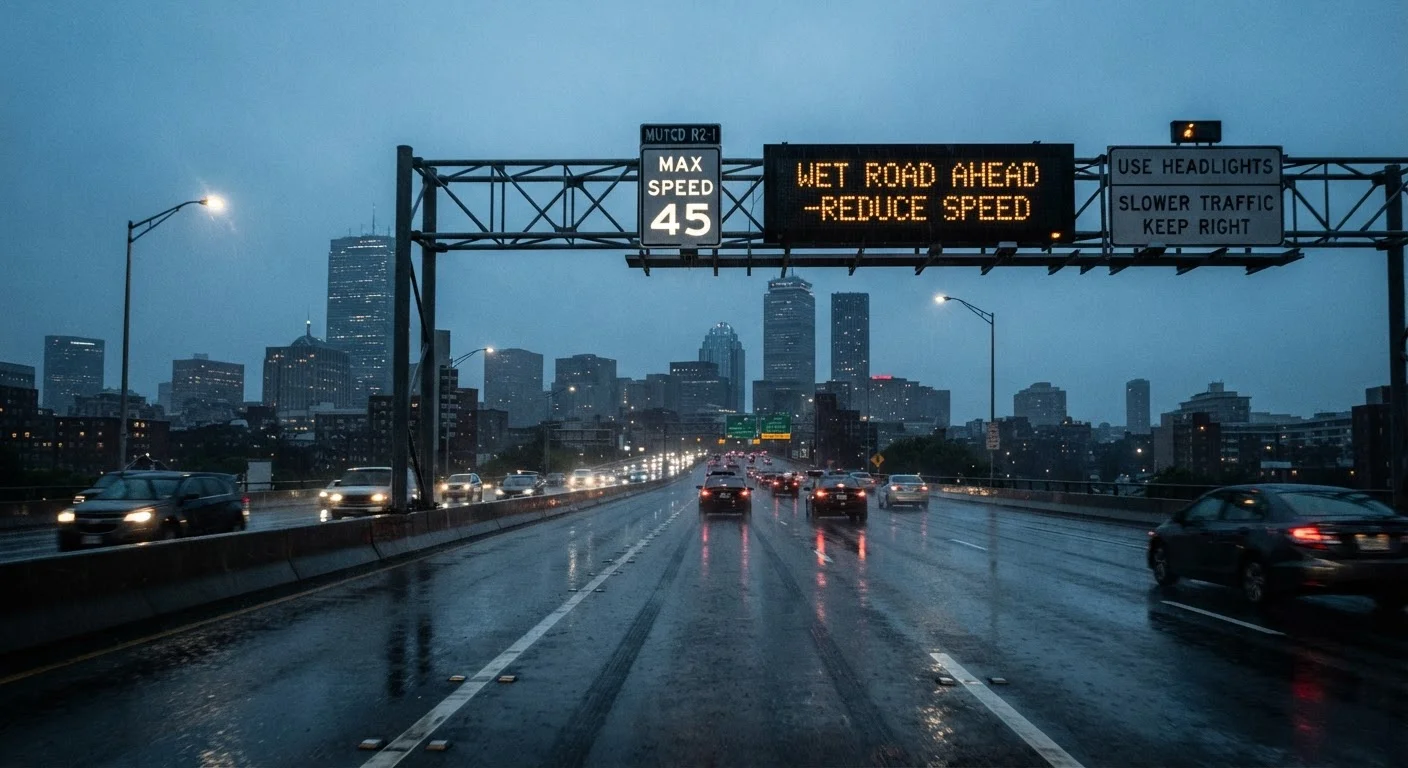
Variable speed limits (VSLs) are electronically displayed limits that change in response to real-time conditions — traffic density, weather, or incidents ahead. They appear on overhead gantry signs or dynamic message boards and are increasingly common on busy corridors and managed expressways.
Variable Limits Are Legally Enforceable
In most states where variable speed limits are deployed on managed expressways, the electronically displayed number carries the same legal weight as a fixed posted sign. Drivers who pass beneath a gantry showing a reduced limit and continue at a higher speed can be cited, even if no static sign nearby carries that number. When no variable limit is shown, the standard posted limit resumes.
In most states where variable limits are deployed, the displayed number carries the same legal weight as a static posted sign. Ignoring a reduced variable limit is a citable offense, not merely an advisory. If no variable limit is displayed, the static posted limit applies.
Advisory vs. Regulatory
Some corridors use advisory speed displays — often shown in yellow rather than white — which indicate a recommended safe speed for current conditions but are not legally binding. Regulatory variable limits use standard white-on-black or overhead white signage. When in doubt, treat any electronically displayed lower number as enforceable.
For a detailed breakdown of how managed highway systems coordinate these tools, see how smart motorway systems work.
The Reasonable and Prudent Standard
Even where no specific limit is posted, nearly every U.S. jurisdiction recognises a reasonable and prudent standard: drivers must travel at a speed appropriate for current conditions — weather, visibility, traffic, and road surface — regardless of the posted maximum. Driving at the posted limit during a whiteout or heavy rain can still constitute a violation if a court determines conditions required a lower speed.
~31%
Share of U.S. traffic fatalities linked to speeding
According to the National Highway Traffic Safety Administration (NHTSA), speeding is consistently cited as a factor in roughly three in ten fatal crashes annually.
2–3×
Increase in stopping distance from 30 to 60 mph
Physics dictates that stopping distance does not scale linearly — doubling speed roughly quadruples the kinetic energy a vehicle must absorb to stop.
Following distance also scales with speed — a factor the reasonable and prudent standard implicitly encompasses. As speed increases, both stopping distance and the severity of potential impact rise significantly, making speed choice in variable conditions one of the most consequential decisions a driver makes.
This article provides general reference information about speed limit frameworks in the United States. Traffic laws vary by state and locality; always consult official state DMV resources or a qualified legal professional for guidance specific to your jurisdiction.