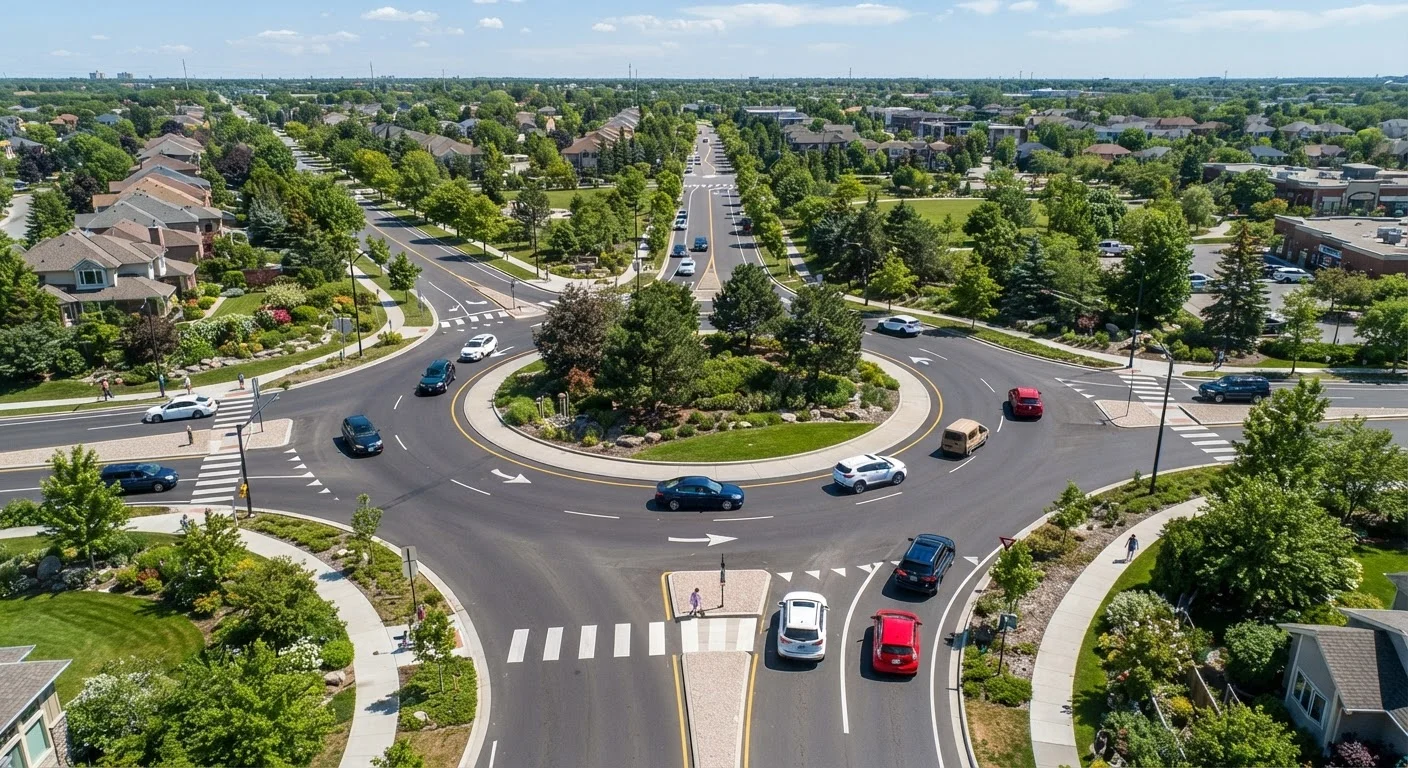
Why Roundabouts Catch So Many Drivers Off Guard
Roundabouts are among the most misunderstood junctions on American roads. Partly this is familiarity: four-way stops and signalised intersections still dominate most driver education, so roundabouts can feel like an exception to a rule rather than a rule of their own. The result is hesitation, incorrect lane use, and collisions that are almost entirely avoidable.
Understanding roundabouts is also part of broader road literacy. Just as road markings carry specific legal meaning, the layout of a roundabout communicates priority and path in ways that have to be read correctly to be followed safely. This article breaks down the five most common roundabout mistakes and explains what the rules actually require.
Yield Means Yield — Not Stop
A yield sign at a roundabout entry does not mean you must stop — it means you must give way to circulating traffic. Stopping when no vehicle is present disrupts flow and can cause rear-end collisions. Approach at a reduced speed, judge the gap, and merge smoothly when it is safe to do so.
The Five Mistakes — and How to Correct Them
Each of the errors below reflects a real, recurring pattern observed across traffic studies and driver education research. They range from priority misunderstanding to signalling omissions, and all of them are correctable with a clearer grasp of the rules.
Failing to yield to circulating traffic and entering the roundabout at full speed.
Why it happens: Drivers accustomed to four-way stops or traffic-light junctions expect an equal-turns system, not a yield-to-circulating rule.
Choosing the wrong lane on approach, then cutting across lanes mid-roundabout to reach the intended exit.
Why it happens: Drivers often make a lane decision too late, committing to an entry lane without first identifying which exit they need.
Not signalling when exiting the roundabout, leaving other drivers uncertain of your intended path.
Why it happens: Many drivers signal on entry but forget that exiting also requires a clear signal, often because roundabout signalling feels counterintuitive.
Drifting out of lane while navigating a multi-lane roundabout, encroaching on adjacent vehicles.
Why it happens: The curved path of a roundabout creates natural centrifugal pressure, and drivers underestimate how much steering input is needed to hold their lane.
Stopping inside the roundabout to allow entering traffic to merge, reversing the legal priority rule.
Why it happens: A misplaced sense of courtesy leads drivers to assume that sharing means taking turns, regardless of who has legal priority.
~40%
Reduction in fatal crashes at converted intersections
Research published by the Insurance Institute for Highway Safety (IIHS) found that converting conventional intersections to roundabouts reduced fatal crashes by roughly 40 percent.
~75%
Reduction in injury crashes at roundabout conversions
The same IIHS research indicated injury crashes dropped by approximately 75 percent at locations where signal-controlled intersections were converted to roundabouts.
Lane Discipline and Signalling: The Detail Most Drivers Skip
Of all the roundabout rules, lane discipline inside a multi-lane roundabout is the one that generates the most conflict. The principle is straightforward: the lane you enter is the lane you stay in until your exit. Weaving between lanes while circulating is both dangerous and, in most jurisdictions, illegal. Pavement arrows and lane markings — where they exist — are binding guidance, not suggestions.
Signalling requirements vary slightly by state, but the general expectation is consistent: signal your intention to exit before you reach your exit point, not after you have already begun turning. This gives pedestrians at the exit crosswalk and drivers waiting to enter a clear and early warning of your path. Treating signalling as optional is one of the habits that experienced drivers often form after years of muscle memory on conventional intersections.
For a broader look at how road environment shapes driving technique, including how roundabout-dense urban areas differ from open-road driving, see how urban and motorway technique differ. Sharpening your ability to read a junction before you reach it — a skill explored in what experienced drivers notice on the road — is directly applicable to roundabout navigation.
Pedestrians and Cyclists Have Right of Way at Exits
When exiting a roundabout, you must yield to pedestrians in the crosswalk and cyclists using the shared path. Many drivers focus on the vehicles circulating behind them and neglect to check the crosswalk directly ahead. Always complete your mirror and shoulder check before fully exiting the junction.