What Hazard Perception Really Means
Passing a driving test confirms that someone can operate a vehicle competently in standard conditions. What it doesn't guarantee is the ability to read a road — the ongoing, layered process of extracting meaning from the environment before a hazard becomes critical. This skill gap is one reason why crash risk remains statistically elevated in the first two years after licensing, according to road safety research bodies.
Reading a road isn't about having faster reflexes. It's about perceiving risk earlier, so responses can be measured rather than reactive. The cues are there on every journey; experienced drivers have simply learned to notice and interpret them. The list below covers the most important ones — and why beginners tend to overlook them.
Try narrating your drive aloud
One technique used in advanced driving instruction is 'commentary driving' — describing hazards and decisions out loud as you drive. It sounds unusual, but it exposes gaps in your scanning pattern and forces you to consciously process cues you'd otherwise skip. Even ten minutes on a familiar route can highlight habits you didn't know you had.
The Cues That Separate Confident Drivers From Cautious Ones
Road surface texture and condition
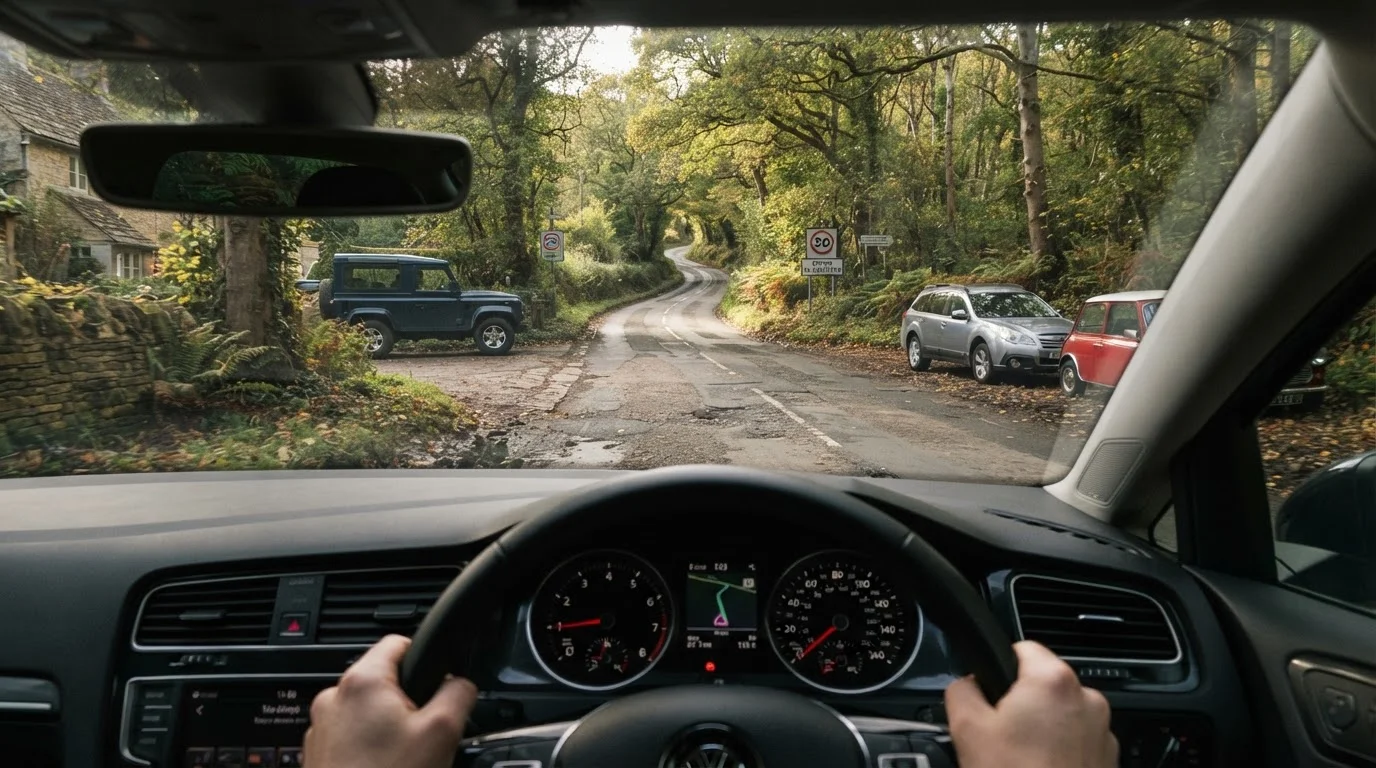
Beginners tend to treat the road surface as a neutral given. Experienced drivers read it actively. Patches of discoloration can indicate standing water or diesel spill. A shiny surface in cold weather suggests ice before any skid confirms it. Rippling or broken tarmac on a bend signals reduced grip exactly where it matters most. Even the change from asphalt to concrete mid-road can affect braking distance slightly.
The practical rule: when the road surface changes character, assume grip may also change — and adjust speed accordingly.
A shiny road surface in cold weather suggests ice before any skid confirms it.
Sight lines and the limit point
The 'limit point' is the furthest visible point along the road — where the left and right edges appear to converge. On a straight road it's distant; on a tightening bend it closes in rapidly. Experienced drivers use this point to judge bend severity in real time: if the limit point is moving toward you faster than you're closing the distance, the bend is tightening and speed needs to come down.
This technique, taught in advanced driving courses, means a driver is always managing speed within their actual stopping distance — not just reacting when a corner turns out sharper than expected. Understanding stopping distance in full is essential context for this habit.
If the limit point is closing faster than you're moving, the bend is tightening — slow down.
Parked vehicles and the doors zone
A line of parked cars represents one of the most consistent urban hazards. Each vehicle is a potential source of: a door opening suddenly into traffic, a pedestrian stepping out from between cars without looking, or a vehicle pulling out without signalling. Experienced drivers position themselves — where safe — to increase the gap to parked vehicles, and they scan for movement cues: an occupied car often has a slight exhaust plume in cold weather, a head visible through the rear window, or wheels turned outward suggesting intent to move.
Slowing and covering the brake when passing clusters of parked vehicles is standard defensive practice, not excessive caution.
Each parked vehicle represents three distinct hazard types: doors, pedestrians, and moving vehicles.
Pedestrian behaviour and body language
Not every pedestrian on a pavement is a hazard — but body language tells experienced drivers which ones warrant attention. A pedestrian walking toward the kerb without looking up, a child near the road, someone absorbed in a phone, or a group whose attention is elsewhere all signal elevated risk. Near schools, markets, or bus stops, the density of people makes stepping out more likely.
The key perceptual skill here is not watching where pedestrians are, but predicting where they might be in the next two to three seconds — before they move.
Read where pedestrians might be in three seconds, not just where they are right now.
Environmental context and soft cues
The surroundings of a road carry meaningful information. A school sign, a church, a pub car park, a supermarket entrance — each predicts the type of road users likely to appear. Leaves blown across a road suggest wet patches underneath. Long grass at junctions obscures sight lines more than expected. A rural road crossing a stream is more likely to have ice on the bridge in winter. Trees overhanging a lane create a perpetually damp surface regardless of recent rain.
Experienced drivers build a mental model of the environment and use it to anticipate, not just observe. This is particularly relevant after dark — see our guide on how darkness changes risk and what to do about it.
Surroundings — schools, pubs, market entrances — predict which hazard types are most likely ahead.
Scanning rhythm and eye movement
One of the most measurable differences between novice and experienced drivers is where their eyes go. Beginners tend to fix their gaze close to the front of the vehicle and react to what appears directly ahead. Skilled drivers use a structured scanning pattern: far ahead for emerging hazards, mid-distance for developing situations, near field for immediate action, and regular mirror checks woven in.
This rhythm means the experienced driver is always processing information from multiple distances simultaneously — giving them more time to respond to any one of them. It also means they're rarely surprised, because they've already registered the hazard as a developing situation before it becomes urgent.
Skilled drivers scan at three distances simultaneously — far, mid, and near — rather than fixating ahead.
Developing these habits takes time and intentional practice. If you're newer to driving, pairing this awareness with solid vehicle fundamentals helps — see our guide for new drivers on building good maintenance habits for the mechanical side of staying safe. For the rules that govern road markings you'll encounter while scanning ahead, understanding what road markings actually mean fills in important context.
Advanced driving courses build these skills formally
Organisations such as IAM RoadSmart and RoSPA Advanced Drivers and Riders in the US and UK offer structured post-license training that directly targets hazard perception and road-reading. These aren't remedial courses — they're designed for competent drivers who want to develop further. Insurance providers sometimes recognise advanced qualifications, though outcomes vary by policy.
Building the Habit Over Time
None of these skills arrive automatically. The most effective way to develop them is deliberate, low-pressure practice — narrating potential hazards aloud on familiar routes, varying the roads you drive, and progressively tackling more complex environments such as urban centres, motorways, and poor weather conditions. Our guides on driving in rain, fog, and ice and adjusting your technique between urban and motorway driving can help you apply road-reading skills across different contexts.
The goal isn't anxiety or hyper-vigilance — it's quiet, structured attention. Over time, noticing the road's signals becomes automatic, freeing cognitive capacity rather than consuming it.