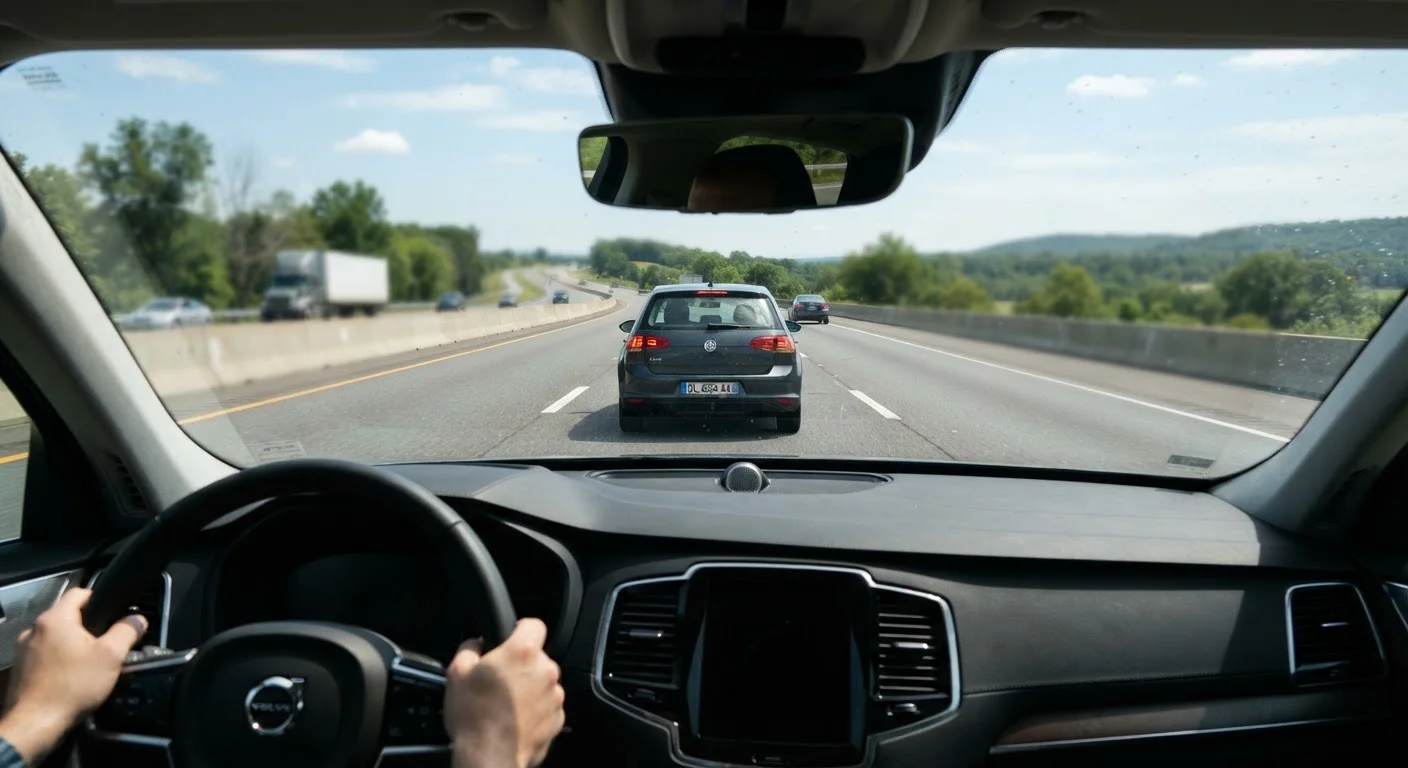
Why Two Seconds Is the Floor, Not the Ceiling
The two-second rule is a useful starting point precisely because it translates across speeds: the gap it creates at 30 mph is shorter in feet than the gap at 65 mph, but in both cases it represents roughly the same window of reaction time. At highway speeds, two seconds of distance is approximately 190 feet — nearly two-thirds of a football field.
But two seconds assumes ideal conditions: dry pavement, an alert driver, a well-maintained vehicle with responsive brakes, and no visual obstructions. When any of those variables change, the minimum safe gap changes with them. Think of two seconds as the lower boundary of acceptable — the point below which you're genuinely gambling on events outside your control.
Increase Your Gap Before You Need It
Don't wait until you spot a hazard to create more space. When entering a higher-speed zone, approaching a curve with limited sight lines, or sensing the driver ahead is distracted, proactively widen your following distance. Creating the buffer early costs nothing and eliminates the need to react under pressure.
Understanding how speed interacts with stopping distance reinforces why following distance matters so much on highways. For a broader look at how speed rules shape driving expectations, see our driver's reference guide to speed limits and zones.
The Physics Behind the Gap
Stopping a vehicle involves two distinct phases. The first is reaction distance — the ground covered while your brain registers danger and your foot moves to the brake. At an average reaction time of 1.5 seconds, a driver at 60 mph travels about 132 feet before braking even begins.
The second is braking distance — the ground covered while the vehicle actually decelerates. Critically, braking distance increases with the square of your speed. Double your speed and braking distance roughly quadruples. At 30 mph on dry pavement, a typical passenger vehicle needs around 45 feet to stop. At 60 mph, that figure climbs to roughly 180 feet — not 90.
~29%
Share of U.S. crashes that are rear-end collisions
Federal highway safety research consistently identifies rear-end crashes as one of the most common crash types on American roads, with following too closely as a primary contributing factor.
4×
Increase in braking distance when speed doubles
Because braking distance increases with the square of speed, doubling your speed from 30 to 60 mph quadruples the distance needed to stop, not merely doubles it.
132 ft
Distance traveled before braking begins at 60 mph
At an average driver reaction time of 1.5 seconds, a vehicle moving at 60 mph covers approximately 132 feet before the brakes are even applied.
This nonlinear relationship is why even modest increases in speed on wet roads can transform a manageable situation into an unavoidable collision. The physics don't negotiate.
Conditions That Demand a Larger Buffer
Experienced drivers treat following distance as a dynamic variable, not a fixed setting. Several conditions require a meaningful increase beyond the two-second baseline:
- Wet pavement: Water reduces tire-to-road friction. Double your following distance — four seconds minimum — in rain.
- Ice or packed snow: Stopping distances can extend six to ten times beyond dry-road figures. Eight to ten seconds is a reasonable benchmark on ice.
- Driver fatigue: Reaction time degrades significantly when tired. A fatigued driver's effective reaction time may be 30–50% longer than when alert.
- Towing or hauling: Additional weight increases momentum and extends braking distance. A loaded trailer behind your vehicle changes the stopping equation considerably.
- Following large trucks: Trucks have longer stopping distances than cars and obscure your view of the road ahead. A wider gap restores your sight lines.
Developing a habit of reading road and traffic conditions — and adjusting your gap proactively — is one of the marks of skilled driving. Our companion piece on what experienced drivers notice that beginners miss covers this perceptual skill in depth.
Following Distance and Nighttime Driving
At night, your headlights typically illuminate only 200–250 feet ahead — which at 60 mph represents less than three seconds of travel time. If your following distance matches or exceeds that range, your effective reaction window shrinks because you can't see hazards beyond your light beam. Reducing speed and extending the gap helps compensate for the reduced visibility window.
Putting It Into Practice
Maintaining safe following distance is easier said than done in dense traffic, where closing gaps is common and social pressure to move forward can feel strong. A few practical approaches help:
- Pick a fixed landmark. When the vehicle ahead passes a highway marker, bridge, or shadow on the road, start counting. Reach two seconds — or more — before you pass the same point.
- Drop back deliberately after a merge. When another vehicle cuts in front of you, ease off the gas slightly to re-establish your buffer rather than braking sharply or feeling annoyed.
- Use speed to your advantage. On open roads, matching the flow of traffic at a consistent speed requires fewer braking events and makes maintaining your gap easier.
These habits matter most on long drives when sustained attention is harder to maintain. If you regularly cover significant highway mileage, the road trip planning guide covers the broader set of habits and preparations that support sustained safe driving.