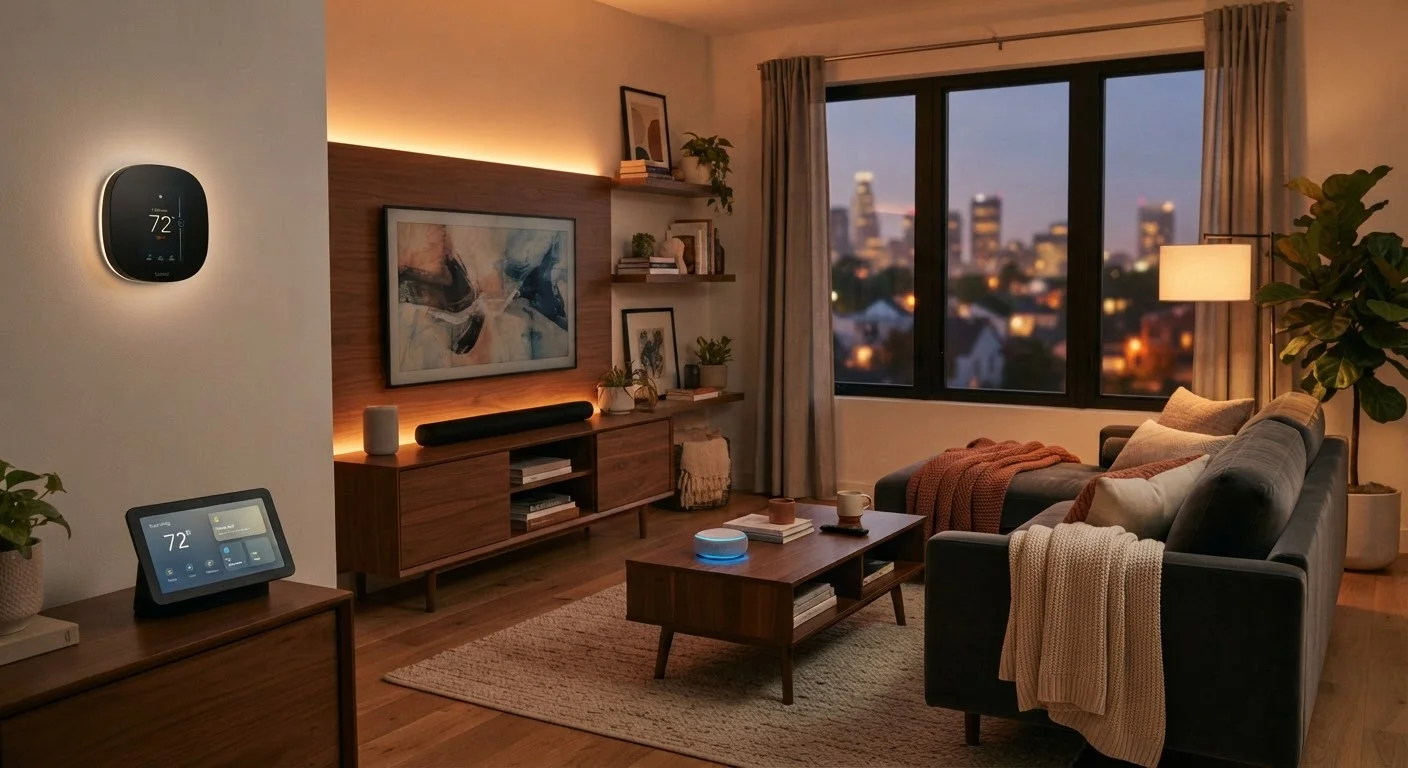
What 'Fully Connected' Actually Means
A fully connected home — sometimes called a smart home — links everyday appliances, lighting, locks, thermostats, cameras, and entertainment systems to a central app or voice assistant, usually over Wi-Fi or a dedicated smart-home protocol. The idea is that these devices share information and automate routine tasks: your thermostat learns your schedule, your lights dim at sunset, your doorbell sends a video clip to your phone.
Before weighing the trade-offs, it helps to be clear that "fully connected" is a spectrum, not a switch. Most households land somewhere in the middle — a smart speaker here, a connected thermostat there — rather than deploying every possible device at once. If you're still exploring where to begin, our step-by-step guide to setting up a smart home from scratch can help you map a realistic starting point.
The Real Advantages
Done thoughtfully, connected home technology solves friction that once required manual attention every single day.
Automates repetitive daily routines effectively
Lighting, heating, and locks can be programmed or voice-controlled, reducing the mental load of managing a home's basic functions throughout the day.
Provides real-time energy usage visibility
Smart thermostats and energy monitors surface consumption patterns that most households were previously unaware of, supporting more intentional energy use.
Remote monitoring adds genuine peace of mind
Checking door locks, viewing camera footage, or receiving alerts about unusual activity while away from home is a practical security benefit many users rely on.
Improves accessibility for some household members
Voice-activated controls and automated routines can be genuinely valuable for older adults or people with mobility limitations who benefit from reduced physical interaction with devices.
Enables flexible, scene-based home control
Grouping devices into scenes — 'movie mode,' 'good morning,' 'leaving home' — allows complex multi-device adjustments to happen instantly with one command.
Energy monitoring is one of the most tangible benefits. Smart thermostats can track usage patterns and adjust heating or cooling around your actual schedule rather than a fixed timer. Over time, that visibility often surfaces waste that was previously invisible. Similarly, smart plugs and lighting systems allow households to identify which devices draw power even in standby mode.
Convenience compounds, too. Routines that once required a dozen separate steps — locking up, arming a security system, dimming lights, adjusting the thermostat — can be collapsed into a single voice command or an automated trigger at a set time.
The Honest Disadvantages
The case against — or at least the case for caution — is equally concrete.
Subscription fees accumulate across multiple devices
Hardware costs are often just the entry price; cloud storage, advanced features, and professional monitoring add recurring monthly charges that compound across a fully connected setup.
Ecosystem fragmentation creates compatibility headaches
Devices from different manufacturers frequently require separate apps or hubs and don't always interoperate smoothly, even as standards like Matter work toward greater cohesion.
Privacy exposure is real and often underexplored
Smart speakers, doorbells, and cameras collect behavioral data that is stored in manufacturer clouds, shared under varying privacy policies, and potentially vulnerable to breaches.
Setup and troubleshooting demands ongoing effort
Connected devices require software updates, occasional resets, and network troubleshooting — tasks that can frustrate less technically confident users when something stops working.
Device obsolescence leaves hardware unsupported
Manufacturers periodically discontinue app or cloud support for older devices, which can render expensive hardware functionally useless without a costly replacement.
Internet dependency creates points of failure
Many smart home functions stop working during internet or power outages, meaning a system designed for convenience can become less functional than traditional switches in basic failure scenarios.
Subscription creep is one of the least-discussed costs. Many smart home devices are sold at a relatively modest hardware price, but advanced features — cloud storage for camera footage, extended AI features, professional monitoring — sit behind recurring monthly fees. Across five or six devices, those fees can add up considerably over a year.
Compatibility is another persistent headache. Despite the emergence of the Matter interoperability standard, not every device from every manufacturer works smoothly with every hub or voice assistant. Our look at what smart home tech actually can't do covers why universal plug-and-play remains more aspiration than reality for many setups. Before adding any new device, the compatibility and setup checklist is worth running through first.
Privacy and Security: The Dimension Most People Underestimate
Every connected device is a potential entry point into your home network. Smart doorbells, voice assistants, and thermostats all collect data — some of it expected, some of it surprising. Understanding what's actually recorded and where it goes is a prerequisite for making informed choices, not an optional detail.
Default Privacy Settings Rarely Reflect Your Preferences
Most smart home devices ship with data-sharing settings optimised for the manufacturer's analytics rather than the user's privacy. Reviewing these settings during setup — rather than after — gives you meaningful control over what is collected and stored. This applies equally to voice assistants, connected cameras, and smart doorbells. It takes roughly 10–15 minutes per device but can significantly limit unnecessary data exposure.
Our detailed breakdown of what your smart devices actually record covers the specifics by device category. For the security side — how to reduce vulnerabilities on your home network without deep technical knowledge — see our guide to locking down your smart home devices and network.
Making the Trade-Off Work for Your Household
The households that report the most satisfaction with connected technology tend to share a few characteristics: they started with a specific problem to solve rather than a general desire for "smart" features, they built incrementally rather than all at once, and they actively reviewed privacy settings rather than leaving everything at default.
57%
US households owning at least one smart home device
According to Statista consumer technology research, smart speaker and smart display ownership has driven broad adoption across US households.
10–15%
Potential heating/cooling savings from smart thermostats
The US Environmental Protection Agency's ENERGY STAR program suggests properly used smart thermostats can meaningfully reduce HVAC energy consumption.
3–5
Average separate apps needed to manage a mixed-brand setup
Industry observers frequently note that multi-brand smart home setups often require managing several manufacturer apps before Matter-certified devices fully unify control.
It's also worth recognising that a connected home isn't a one-time purchase — it's an ongoing relationship with technology that updates, changes pricing, and occasionally gets discontinued. Manufacturers do sunset products, which can leave hardware orphaned without software support. Keeping that long-term view in mind before committing to a particular ecosystem is a practical form of consumer caution, not pessimism.
For those curious how similar connectivity trade-offs play out in other areas of life, the connected-car landscape offers an interesting parallel — the questions of data, subscriptions, and compatibility arise there too.