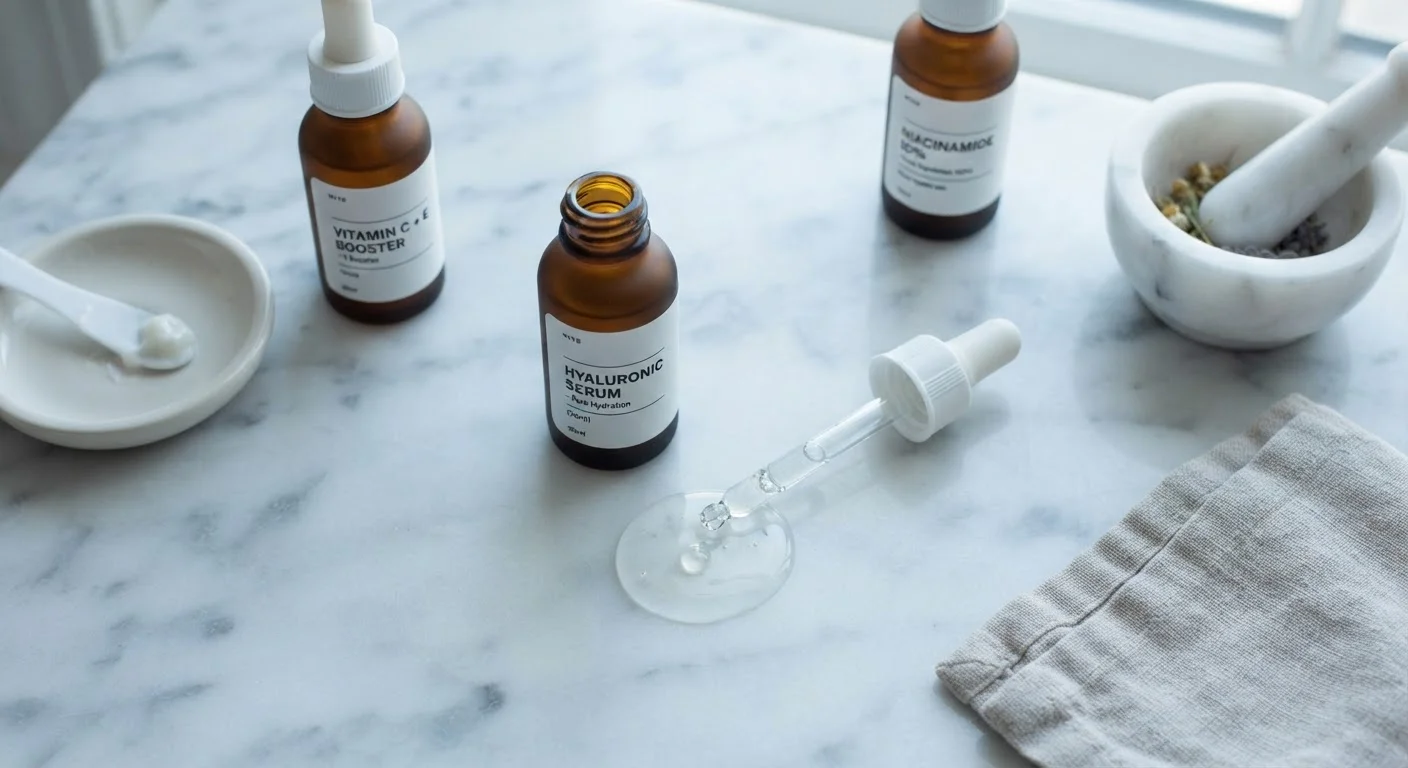
What Makes Something a Humectant?
Before comparing the two ingredients, it helps to understand what a humectant actually does. Unlike emollients (which smooth and soften) or occlusives (which form a barrier to prevent water loss), humectants attract and bind water molecules — drawing moisture from the environment or from deeper skin layers up toward the surface. For a full breakdown of these category terms, see our skincare ingredients glossary.
Both hyaluronic acid and glycerin fall squarely into the humectant category, which is why they're often discussed together. But their structures, origins, and behaviors differ in ways that matter for routine-building.
Not All Humectants Are Equal
Other common humectants include panthenol (vitamin B5), sodium PCA, and honey. Each attracts and retains water differently. Hyaluronic acid and glycerin are simply the two most prevalent in contemporary skincare formulas, which is why comparing them directly is especially useful for label-reading.
How Each Ingredient Works
Hyaluronic acid (HA) is a polysaccharide — a long-chain sugar molecule — that occurs naturally in the body, particularly in connective tissue and skin. In skincare, it's typically synthesized through bacterial fermentation. What makes it distinctive is molecular weight: HA is available in high, medium, and low molecular weight forms. High-weight HA stays near the skin surface, providing immediate surface hydration. Lower-weight fragments penetrate more deeply, delivering moisture to the lower layers of the epidermis.
Glycerin (also called glycerol) is a small, simple alcohol derived from plant oils or as a byproduct of soap manufacturing. Because its molecule is considerably smaller than even low-weight HA, it penetrates readily and distributes efficiently within the skin. Studies have shown glycerin also helps maintain the integrity of the skin barrier by supporting the movement of water through aquaporins — proteins that act as water channels in skin cells.
| Criterion | Hyaluronic Acid | Glycerin |
|---|---|---|
| Molecule type | Polysaccharide (long-chain sugar) | Simple polyol (sugar alcohol) |
| Molecular size | Varies: high, medium, low weight | Very small, single molecule |
| Skin penetration | Depth depends on molecular weight | Penetrates readily and efficiently |
| Water-holding capacity | Up to 1,000× its weight in water | High, but lower than HA |
| Barrier support | Indirect (via surface hydration) | Direct (supports aquaporin function) |
| Typical product format | Serums, essences, ampoules | Moisturizers, cleansers, toners |
| Texture on skin | Lightweight, gel-like | Can feel slightly tacky at high concentrations |
| Sensitivity risk | Low; rare reactions possible | Very low; extremely well tolerated |
Performance in Different Conditions
One practical consideration is climate. Both humectants draw moisture from their surroundings — in a humid environment, this works well. In very dry air, however, they can draw water upward from deeper skin layers instead of the atmosphere, potentially leaving skin feeling drier without an occlusive layer on top. This is why dermatologists commonly recommend applying humectants to damp skin and following with a moisturizer or facial oil to lock in what's been attracted.
Understanding your skin type also shapes how these ingredients perform. To identify which category you fall into and what that means for product selection, our guide to understanding your skin type offers a useful framework.
1,000×
Water weight HA can hold relative to itself
This capacity is cited across peer-reviewed dermatology literature and is a key reason HA is so widely used in hydrating formulas.
~5%
Typical effective glycerin concentration in topical products
Research published in skin barrier studies suggests concentrations around 5% optimize hydration without causing the tackiness associated with higher levels.
3 sizes
Distinct molecular weight categories of hyaluronic acid in skincare
High, medium, and low molecular weight HA act at different skin depths; many multi-weight serums combine all three for broader coverage.
In terms of texture and finish, glycerin can feel slightly tacky at higher concentrations, whereas HA-heavy serums tend to feel lighter and more gel-like. Formulators typically adjust concentrations to minimize these effects in finished products.
How to Layer and Combine Both
The good news: you don't have to choose. Hyaluronic acid and glycerin are highly compatible and frequently appear together in a single formula. When used separately, the general guidance is to apply lighter, water-based serums — often where HA appears — before thicker creams or lotions that may contain glycerin. This is consistent with the broader serum-then-moisturizer approach explained in our article on moisturizer vs. serum layering.
If your routine includes active ingredients like chemical exfoliants, it's worth considering order of application and potential interactions. For context on how exfoliants fit into a routine, see our comparison of chemical exfoliants vs. physical scrubs.
For most people, a straightforward approach works well: apply an HA serum to clean, slightly damp skin, wait for absorption, then follow with a glycerin-containing moisturizer. Finish with SPF in the morning. This simple sequence gives you the layered hydration benefits of both ingredients without complexity.
This article is for general informational and educational purposes only. For personalized skincare advice, particularly if you have a diagnosed skin condition, consult a qualified dermatologist.