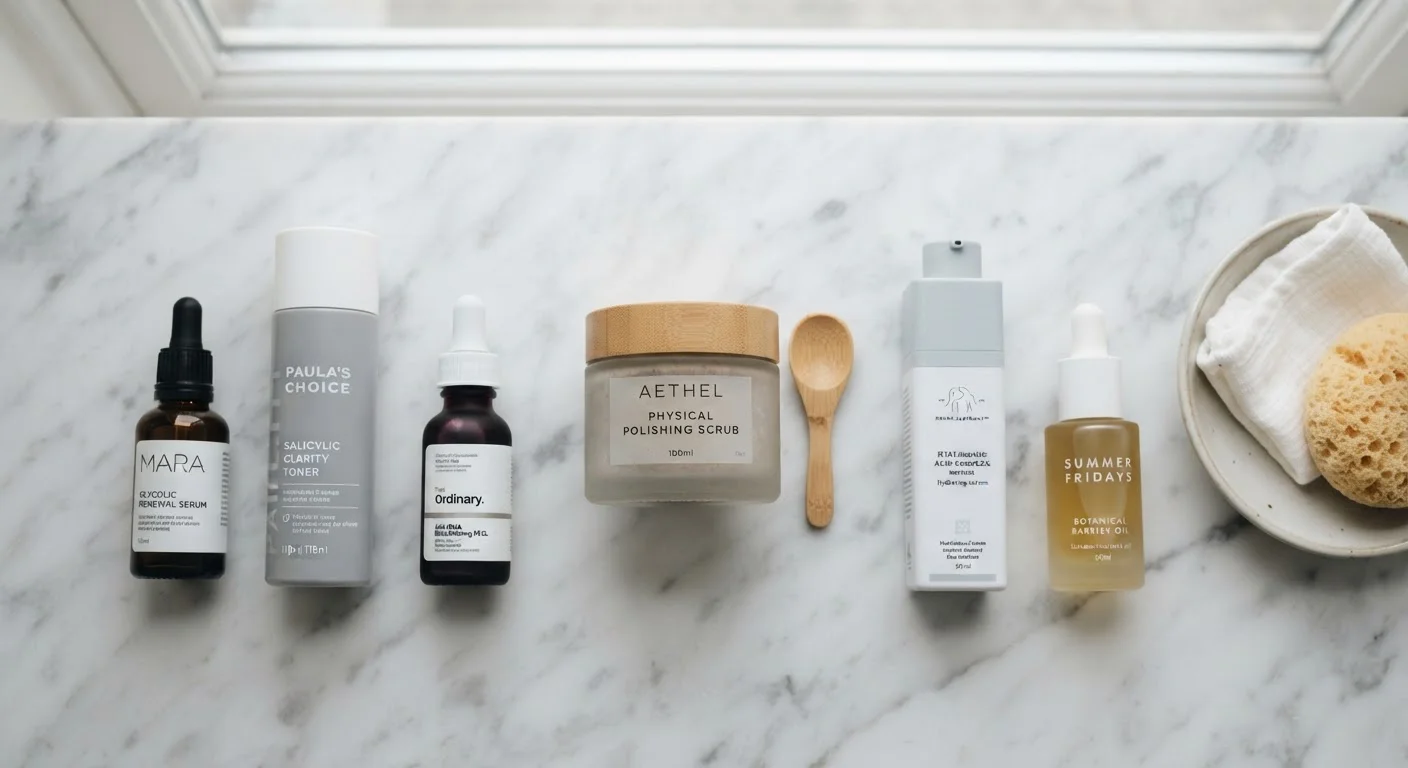
How Each Method Actually Works
Exfoliation accelerates the skin's natural cell turnover process — clearing away dead cells that can dull the complexion, clog pores, and contribute to uneven texture. What separates the two major approaches is how that removal happens.
Chemical exfoliants use acids or enzymes to break the bonds holding dead cells to the skin's surface. The three main categories are:
- AHAs (alpha-hydroxy acids) — water-soluble acids such as glycolic, lactic, and mandelic acid that work primarily on the skin's surface. Most effective for addressing dullness, uneven tone, and fine lines.
- BHAs (beta-hydroxy acids) — oil-soluble acids, most commonly salicylic acid, that penetrate into pores and are particularly effective for oily and acne-prone skin.
- Enzyme exfoliants — typically derived from papaya or pineapple, these digest surface proteins more gently than acids and suit sensitive skin well.
Physical scrubs use abrasive particles — such as sugar, oat flour, or synthetic microbeads — to manually dislodge dead skin cells through friction. The result depends heavily on particle size, shape, and how much pressure is applied during use.
Understanding your skin type is a practical first step before choosing an approach. See our guide to identifying your skin type for a structured starting point.
Comparing the Two Approaches
The table below outlines how chemical and physical exfoliation differ across the criteria most relevant to everyday routine-building.
| Chemical Exfoliants | Physical Scrubs | |
|---|---|---|
| Mechanism | Dissolves dead cell bonds via acids or enzymes | Manually dislodges cells through friction |
| Precision | Consistent, formula-controlled results | Varies with pressure and technique |
| Barrier risk | Low to moderate if used correctly | Higher risk with coarse or irregular particles |
| Best for | Targeted concerns (acne, pigmentation, texture) | Quick surface smoothing, tactile preference |
| Sensitive skin suitability | Enzyme types or low-concentration AHAs | Fine-particle formulas only, used gently |
| Ease of use | Apply and rinse or leave on; minimal technique needed | Requires controlled pressure to avoid irritation |
One key distinction worth noting: physical scrubs deliver results that vary significantly based on technique. Too much pressure or too-coarse a particle can create micro-abrasions in the skin barrier — a concern dermatologists frequently raise about walnut shell or apricot kernel scrubs with jagged, irregular particles.
Not All Scrub Particles Are Equal
Scrubs containing walnut shell powder, apricot kernel, or other jagged-edged particles have been flagged by dermatologists for their potential to create microscopic tears in the skin barrier. These abrasions can worsen sensitivity and increase the risk of infection over time. If you prefer a physical exfoliant, look for products formulated with fine, uniform particles such as rice bran, oat flour, or rounded synthetic beads.
Frequency, Layering, and What to Avoid
Regardless of which method you choose, over-exfoliation is one of the most common — and underrecognised — skincare mistakes. Signs include persistent redness, a tight or stinging sensation, increased breakouts, and a shiny but dehydrated appearance.
2–3×
Maximum weekly exfoliation for most skin types
Dermatological guidelines generally recommend no more than two to three exfoliation sessions per week to preserve the skin barrier.
~28 days
Natural skin cell turnover cycle
The skin naturally sheds and renews its surface cells roughly every four weeks; exfoliation supports this process without replacing it.
General guidance from dermatologists suggests:
- AHAs and BHAs: one to three times per week for most skin types, starting at the lower end
- Physical scrubs: one to two times per week, using light pressure and circular motions
- Never combine both methods in the same session
Layering chemical exfoliants with retinoids, vitamin C, or other actives on the same day raises the risk of irritation considerably. Our article on introducing new skincare ingredients safely covers how to sequence and space actives without disrupting your skin's balance.
Whichever exfoliant you use, applying a broad-spectrum SPF the following morning is non-negotiable — exfoliation increases photosensitivity. For a broader look at habits that quietly undermine a solid routine, see where most skincare routines go wrong.
Start Low and Build Slowly
If you're new to chemical exfoliants, begin with a lower concentration — such as 5% glycolic acid or 0.5–1% salicylic acid — and use it once a week for the first month. This gives your skin time to acclimate before you increase frequency. Patience at the start reduces the risk of irritation and helps you identify exactly how your skin responds.
This article is for informational purposes only and does not constitute medical or dermatological advice. If you have a diagnosed skin condition or ongoing concerns, consult a qualified dermatologist before introducing new exfoliating products.