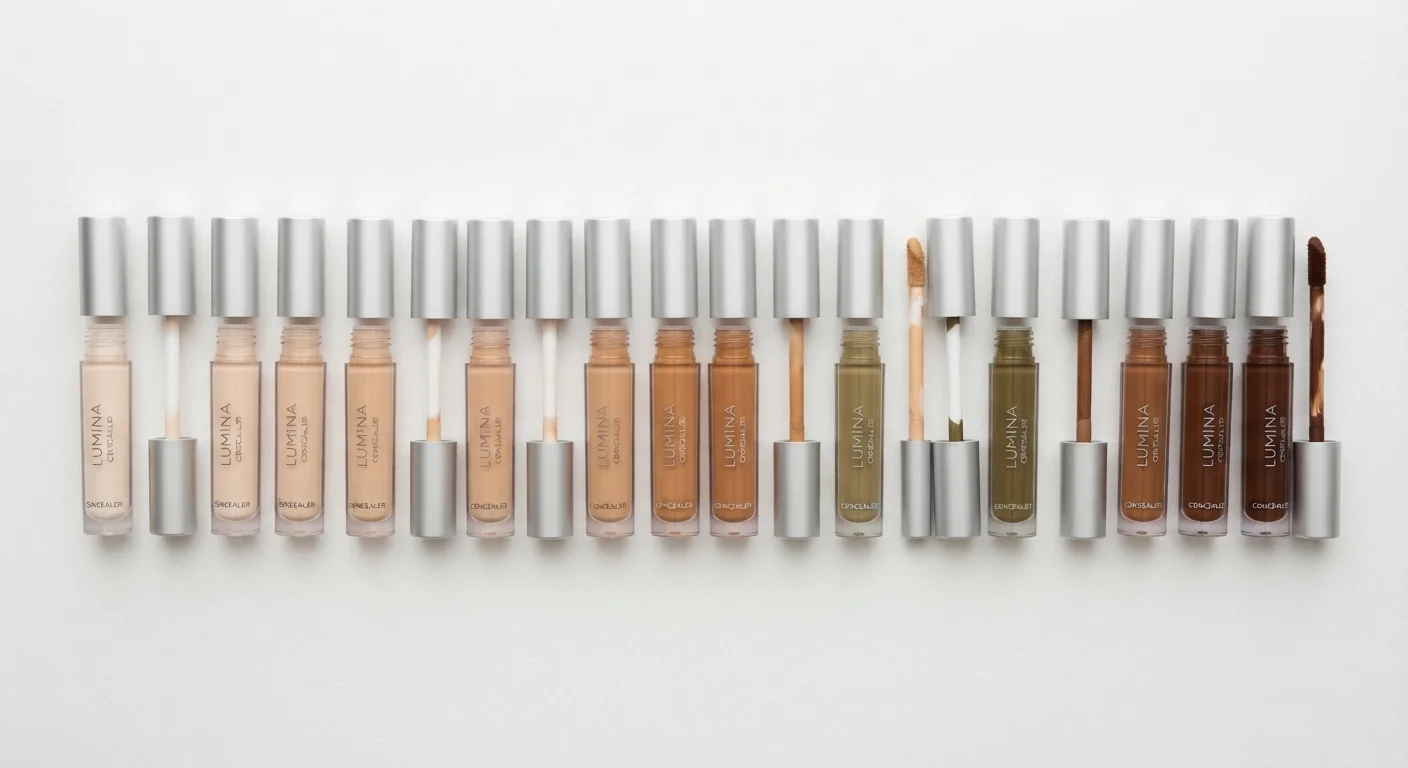
Why Shade and Undertone Are Both Essential
Most concealer frustrations — grayish under-eyes, a patchy finish that won't blend, circles that look darker after application — trace back to a mismatch in either shade depth or undertone. These are two separate variables, and getting only one right isn't enough.
Shade depth refers to how light or dark a concealer is on the spectrum from porcelain to deep ebony. Undertone is the subtle cast beneath your skin's surface: warm (yellow, peachy, golden), cool (pink, red, bluish), or neutral (a balance of both). A concealer can be the right depth but the wrong undertone — and it will still look off.
For general coverage (blemishes, redness, hyperpigmentation), your concealer shade should match your skin tone precisely. For under-eye circles specifically, going one to two shades lighter than your skin tone is a common technique to brighten the area — but the undertone still needs to complement your skin, not fight it. See our guide on base product coverage if you're also weighing how concealer fits into your broader base routine.
| Concealer vs. foundation shade | Concealer for blemishes should match skin exactly; under-eye concealer is typically 1–2 shades lighter |
| Undertone categories | Warm, cool, and neutral — determined by the pigment beneath the skin's surface |
| Most common under-eye concern | Blue-purple circles (vascular), addressed with a peach or salmon color corrector |
| Best testing environment | Natural daylight — artificial lighting distorts both shade depth and undertone |
| Color corrector step | Applied before concealer, not instead of it — corrector neutralizes; concealer covers |
Identifying Your Undertone
Undertone doesn't always match your surface skin color — someone with deep skin can have a cool undertone, and someone with fair skin can run warm. A few practical methods help identify yours:
- Vein test: Look at the veins on your inner wrist in natural light. Blue or purple veins suggest a cool undertone; green veins suggest warm; a mix of both points to neutral.
- Jewelry test: Notice whether gold or silver jewelry tends to look more harmonious against your skin. Gold flatters warm undertones; silver flatters cool; both work well for neutral.
- Sun reaction: Skin that burns easily and turns pink tends toward cool; skin that tans quickly and turns golden tends toward warm.
- White fabric test: Hold a stark white cloth next to your face. If your skin looks rosy or ruddy, you likely run cool. If it looks yellowish or sallow, you likely run warm. If you can't tell, neutral is probable.
Once you've identified your undertone, apply that knowledge to color-correcting as well — the step that happens before concealer. Understanding your personal colour palette can reinforce these instincts across your whole makeup routine.
Undertone
The subtle hue beneath the surface of your skin — typically warm (yellow, golden, peachy), cool (pink, red, bluish), or neutral. Undertone remains relatively constant regardless of tanning or seasonal changes.
Color corrector
A pigmented product applied before concealer to neutralize specific discoloration using complementary color theory. Peach corrects blue-purple; orange corrects deep blue-gray; green corrects redness.
Shade depth
How light or dark a concealer appears on a scale from the palest fair through to the deepest ebony. Shade depth is distinct from undertone and must be matched separately.
Setting powder
A finely milled powder applied over liquid or cream concealer to lock it in place, reduce creasing, and extend wear. Available in translucent and tinted formulations.
Complementary color neutralization
The principle, rooted in color theory, that opposite hues on the color wheel cancel each other out. This is why an orange-toned corrector reduces the appearance of dark blue circles.
The Undertone-to-Concealer Match Reference
Use the table below as a starting lookup. It maps common under-eye concerns and skin undertones to the concealer undertone most likely to work. Remember this is a general reference — individual variation applies, and testing in natural light is always the most reliable method.
| Skin Undertone | Under-Eye Concern | Recommended Concealer Undertone |
|---|---|---|
| Cool (pink/red) | Blue or purple circles | Peach or salmon (color-corrects before a cool-toned concealer) |
| Cool (pink/red) | Redness or general discoloration | Cool-toned or pink-neutral concealer matching skin depth |
| Warm (yellow/golden) | Brown or olive-toned circles | Yellow or golden-undertone concealer, one shade lighter |
| Warm (yellow/golden) | Blemishes or hyperpigmentation | Yellow-toned concealer matching skin depth exactly |
| Neutral | Blue or purple circles | Peach corrector, then neutral concealer one shade lighter |
| Neutral | General coverage | Neutral concealer matching skin depth precisely |
| Deep/cool | Blue-gray circles | Orange or brick corrector, then a deep cool-neutral concealer |
| Deep/warm | Brown circles or hyperpigmentation | Deep warm or golden-toned concealer matching skin depth |
Setting your concealer with a translucent or color-matching powder prevents creasing and extends wear, particularly in the under-eye area. Once your base is complete, a quick makeup check before you head out catches blending issues before they're visible in daylight.
Test Concealers in Natural Light
Store lighting — especially fluorescent — can make a shade appear to match when it actually doesn't. Whenever possible, test concealer near a window or outside before committing to a shade. Apply a small amount to the inner wrist or jawline and allow it to oxidize for a few minutes, as some formulas shift slightly darker after initial application.