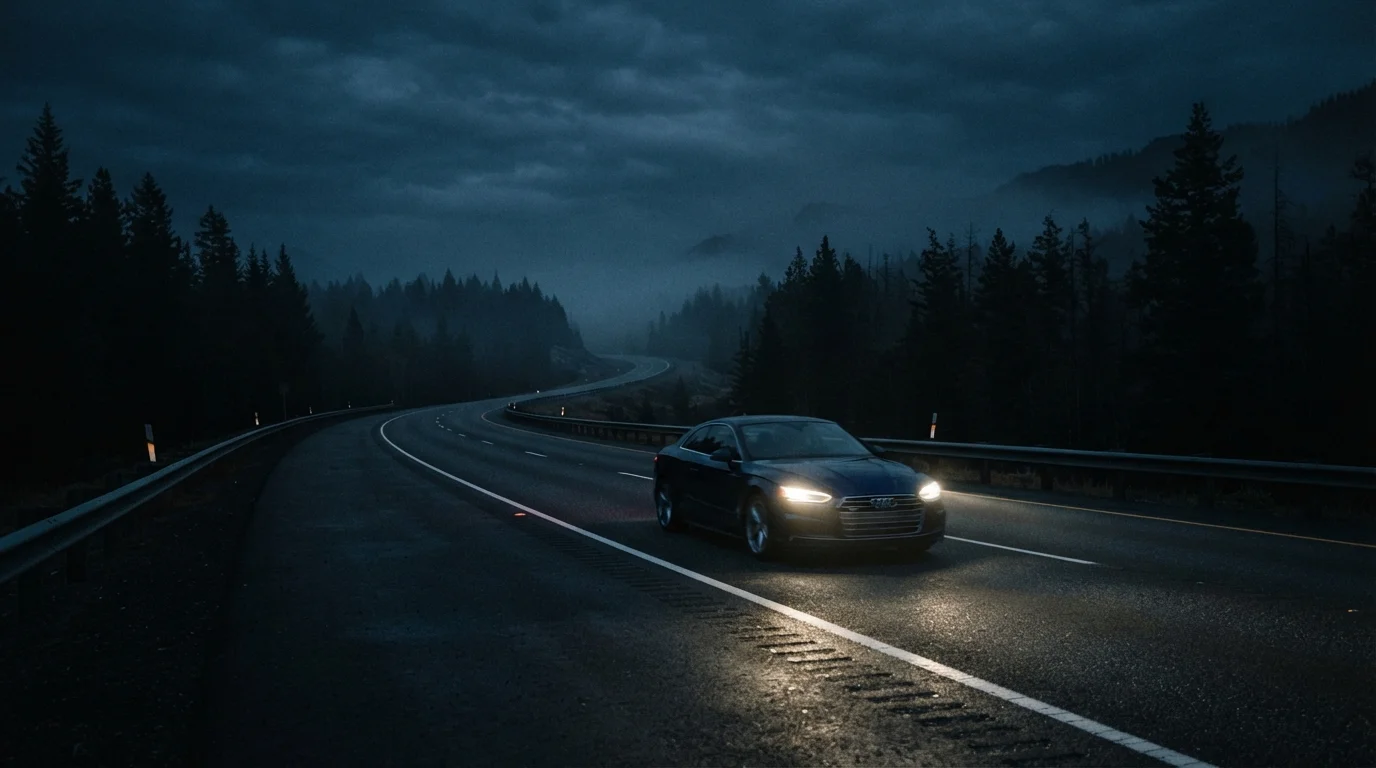
Why Darkness Fundamentally Changes Driving
Driving at night is not simply daytime driving with the lights on. Darkness strips away the visual information drivers rely on constantly — road markings, peripheral hazards, the body language of pedestrians, the texture of the road surface. What remains visible is narrowed to the cone of your headlights, and that cone is smaller than most drivers assume.
The human eye adapts poorly to rapid shifts between light and dark. Glare from oncoming headlights temporarily overwhelms the retina, leaving a period of reduced vision that can last several seconds — long enough to miss a hazard at highway speed. Depth perception and color discrimination also degrade in low light, making it harder to judge how fast another vehicle is approaching or whether a shape on the shoulder is a mailbox or a person.
For a broader look at how road conditions change driver demands, see our guide to reading a road — many of the cues experienced drivers rely on become harder to detect after dark.
Not All Night Driving Is the Same
Urban streets lit by streetlights present different hazards than unlit rural highways. In cities, the risk profile shifts toward pedestrians, cyclists, and complex intersections. On rural roads, the dominant concerns are wildlife, absence of road markings, and limited sight distance. Adjusting your approach based on environment — not just time of day — is part of competent night driving.
The Fatigue Factor: Biology Works Against You
Human alertness follows a circadian rhythm — a roughly 24-hour biological cycle that promotes wakefulness during daylight and sleep at night. Driving during the body's natural low points, typically between midnight and 6 a.m. and again in the early afternoon, impairs performance even in people who feel subjectively alert.
Fatigue affects driving in measurable ways: reaction time slows, lane-keeping becomes inconsistent, and the frequency of attention lapses increases. At its most dangerous, fatigue produces microsleeps — involuntary episodes of unconsciousness lasting a few seconds. At 60 mph, a three-second microsleep means traveling 264 feet with no driver control.
3x
Higher nighttime traffic fatality rate per mile
The National Safety Council estimates nighttime fatal crash rates are roughly three times higher per mile traveled compared to daytime driving.
264 ft
Distance covered in a 3-second microsleep at 60 mph
At highway speed, even a brief involuntary sleep episode means traveling the length of nearly a football field with no driver input.
Up to 50%
Light output lost through dirty or oxidized headlights
Safety researchers have found that degraded headlight lenses can cut usable illumination by half, significantly reducing nighttime sight distance.
Unlike alcohol or distraction, fatigue is particularly insidious because impaired drivers often underestimate how impaired they are. If you notice your eyes feel heavy, you miss an exit, or you can't recall the last few miles, treat it as a warning and stop.
Overdriving Your Headlights: A Common and Serious Error
Standard low-beam headlights typically illuminate the road ahead for approximately 160 feet. At 60 mph, a vehicle requires roughly 240 feet to stop from the moment a hazard is detected — accounting for both reaction time and braking distance. That gap between what you can see and what you need to stop is the core problem described as overdriving your headlights.
The practical implication is straightforward: reducing speed at night isn't about being overly cautious; it's about keeping your stopping distance within your sight distance. High beams extend visibility to around 350–400 feet and should be used on unlit rural roads whenever no oncoming or preceding traffic is present. Switch back to low beams within roughly 500 feet of oncoming vehicles.
Night driving introduces challenges distinct from poor weather. For a comparison of how conditions like rain, fog, and ice alter braking and visibility, see driving in rain, fog, and ice.
Quick Checks Before Driving at Night
Before any nighttime drive, confirm your headlights, taillights, and brake lights are functioning. Clean headlight lenses with a damp cloth if they appear cloudy or yellowed. Adjust your mirrors to reduce glare from following vehicles — most rearview mirrors have a manual night setting. These take under two minutes and meaningfully extend your effective sight distance.
Who Is Most at Risk After Dark?
Pedestrians and cyclists are disproportionately represented in nighttime fatal crash statistics. Many wear dark clothing, and unlike vehicles, they carry no lights that headlights reliably reflect. Animals crossing rural roads pose a similar detection problem — by the time reflective eyes appear in a headlight beam, stopping distance may already be insufficient.
Older drivers face compounding challenges at night. The eye's pupil becomes less effective at dilating with age, reducing the amount of light reaching the retina. Recovery from glare also takes longer. These are physiological realities, not shortcomings — understanding them helps drivers of all ages make better decisions about when and where to drive after dark.
If you're planning a long drive that extends into nighttime hours, preparation matters substantially. Our road trip planning guide covers pre-trip checks and safety habits relevant to extended drives. Similarly, the demands of urban versus motorway driving shift considerably once daylight disappears.