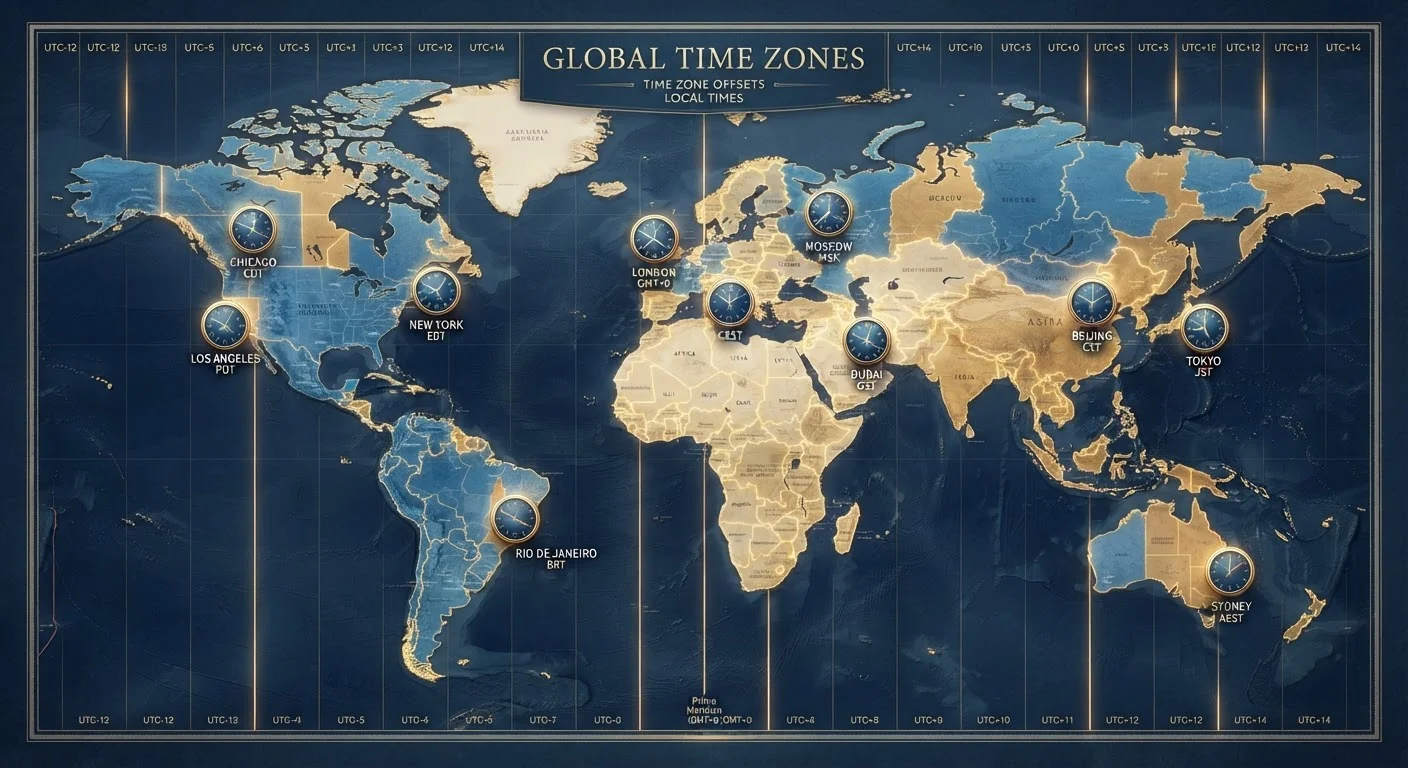
How UTC Works as the Global Reference Point
Every clock in the world is ultimately set relative to a single standard: Coordinated Universal Time (UTC). Think of UTC as the anchor. Local times across the globe are expressed as offsets from it — either ahead (positive) or behind (negative) by a set number of hours or half-hours.
When you see a flight listed as departing at 14:30 UTC+2, that means local time at the departure point is two hours ahead of UTC, so the actual UTC departure time is 12:30. Airlines, air traffic controllers, and military operations commonly use UTC to eliminate ambiguity across borders.
UTC (Coordinated Universal Time)
The primary global time standard used as a reference point for all time zones worldwide. It does not shift for daylight saving time and is effectively the successor to Greenwich Mean Time (GMT).
UTC Offset
The difference, expressed in hours (and sometimes half-hours), between a location's local time and UTC. For example, UTC−5 means the local clock is five hours behind UTC.
Daylight Saving Time (DST)
A seasonal practice of advancing clocks by one hour during warmer months to shift an extra hour of daylight to the evening. Not all countries or regions observe it.
Standard Time
A location's base UTC offset when daylight saving time is not in effect. This is the time observed during autumn and winter months in regions that use DST.
International Date Line
An imaginary line running roughly along the 180° meridian in the Pacific Ocean where the calendar date changes. Crossing it eastward moves you back one day; westward moves you forward one day.
Half-Hour Time Zones
Some regions observe UTC offsets that are not whole hours — for example, India (UTC+5:30), Iran (UTC+3:30), and Nepal (UTC+5:45). These exist for geographic or political reasons.
Understanding UTC offsets is especially useful when scheduling international video calls or calculating layover timing. If you're in New York (UTC−5 in winter) calling someone in London (UTC+0), there is a five-hour gap. Move that same call to summertime when the U.S. is on UTC−4 and the UK is on UTC+1, and the gap narrows to three hours — something that catches many travelers off guard.
For a deeper look at how timing affects your overall travel experience, see the complete trip planning reference.
Daylight Saving Time: What Changes and What Doesn't
Daylight Saving Time (DST) is the practice of advancing clocks by one hour in spring and returning them in autumn. The goal is to align waking hours with natural daylight during longer days. However, adoption is far from universal — most of Asia, Africa, and parts of South America do not observe DST, meaning a country's UTC offset relative to yours can shift by an hour depending on the season.
| Total time zones in use worldwide | Approximately 38–40 (including half- and quarter-hour offsets) (IANA Time Zone Database) |
| Countries that do not observe DST | Most of Asia, Africa, and parts of South America |
| UTC offset range | UTC−12:00 to UTC+14:00 |
| U.S. states that do not observe DST | Arizona (except Navajo Nation) and Hawaii |
| DST transition in the United States | Second Sunday in March (spring forward) and first Sunday in November (fall back) (U.S. Department of Transportation) |
| European DST transition | Last Sunday in March and last Sunday in October |
This seasonal shift creates practical traps for travelers. A flight schedule researched in January may feel different when flown in late March if one country has already switched clocks and the other hasn't yet. Connection times that look comfortable in planning can effectively shrink by an hour due to an offset change neither leg of the itinerary makes obvious.
The body also feels the sudden clock shift more acutely when traveling. Our guide to jet lag and body clock disruption explains why these transitions compound fatigue from long-haul travel.
Verify DST Dates Before You Travel
Daylight saving transitions are set by national or regional governments and can change with little international notice. Always confirm current DST schedules with an official source or a reliable world-clock service close to your departure date. Flight itineraries will reflect local times at origin and destination — double-check connecting times if you're flying around a DST transition weekend.
One important nuance: within a single country, DST observance can vary by state or territory. In the United States, Arizona (with the exception of the Navajo Nation) and Hawaii remain on standard time year-round.
Practical Tips for Managing Time Zones While Traveling
A few habits make navigating time zones significantly easier:
- Set a second clock. Most smartphones allow a second time zone to appear on the lock screen. Keep your home time zone visible alongside local time during the first few days — it helps you stay reachable to contacts back home and gauge meal timing.
- Confirm flight times in local time. Boarding passes display local time at each airport. Confirm whether those local times account for DST before a layover. Our layover planning guide covers connection-time risks in detail.
- Use a world-clock tool for scheduling. When booking meetings or tours across time zones, use a dedicated converter rather than mental arithmetic — half-hour offsets and DST asymmetries make manual calculation error-prone.
- Account for the International Date Line. Flights crossing the Pacific can arrive before they depart — by calendar date. A 10-hour flight leaving Los Angeles on a Tuesday evening may land in Tokyo on Thursday morning. Build this into any itinerary.
Time zone awareness also intersects with planning around seasons and peak travel periods. See how local calendars affect destination conditions in our piece on how seasonality shapes destination choice. Pairing that insight with a firm grasp of UTC offsets makes your day-by-day itinerary far more realistic.
~38
Distinct UTC offsets used globally
The IANA Time Zone Database tracks all active offsets, including fractional-hour zones that complicate simple calculations.
70+
Countries observing Daylight Saving Time
Estimates vary by source and year, as national policies change; verify current DST status for any specific destination.
26 hours
Maximum time difference on Earth at any moment
The span between UTC−12 and UTC+14 means two calendar dates always coexist simultaneously somewhere on the planet.