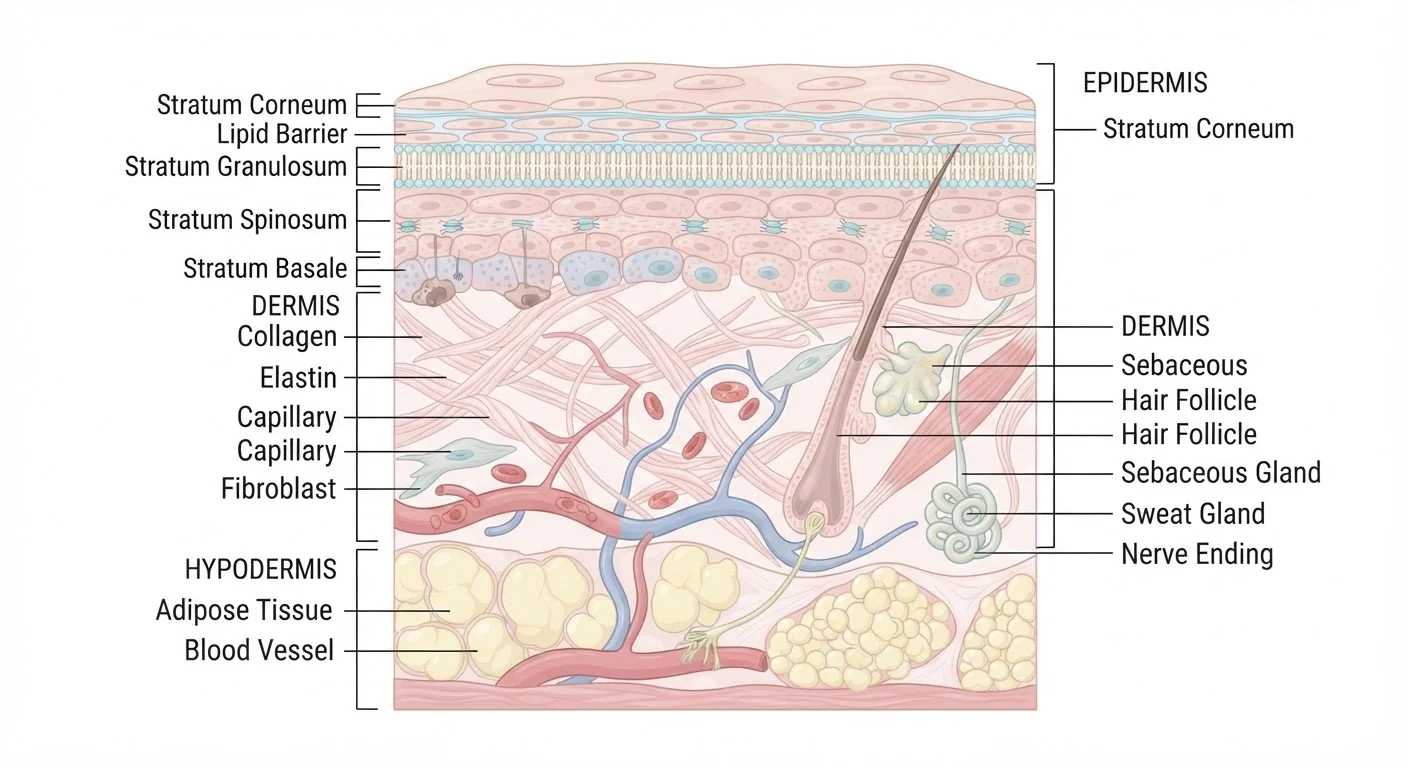
What the Skin Barrier Actually Is
Dermatologists frequently describe the skin barrier using a simple architectural analogy: bricks and mortar. The 'bricks' are flattened, protein-rich dead skin cells called corneocytes. The 'mortar' binding them is a structured mixture of lipids — mainly ceramides, cholesterol, and free fatty acids — secreted by living skin cells beneath. Together, they form a remarkably efficient seal across the surface of the body.
This structure is only about 20 cell layers thick, yet it performs several critical functions simultaneously. It regulates TEWL (transepidermal water loss), meaning it slows the rate at which water evaporates from deeper skin layers. It also acts as a selective filter, blocking pathogens, allergens, and environmental pollutants from penetrating to the living tissue underneath.
It's worth noting that 'skin barrier' is sometimes used loosely to describe broader skin defenses, including the skin's acid mantle — a thin, slightly acidic film on the surface that helps control microbial balance. Both contribute to overall skin resilience.
Barrier Health Varies by Skin Type and Age
Skin barrier function is not uniform. Research indicates that people with darker skin tones may have a denser stratum corneum, while aging skin produces fewer natural lipids, making barrier maintenance progressively more important with age. These differences mean that what constitutes a 'barrier-supportive routine' can vary meaningfully from person to person.
What Disrupts the Skin Barrier
Barrier disruption is far more common than many people realize, and the causes are frequently routine habits rather than underlying disease. Aggressive cleansing is one of the most documented culprits: surfactants that strip natural lipids, hot water that dissolves the lipid mortar, and washing more often than necessary all degrade barrier integrity over time.
Overuse of exfoliating acids (such as AHAs and BHAs) and retinoids — particularly when introduced too quickly or at too high a concentration — can also compromise the barrier by accelerating cell turnover faster than the skin can rebuild its protective layer. This is one reason that common routine mistakes like over-exfoliating quietly undermine otherwise well-intentioned skincare habits.
Environmental factors including low humidity, cold air, UV exposure, and air pollution contribute additional stress. Certain skin conditions — eczema (atopic dermatitis), psoriasis, and rosacea — are characterized in part by structural barrier dysfunction, which is why they're associated with chronic sensitivity and reactivity.
The 'Skin Barrier Reset' Approach
If your skin is suddenly reactive or sensitized, consider a two-week pause on all active ingredients. Stick to a gentle cleanser, a ceramide-rich moisturizer, and broad-spectrum SPF during the day. This simplified approach gives the stratum corneum time to rebuild without ongoing disruption.
How to Support and Repair Your Barrier
The core principle of barrier repair is straightforward: stop removing what the barrier needs, and give it the building blocks to rebuild. In practice, that usually means temporarily scaling back active ingredients — acids, retinoids, vitamin C — and shifting to a simplified routine centered on gentle cleansing and lipid-replenishing moisturizers.
Formulas containing ceramides, fatty acids, and cholesterol in ratios that approximate the skin's own lipid composition are widely used in dermatological practice for this purpose. Occlusive ingredients — such as petrolatum or dimethicone — help by sealing in moisture while the barrier recovers, even though they don't rebuild the structure directly.
~50%
Of skin lipids are ceramides
Research published in dermatology literature indicates ceramides make up roughly half of the lipid content in the stratum corneum, underscoring their central role in barrier structure.
2–4 weeks
Typical barrier recovery window
Dermatologists commonly cite a two-to-four week timeframe for measurable barrier improvement when a simplified, supportive routine is consistently followed.
~28 days
Natural skin cell turnover cycle
Skin cell turnover — the process by which new cells rise to replace old ones — takes approximately four weeks in healthy adult skin, slowing with age.
Hydration matters too, but the mechanism is often misunderstood. Drinking water doesn't directly hydrate the stratum corneum; that layer is already largely composed of dead cells. What matters more is reducing TEWL from within by maintaining a functional lipid matrix.
Once the barrier has stabilized, reintroducing actives slowly and sequentially — as outlined in this guide to product layering — helps prevent re-sensitization.
Why the Skin Barrier Is the Foundation of Every Routine
Every active ingredient — vitamin C, niacinamide, retinol, peptides — depends on a functional barrier to perform as intended. When the barrier is compromised, the skin becomes both more permeable and more reactive: active ingredients may penetrate unevenly, cause irritation, or trigger inflammation that negates their benefits.
This is also why sunscreen matters so directly to barrier health. UV radiation degrades both structural proteins and lipids in the skin, so daily broad-spectrum SPF is one of the most impactful habits for maintaining barrier integrity over time. Our article on evidence-backed sunscreen use covers this in detail.
Understanding your skin barrier also reframes what 'good skin' means. Rather than chasing short-term brightness from aggressive actives, a barrier-first approach prioritizes calm, resilient skin that responds well to a range of conditions — and provides a more consistent canvas for makeup application and everyday life.
This article is for informational and educational purposes only and does not constitute medical or dermatological advice. Consult a qualified healthcare or skincare professional for concerns about your individual skin health.