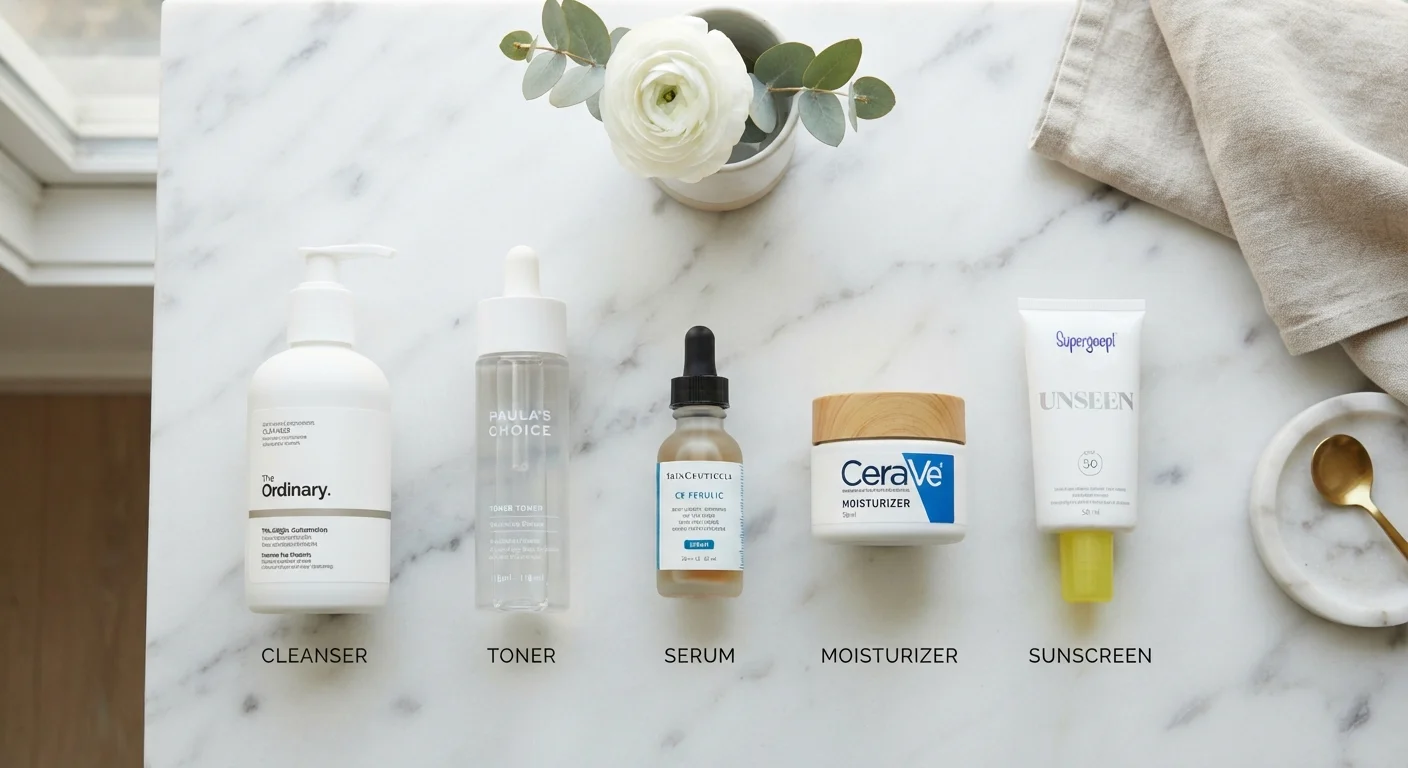
Why Order Actually Matters
Skincare layering isn't a cosmetic industry invention designed to sell more products — there's real science behind the sequence. The skin's outermost layer, the stratum corneum, acts as a selective barrier. Products with small molecules and water-based formulas penetrate this barrier more readily than thick, oil-based ones. When you apply a heavy cream first, you create a film that blocks thinner products from reaching the skin cells where they're intended to work.
The guiding principle is straightforward: apply products from thinnest to thickest consistency. Water-based products go on before oil-based ones. Active ingredients that require direct skin contact — such as chemical exfoliants — are applied early, before anything that could act as a physical barrier between them and the surface.
If you're new to building a routine from scratch, the beginner's guide to skincare routines covers the essentials of what each product category actually does before you start worrying about sequence. And if you want to understand which product textures and ingredients tend to suit different skin types, identifying your skin type is a useful starting point.
The 60-Second Rule for Cleansing
Many cleansers require at least 60 seconds of contact time to work effectively — most people rinse off after just 15. Massaging your cleanser gently for a full minute also primes the skin to absorb whatever comes next. Make it a consistent habit before moving to the rest of your routine.
What You'll Need
You don't need every product category listed below — a minimal routine of cleanser, moisturizer, and SPF is entirely effective. Add steps only as your skin's needs and your comfort with the routine grow.
What you will need
Gentle Cleanser
Removes surface impurities, makeup residue, and excess oil to prep skin for subsequent products.
Toner or Essence
Restores skin's pH balance after cleansing and adds an initial layer of hydration.
Targeted Serum
Delivers concentrated active ingredients — such as vitamin C, niacinamide, or hyaluronic acid — to address specific concerns.
Eye Cream
Applies lightweight, targeted treatment to the delicate skin around the eyes before heavier products.
Moisturizer
Seals in earlier layers, strengthens the skin barrier, and prevents transepidermal water loss.
Facial Oil
Adds a final layer of lipid-rich nourishment; applied after moisturizer but before sunscreen in the AM.
Broad-Spectrum Sunscreen (SPF 30 or higher)
Protects skin from UVA and UVB damage; always the last step in a morning routine.
The Correct Layering Sequence, Step by Step
Follow these steps in order for both your morning and evening routine, noting where certain products apply only to one or the other. Timing matters: if you're layering multiple actives, give each 30–60 seconds to absorb before moving on.
Cleanse your face
Start every routine — morning and evening — with a clean canvas. Use a gentle cleanser appropriate for your skin type and work it in for at least 60 seconds before rinsing with lukewarm water. Hot water can strip the skin barrier; cold water doesn't rinse away oil and product residue as effectively.
If you wear SPF or makeup, consider double-cleansing in the evening: an oil-based cleanser first to dissolve product, followed by a water-based cleanser to remove any remaining residue.
Apply toner or essence (if using)
Toners and essences are optional but serve a real purpose: they help restore the skin's natural pH after cleansing and begin the hydration process. Apply to slightly damp skin using clean hands or a cotton pad, patting gently rather than wiping.
Skip this step if your toner contains exfoliating acids — in that case, treat it as your active step (see Step 3) rather than a base layer.
Apply any exfoliating actives (AHA, BHA, or PHA)
Chemical exfoliants — alpha hydroxy acids (AHAs like glycolic and lactic acid), beta hydroxy acids (BHAs like salicylic acid), and polyhydroxy acids (PHAs) — work best on a clean face with a low-pH environment. Apply before serums and leave on for the time specified by the formulation. Rinse-off and leave-on formulas differ; follow the product instructions.
These actives are typically used 2–3 times per week at most, not daily. Reserve this step for evenings to avoid UV sensitivity during the day.
Apply your serum or treatment
Serums are thin, concentrated formulas designed to penetrate below the surface layer of skin. Apply a pea-sized to dime-sized amount and press gently into skin rather than rubbing. Common serum actives include vitamin C (best in the morning for antioxidant protection), hyaluronic acid (hydration, suitable AM and PM), and niacinamide (barrier support, also versatile across routines).
If you use multiple serums, layer from thinnest to thickest consistency. Allow each layer 30–60 seconds to absorb before applying the next.
Apply eye cream (if using)
Eye creams typically have a lighter texture than facial moisturizers and contain ingredients formulated for the thin, delicate periorbital skin. Apply with your ring finger — the weakest digit — using gentle tapping motions rather than dragging. Dot product along the orbital bone, not directly on the eyelid.
Apply eye cream before moisturizer so it sits close to the skin rather than being applied over a heavier emollient layer.
Apply moisturizer
Moisturizer is the sealing step: it locks in the layers beneath and supports the skin's barrier function. Apply while skin still has some residual moisture from earlier steps — this helps trap hydration rather than just sitting on the surface.
In the evening, a slightly richer moisturizer or an occlusive balm as a final layer (sometimes called "slugging") can support overnight repair. In the morning, choose a lighter formula that pairs well with sunscreen.
Apply sunscreen (morning only)
Broad-spectrum SPF 30 or higher is the final step of every morning routine — applied after moisturizer has had a moment to settle. Use enough product: for the face alone, that's typically a quarter-teaspoon or two finger-lengths of lotion sunscreen. Spreading too little significantly reduces protection.
Mineral sunscreens (zinc oxide, titanium dioxide) can be applied immediately after moisturizer. Chemical sunscreens require approximately 15–20 minutes to bind before sun exposure, so factor that into your morning timing.
Sunscreen Cannot Be Skipped or Buried
SPF is non-negotiable as the final step of your morning routine. Applying anything on top of sunscreen — including moisturizer or facial oil — dilutes the protective film and may compromise its rated effectiveness. If you use a separate facial oil, it goes on before sunscreen, never after.
Common Layering Mistakes — and How to Avoid Them
Even well-intentioned routines go wrong in predictable ways. One of the most frequent errors is applying facial oil too early — oils create an occlusive layer that prevents water-based products applied afterward from penetrating effectively. Oils always go near the end of a routine, after serums and moisturizer but before sunscreen in the morning.
Another common misstep is using incompatible actives in the same session. Where most skincare routines go wrong explores these habits in detail, including the over-exfoliation trap that can compromise the skin barrier over time.
Don't Mix Certain Actives in the Same Routine
Retinoids and exfoliating acids (AHAs, BHAs) can cause significant irritation when used together in the same session. If you use both, alternate them on different nights or follow guidance from a dermatologist. Niacinamide and vitamin C can be used together for most people, but if you notice flushing or sensitivity, separate them into AM and PM routines.
If you're adding a new active ingredient to your existing routine, introduce it slowly rather than layering it in immediately alongside everything else. The guide to introducing new skincare ingredients walks through patch testing and gradual integration. And if you've ever wondered whether your morning and evening routines should differ beyond just the SPF step, morning versus evening skincare differences explains the reasoning behind AM and PM product choices.