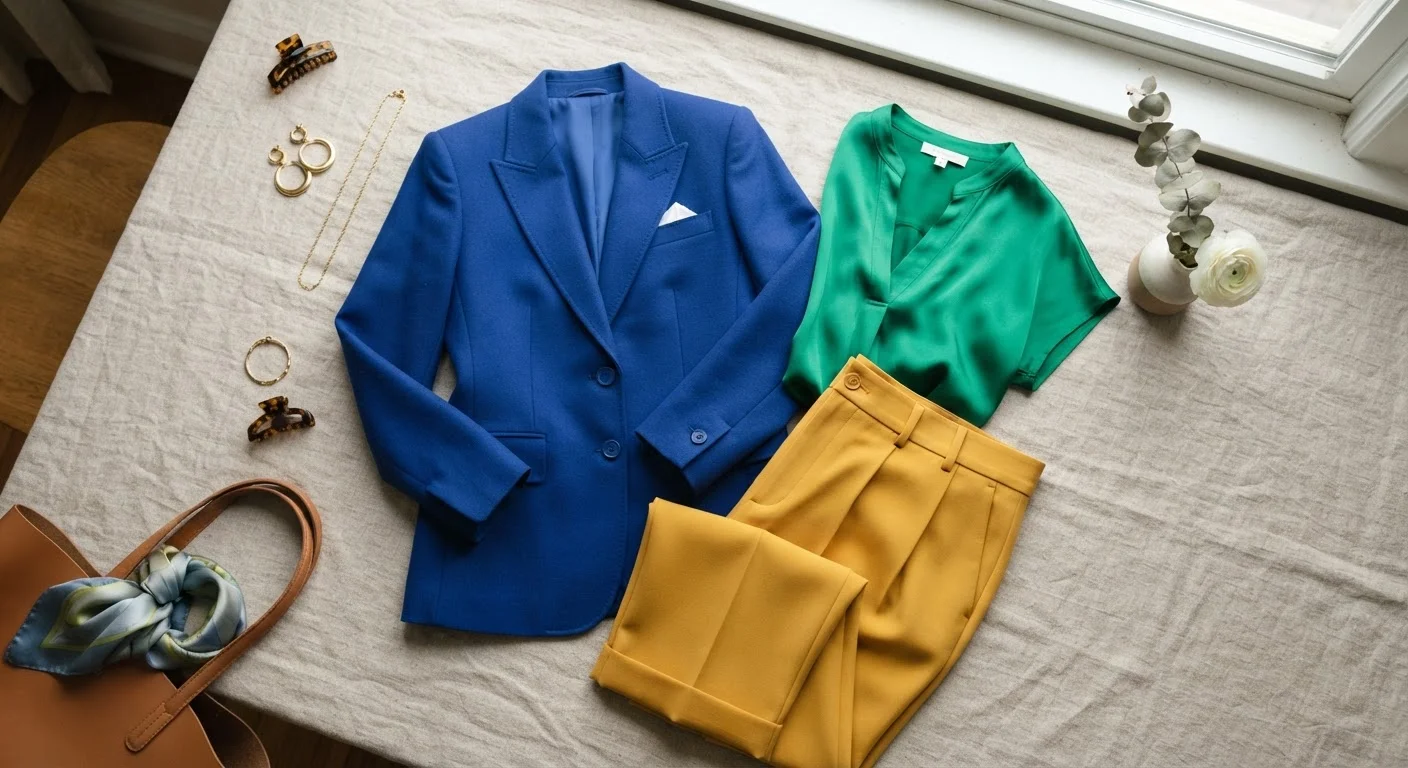
Why Colour Is Worth the Leap
There is something undeniable about a person who walks into a room wearing a rich terracotta coat or a vivid cobalt dress with full conviction. Colour communicates before you say a word. Research in environmental psychology consistently supports the idea that colour influences both the wearer's mood and the perceptions of those around them — though the specific effects vary significantly by cultural context and individual association.
Beyond psychology, colour gives your wardrobe personality. A wardrobe built entirely on black, white, and grey is functional, but it can feel interchangeable. Introducing even a single consistent hue — a signature colour — creates a visual identity that people remember. This is a principle well understood in fashion and branding alike.
Instantly elevates mood and personal energy
Wearing colour you genuinely like can positively influence how you feel throughout the day. While effects vary by individual, the connection between colour and emotional state is well-documented in psychological literature.
Creates a memorable, distinctive visual identity
A signature colour or consistent bold palette makes your style recognisable and intentional. It signals that your wardrobe choices are deliberate rather than default.
Fewer accessories needed to complete an outfit
A bold piece of clothing does the visual heavy lifting on its own, meaning you can build a complete look around it without needing elaborate jewellery or layering.
Encourages creativity and outfit experimentation
Working with colour challenges you to think more actively about how garments interact, which tends to build genuine styling skill over time.
Bold dressing also pairs naturally with the kind of intentional style explored in building a personal style on a limited budget. A single statement piece in an unexpected colour can carry an entire outfit, reducing the need for layering accessories or complex combinations.
The Real Challenges of a Colour-Forward Wardrobe
Committing to bold colour is not without friction. The most immediate challenge is versatility. A vibrant fuchsia skirt is striking — but how many items in a typical wardrobe can it realistically pair with? The fewer the natural combinations, the more deliberate your shopping and outfit planning needs to be.
Reduced outfit versatility and mix-and-match potential
Very bold or unusual colours often pair naturally with fewer other items, meaning you need to plan purchases more deliberately to avoid isolated pieces that rarely get worn.
Trend-driven hues can date quickly
Colours that dominate a particular season can feel noticeably time-stamped within a year or two, reducing the cost-per-wear value of a statement piece built around them.
Context and occasion can limit when bold pieces feel appropriate
Certain workplaces, formal events, or cultural settings carry implicit expectations around dress that may make very bold choices feel jarring or inappropriate, regardless of personal preference.
Requires more thoughtful styling to avoid visual clashes
Combining bold colours without understanding basic colour theory — complementary, analogous, or tonal relationships — can result in outfits that feel chaotic rather than intentional.
Occasion context also matters. Certain professional environments, formal settings, or social contexts carry implicit dress expectations where very bold choices can feel out of place or distracting. This is not about conforming to arbitrary rules — it is about reading the room and deciding when self-expression serves you and when it works against you.
There is also the question of longevity. Trend-driven colours — the "colour of the year" variety — can feel dated within a season or two. This tension between bold dressing and timeless dressing is worth thinking through carefully, especially as explored in the classic versus trendy dressing trade-off.
Colour and Professional Contexts
Dress codes in professional settings vary enormously by industry, region, and workplace culture. What reads as creative confidence in one environment may feel out of place in another. When testing bold colour in a workplace setting, a useful approach is to start with a single coloured accessory or layer rather than a head-to-toe statement look, and observe the culture before committing to a fuller shift. This is general guidance, not a prescription — your own reading of your environment matters most.
Practical Strategies for Wearing Colour with Confidence
Understanding your skin's undertone — whether warm, cool, or neutral — is one of the most useful frameworks for choosing shades that harmonise naturally with your complexion. This is not a rigid rule, but a starting point: warm undertones often feel at home in earthy ambers, olive greens, and rusted reds, while cool undertones tend to align with blues, purples, and jewel tones. Neutral undertones have the most flexibility.
62%
Of people say clothing colour affects their mood
According to a survey conducted by the Colour Marketing Group, a majority of respondents reported that the colour of their outfit influences how they feel on a given day.
90 sec
Time taken to form a first impression via colour
Research cited in the journal Management Decision suggests that colour accounts for a significant share of first impressions formed within the first 90 seconds of an interaction.
If you are new to bold colour, the practical entry point is a single statement item — a coat, a bag, or even a shoe — worn against a neutral base. This limits risk while allowing you to observe how you feel in colour over time. As your confidence builds, you can begin exploring tonal dressing (layering shades of a single colour family) or colour-blocking (pairing two contrasting bold tones deliberately).
It is also worth noting that wardrobe and style needs shift over time. A bold palette that feels right now may evolve — and that is entirely valid, as discussed in the context of adapting your style through major life transitions. Style is not a fixed destination.