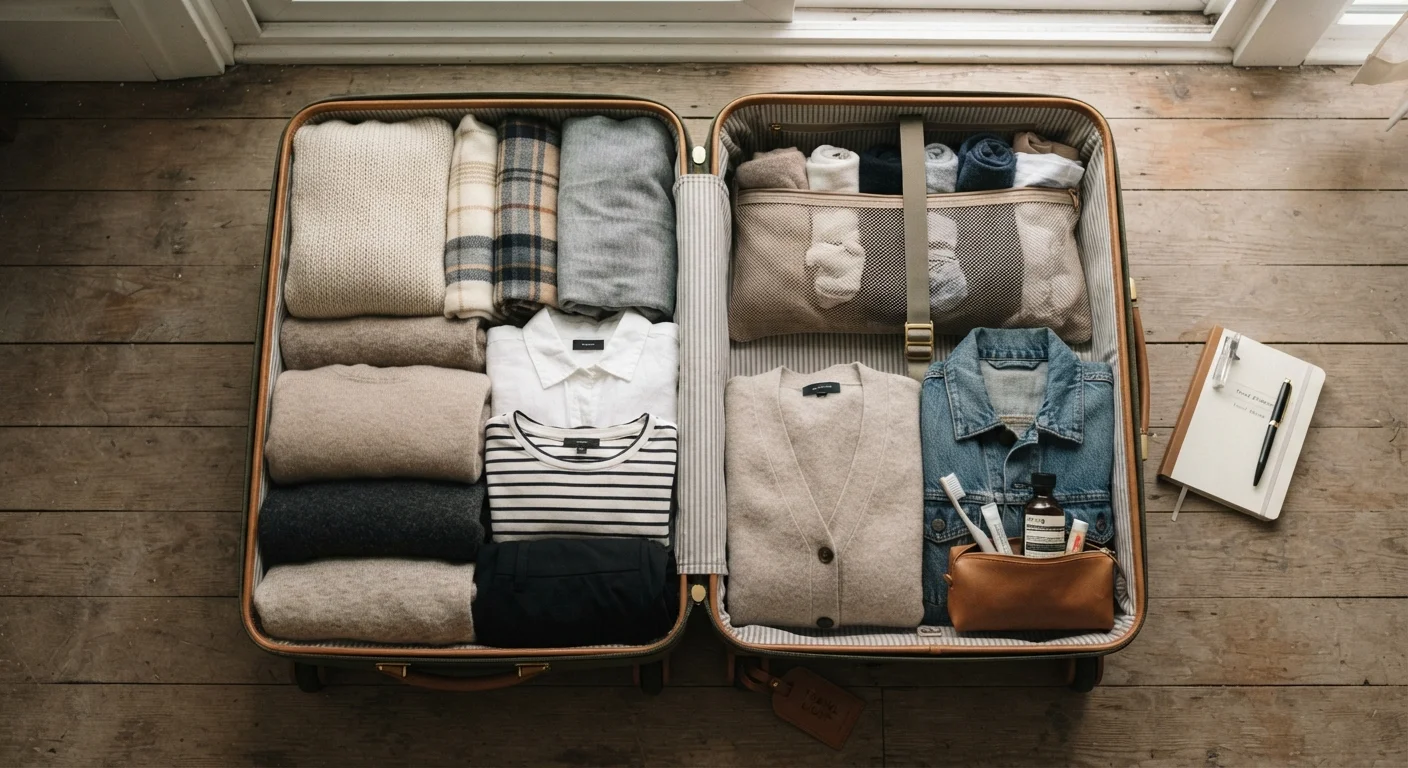
Why a Layering System Works Across Climates
The core challenge of packing for varied climates isn't predicting the weather perfectly — it's building flexibility into your wardrobe so you can respond to what you actually encounter. A layering system solves this by breaking clothing into discrete functional roles: a base that manages moisture, a mid-layer that provides insulation, and an outer shell that handles wind and rain. Each layer can be added or removed independently as conditions shift throughout a single day.
This approach works regardless of destination. Whether you're moving between a cool mountain morning and a warm valley afternoon, or dealing with a city where air-conditioned interiors contrast sharply with humid outdoor heat, having separable layers means you're never stuck overdressed or underprepared. Packing well for varied climates is an integral part of planning any trip thoughtfully.
Verify Climate Conditions Before You Pack
Weather forecasts and historical averages are useful guides, but local climate can be unpredictable. Always check official meteorological sources or destination travel advisories close to your departure date. For trips involving remote terrain, extreme altitudes, or seasonal transitions, consult local experts or official park and tourism bodies for current conditions.
Fabric selection underpins the entire system. Synthetic and merino wool fabrics maintain their insulating properties even when damp, dry quickly, and resist odor accumulation — properties that cotton lacks almost entirely. Choosing the right materials means fewer garments do more work, keeping your bag lighter and your options broader.
What to Pack and How to Assemble Your Wardrobe
What you will need
Before selecting specific items, clarify what your itinerary actually demands. A trip that begins in a temperate coastal city and ends at altitude requires genuinely different planning than a single-climate beach trip. Use your prerequisite research to set firm constraints on volume and function, then build against those constraints.
Packing cubes
Compress and organize clothing by category, making layered outfits easier to access without unpacking everything.
Luggage scale
Verify your bag's weight before departure to avoid airline overweight fees.
Weather reference (official meteorological source)
Determine accurate temperature ranges and precipitation likelihood for your destination dates.
Laundry detergent sheets or travel soap
Enable mid-trip washing, which reduces the total number of garments you need to pack.
Research your destination's climate range
Start with the coldest and warmest temperatures you're likely to encounter across your entire trip. If your itinerary spans multiple destinations or elevations — say, a coastal city followed by a mountain region — identify the full temperature spread rather than averaging it. A 35°F gap between your lowest and highest expected temperature is your design constraint.
Factor in humidity, wind, and rain probability alongside temperature. A 55°F day in a coastal wind is a different packing challenge than a 55°F day in a dry desert interior.
Build a base layer foundation
Base layers regulate body temperature closest to your skin. Choose moisture-wicking fabrics — merino wool and certain synthetics are the most versatile because they handle both warmth and breathability. Merino, in particular, resists odor effectively, meaning pieces can be worn multiple times between washes.
Aim for two to three base layer tops and one to two base layer bottoms. In warmer climates, these often serve as your primary garment; in cold conditions, they anchor the full layering system.
Select mid-layers for insulation
Mid-layers trap heat and bridge the gap between your base and outer shell. A lightweight fleece, a packable down vest, or a knit sweater are all effective options depending on how cold your destination gets. The goal is insulation that compresses well and adds negligible bulk to your bag.
For most mixed-climate trips, one or two mid-layer pieces are sufficient. Choose items that can also function as standalone outerwear in mild weather — doubling roles is the core logic of capsule packing.
Choose an outer layer for weather protection
Your outer layer handles wind and precipitation. A packable rain jacket with a hood is the single most useful outer layer for diverse climates — it packs small, works over all your mid-layers, and provides wind resistance in cool but dry conditions too.
If your destination involves genuine cold (below freezing), consider a heavier insulated shell or a fleece-lined jacket that combines mid and outer functions. For tropical climates with occasional downpours, an ultralight rain shell may be all you need.
Build a neutral-toned capsule of bottoms and tops
Select bottoms and tops in a limited palette — typically two to three neutral base colors (navy, charcoal, tan, black, white) — so every combination works without clashing. A travel wardrobe of 10–15 pieces covering tops, bottoms, and layers can generate far more daily outfit combinations than a randomly assembled 20-piece bag.
Include one slightly more formal option if your itinerary includes dinners, religious sites, or events with dress codes. A versatile dress or tailored trouser can meet these needs without adding significant weight. For further thinking on building cohesive selections, the principles in classic vs. trendy dressing apply directly to travel capsule logic.
Finalize footwear and accessories
Footwear is typically the heaviest and least compressible category. Limit yourself to two to three pairs: a comfortable walking shoe suitable for long days, a sandal or lightweight option for warm evenings or beach settings, and — if conditions demand — a waterproof boot or trail shoe. Wear your bulkiest pair while traveling.
Accessories — a lightweight scarf, a packable hat, gloves for cold-weather trips — dramatically extend your wardrobe's temperature range without taking up meaningful space. A scarf, in particular, functions as a layer, a blanket substitute on flights, and a cover for shoulders in sites requiring modesty.
Plan for laundry to reduce total volume
Building mid-trip laundry into your plan — whether using hotel laundry services, a laundromat, or hand-washing in a sink — meaningfully reduces how many garments you need. Packing travel detergent sheets and choosing quick-drying fabrics makes this practical even for shorter trips.
This approach is especially valuable on extended travel. For a full comparison of how packing logic shifts between short getaways and multi-week journeys, see short trips vs. extended travel.
Test Your Wardrobe Before Departure
Lay out every item you plan to pack and build complete outfits from them. If a piece doesn't combine with at least two other items in your selection, reconsider including it. This exercise consistently reveals redundancies and gaps before they become problems on the road.
Once assembled, your wardrobe should support the full range of your trip activities without requiring purchases at the destination. For travelers also thinking about how their broader personal style intersects with practical travel packing, the framework in a wardrobe audit checklist can help identify which pieces in your existing closet are genuinely travel-ready.
Airline Baggage Rules Vary Widely
Weight limits, carry-on dimensions, and fees differ significantly between carriers and fare classes. Before finalizing your packing approach, confirm current policies with your airline directly. See our carry-on vs. checked luggage guide for a fuller breakdown of the trade-offs.