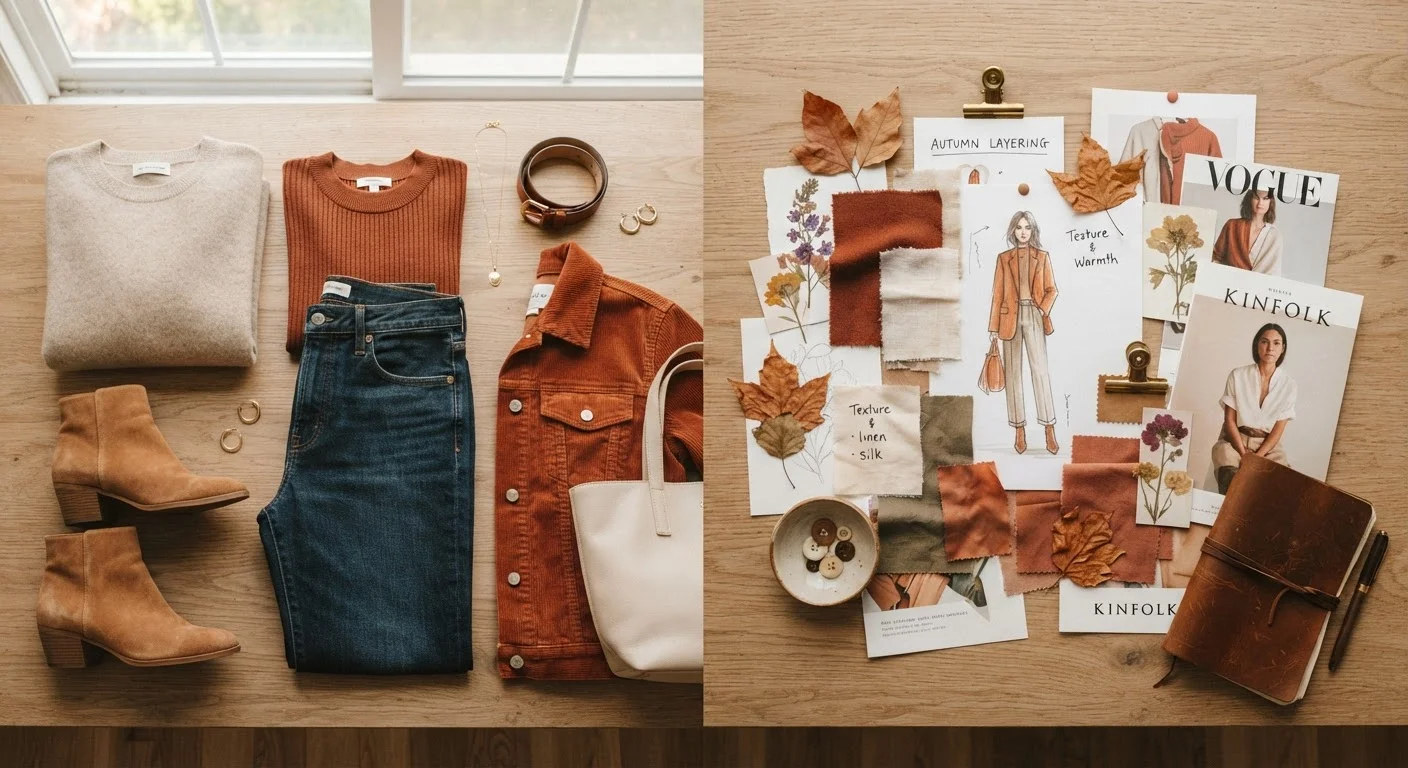
What Each Approach Actually Means
Dressing for your body shape is a proportion-based framework. Its central idea is that certain silhouettes, cuts, and garment structures create visual balance relative to your natural proportions — wide shoulders, a defined waist, or a longer torso, for example. Style guides built around body shape use categories (often named after letters or geometric forms) to suggest which cuts draw the eye toward or away from specific areas.
Dressing for your mood, by contrast, starts with an internal state rather than an external measurement. How do you feel today — energised, soft, powerful, invisible? This approach treats clothing as emotional vocabulary. What you choose to wear becomes a way of communicating something to yourself and others, whether that's confidence, playfulness, or the desire to simply feel comfortable.
These two frameworks aren't inherently in conflict, but they answer different questions. Body-shape dressing asks: What will look balanced on me? Mood-based dressing asks: What do I want to feel like today? Understanding this distinction is the first step toward using each one effectively. If you've ever felt puzzled by why outfits that look objectively right still feel somehow off, see our exploration of what makes outfits feel wrong — it touches on exactly this gap.
The Case for Body-Shape Dressing
Body-shape guidelines became popular because they offer a repeatable system. For someone overwhelmed by choice, knowing that a wrap dress tends to create visual waist definition, or that straight-leg trousers balance a wider hip, gives a useful starting point. This is practical information — not a mandate.
The strongest argument for this approach is consistency. When you understand which silhouettes tend to work with your proportions, getting dressed becomes faster and the results are more predictable. It's especially useful when building a core wardrobe, since it helps you avoid purchasing pieces that look great on a hanger but rarely leave your closet.
| Criterion | Body-Shape Dressing | Mood-Based Dressing |
|---|---|---|
| Primary question | What fits my proportions? | What reflects how I feel? |
| Starting point | Physical measurements and silhouette | Emotional state and intention |
| Consistency | High — repeatable formulas | Variable — shifts day to day |
| Creative flexibility | Moderate — guided by rules | High — few fixed constraints |
| Risk of feeling 'off' | Looks right but may feel hollow | Feels right but may lack polish |
| Best for wardrobe building | Strong foundation for core pieces | Better for expressive accent pieces |
That said, body-shape frameworks have real limitations. The categories themselves are broad and imprecise. Many people don't fit neatly into a single shape, and the guidelines were historically developed with a narrow range of body types in mind. Treating these rules as rigid can create unnecessary self-criticism. They're best approached as one lens among several — not a definitive authority. This parallels the broader question of how we balance structure with personal expression, which also comes up in classic versus trendy dressing.
The Case for Mood-Based Dressing
There's growing recognition in style psychology that how clothing makes us feel matters as much as how it makes us look. Research into what's sometimes called enclothed cognition — a term used in psychological literature to describe how clothing influences the wearer's mental state — suggests that our outfit choices genuinely affect confidence, focus, and self-perception.
Mood-based dressing leans into this. It invites you to check in with your emotional state before reaching for anything and to choose accordingly. Feeling drained? Maybe a soft, oversized layer is more honest than a structured blazer. Feeling bold? A saturated colour or unexpected silhouette can amplify that energy.
57%
Report clothing affects daily confidence
A survey by the American Psychological Association found a majority of respondents said their clothing choices influenced how confident they felt on a given day.
2-in-3
Dress to influence their own mood
Research published in the Journal of Experimental Social Psychology noted that many people consciously or unconsciously select clothing to shift or reinforce their emotional state.
The limitation here is that mood-based dressing without any structural foundation can lead to a wardrobe full of impulse pieces that don't coordinate. It also asks for a degree of self-awareness that takes practice. But as a complement to proportion-based thinking, it adds the dimension that many style frameworks lack: you, as a person with a changing interior life. This becomes especially relevant during periods of personal change — something we explore in depth in our piece on navigating style through life transitions.
How to Use Both Together
The most resilient personal style tends to draw from both frameworks. Think of body-shape principles as the architecture of your wardrobe — they help you identify the cuts and structures worth investing in for your core pieces. Mood-based dressing then operates within that architecture, directing how you layer, accessorise, and make day-to-day choices.
A practical version of this looks like: knowing that high-waisted trousers tend to work well for your proportions (body-shape insight), but choosing between navy, camel, or a printed pair based on how you want to feel that day (mood insight). The structure stays stable; the expression shifts.
For those working within a smaller wardrobe, this integration becomes even more important — every piece needs to both fit well and feel meaningful. Our guide to personal style on a limited budget offers practical approaches for achieving exactly that balance without overinvesting.
A Note on Body-Shape Categories
Body-shape frameworks were developed decades ago and reflect a limited range of body types. Many people don't fit neatly into a single category, and proportions shift over time with age, fitness, and other factors. These guidelines are worth knowing but should be treated as suggestions, not rules — use what's helpful and discard what isn't.
Ultimately, neither framework should make you feel worse about yourself. If a body-shape category feels reductive or a mood-based outfit gets a raised eyebrow in a professional setting, adjust accordingly — and without guilt. Style is a tool. Use it on your terms.