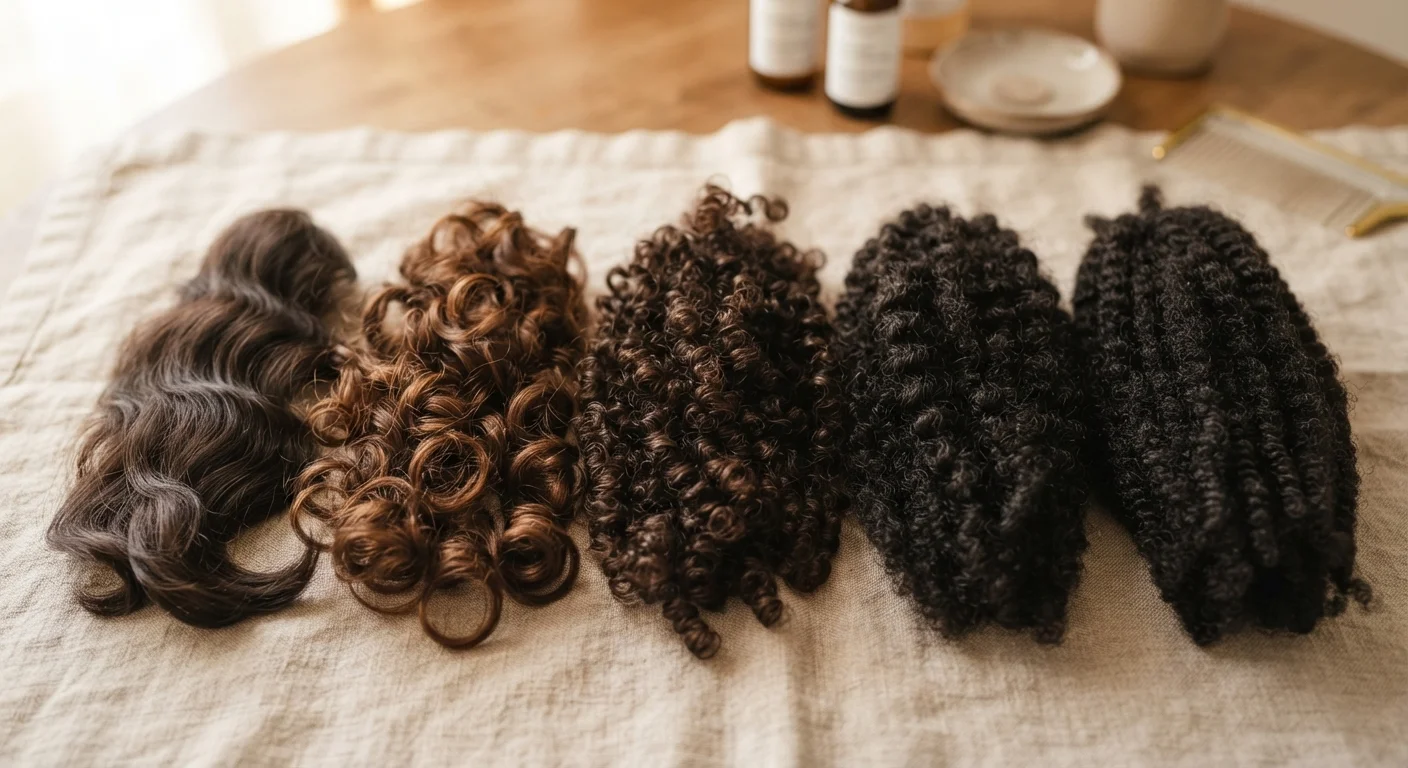
The Curl Classification System, Explained
If you've ever seen a number-letter code on a hair care chart and wondered what it actually means for your strands, you're not alone. The most widely used curl classification system organizes hair into four main types — Type 1 (straight), Type 2 (wavy), Type 3 (curly), and Type 4 (coily) — each subdivided into A, B, and C based on the tightness and diameter of the curl or wave pattern.
This framework, popularized by hairstylists and texture specialists over the past two decades, is a useful starting point — not a rigid rulebook. Most people have more than one curl type on their head, with the nape and crown often behaving differently from the sides.
| Number of main hair types | 4 (Types 1–4) |
| Subcategories per type | 3 (A, B, C) |
| Shrinkage range for Type 4C | Up to 75% of hair length |
| Most common multi-type scenario | Different types at crown vs. nape |
| Key factor alongside curl type | Porosity, density, strand thickness |
Knowing your general type helps you understand how your hair behaves: how it responds to humidity, how quickly it dries, how much moisture it can hold, and which styling approaches tend to work. It's also a practical lens when reading hair care guidance — some advice is highly type-specific.
Breaking Down Each Type
Type 2 — Wavy
Wavy hair (2A–2C) forms a loose S-shape and is the most versatile of the textured types. It tends to be neither fully straight nor tightly coiled, which means it can lean frizzy in humidity. The 2A subcategory produces a fine, barely-there wave; 2B has a more defined S pattern; 2C waves are thicker and begin to spiral at the ends.
Type 3 — Curly
Type 3 hair (3A–3C) forms clear, springy loops. A 3A curl is loose with a wide circumference — roughly the size of a piece of sidewalk chalk. A 3B curl is tighter, more voluminous, and prone to shrinkage. Type 3C curls are densely packed corkscrews with significant shrinkage and a higher tendency toward dryness.
Type 4 — Coily
Coily hair (4A–4C) has the tightest curl patterns and the highest rate of shrinkage — sometimes 50–75% of actual hair length. Type 4A coils have a defined S pattern when stretched; 4B forms a Z-shaped bend with less visible curl definition; 4C has the least visible curl pattern and the most fragility, making gentle handling essential. Many misconceptions about coily hair — including ideas about growth and moisture — are addressed in our piece on natural hair myths.
Curl type
A classification of hair based on the shape and tightness of its natural pattern, ranging from straight (Type 1) to coily (Type 4). Each main type is further divided into A, B, and C subcategories.
Porosity
The hair's ability to absorb and retain moisture. Low-porosity hair resists moisture absorption; high-porosity hair absorbs quickly but loses moisture just as fast.
Shrinkage
The difference between a strand's stretched length and its natural coiled or kinked length when dry. Tighter curl patterns experience more shrinkage, sometimes significantly reducing apparent hair length.
Density
The number of individual hair strands on the scalp. High-density hair appears thick and full; low-density hair may look fine or sparse even with thick individual strands.
Protective styling
Hairstyles that tuck or shield the ends of the hair to reduce breakage and retain moisture. Common examples include braids, twists, and updos.
What Your Curl Type Means for Your Routine
Curl pattern is one factor — but porosity (how well your hair absorbs and retains moisture), density, and strand thickness shape your routine just as much. That said, some useful generalizations hold:
- Wavy hair often benefits from lightweight products that enhance definition without weighing waves down. Heavy creams can cause limpness.
- Curly hair typically needs consistent moisture. Leave-in conditioners and curl creams help maintain definition between washes without stripping natural oils.
- Coily hair requires the most intentional moisture retention. The natural oils produced at the scalp travel more slowly down tightly coiled strands, making regular deep conditioning and protective styling especially worthwhile.
Heat styling is another area where curl type matters. Tighter textures require higher heat settings to achieve straightening, which increases the risk of damage over time. Our overview of heat styling tools covers how to match the right tool to your texture. Similarly, if you color your hair, caring for color-treated strands takes on added nuance when curl pattern affects how the hair processes and retains pigment.
Your curl pattern is also worth thinking about when choosing a cut. Curly and coily hair behaves very differently when dry versus wet, and the relationship between face shape and hairstyle shifts depending on how much volume your natural texture adds.
Curl Type Is a Starting Point, Not a Label
The classification system is a practical tool, not a definitive identity. Hair texture can shift with hormonal changes, health factors, chemical processing, and even seasonal climate shifts. Use your curl type as a guide for understanding your hair's tendencies, and adjust your routine based on how your hair actually responds over time.