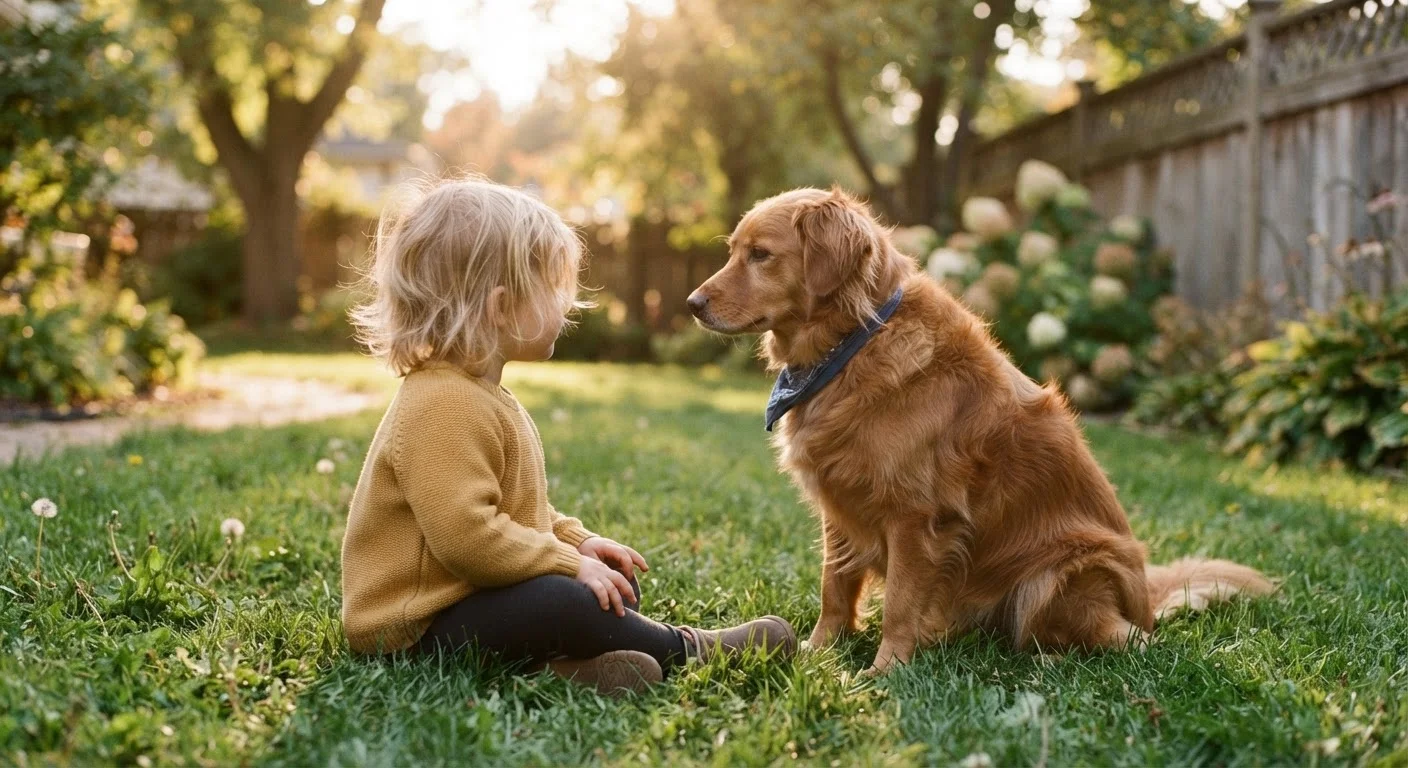
Why Children and Animals So Often Misunderstand Each Other
Children are natural empathizers — they project feelings onto stuffed animals, cartoon characters, and the family dog with equal enthusiasm. That same warm instinct can backfire around real animals. When a dog holds perfectly still while being hugged, a child reads it as contentment. The dog is almost certainly communicating something far more complicated.
This isn't a failure of care or intelligence. It's a developmental pattern. Young children process the world in deeply human terms, and they haven't yet built a mental library of what non-human communication actually looks like. The result is a gap between what an animal is expressing and what a child believes they're seeing — a gap that safety habits built early can meaningfully close.
Most Bites Happen in Familiar Settings
According to the American Veterinary Medical Association, the majority of dog bites to children involve a dog the child knows — often a family or neighbor's dog in a home environment. Unfamiliar dogs in public are not the primary risk. This is why teaching signal recognition at home, with a pet the child trusts, is so valuable.
The Signals Children Get Wrong Most Often
Understanding the specific misreadings that happen most frequently helps parents know exactly where to focus. Here are some of the most common:
- Wagging tail = friendly dog. In reality, tail wagging signals arousal. A stiff, high, slow wag paired with a tense body is a warning sign — not an invitation.
- Exposed belly = wants a rub. A dog that rolls over may be offering a submissive or appeasement gesture, not requesting touch. Reaching in can startle them.
- Cat approaching = wants affection. Cats sometimes approach out of curiosity and then feel cornered. A twitching tail and dilated pupils mean they've had enough, even if they walked over first.
- Stiff posture = playing statue. Freezing is often a stress response in both dogs and cats. Children sometimes interpret this stillness as calm or playfulness.
- Yawning or lip licking = sleepy or hungry. These are well-documented calming signals in dogs, indicating anxiety or overstimulation — not tiredness.
For a deeper look at how pets signal stress across species, reading the signs pets give when uncomfortable is a helpful companion resource.
~50%
Children bitten by a dog before age 13
The American Veterinary Medical Association estimates roughly half of children experience a dog bite before their teenage years, with young children at highest risk.
77%
Bites from known dogs, not strangers
Research cited by the AVMA indicates the large majority of dog bites to children involve a familiar dog, underscoring the importance of home-based safety education.
Under 10
Age group most prone to animal signal misreading
Child development researchers note that children younger than 10 are significantly more likely to anthropomorphize animal behavior and miss stress signals.
How to Build Body Language Literacy with Your Child
The good news is that animal body language is teachable — and some of the best lessons happen in ordinary moments at home. Narration is one of the most effective tools parents have. When your cat tucks her ears back or your dog starts yawning repeatedly during a play session, say it out loud: "She's telling us she needs a break right now."
A few practical approaches that work well across different ages:
- Observe before touching. Build the habit of pausing and watching an animal's posture before any interaction. This alone reduces impulsive approaches dramatically.
- Name the signal, name the need. Match what you see to a simple need: "Those flat ears mean she wants quiet." Concrete language helps young children remember.
- Practice with your own pet. Familiar animals are safer learning environments than unknown ones. Use calm, supervised sessions to point out real-time cues.
- Let the animal choose. Teach children to extend a hand and wait, rather than reaching toward an animal. If the pet moves away, that's a complete answer.
Make 'Reading the Pet' a Daily Habit
A simple routine of asking 'How is our pet feeling right now?' at different points in the day helps children internalize observation as a habit rather than a one-time lesson. Keep it playful and low-pressure — the goal is curiosity, not a quiz. Over time, children begin noticing signals automatically.
These habits connect directly to the larger picture of how growing up with animals shapes children — building empathy alongside safety awareness creates lasting benefits.
Why This Matters Beyond Bite Prevention
Teaching children to read animal signals isn't only about preventing injuries — though that matters enormously. It's also about cultivating a form of empathy that extends beyond the family pet. Children who learn to observe carefully, interpret signals charitably, and respect a creature's limits carry those skills into human relationships too.
For families preparing to approach unfamiliar animals, teaching children to interact safely with unfamiliar animals builds on this foundation with specific, evidence-informed principles. And for parents curious about the broader developmental picture, the science behind growing up with animals offers a nuanced look at what research really shows.
The goal isn't to make children fearful of animals — it's to help them become confident, respectful companions to the creatures they love.
“Children who learn to observe and respect animal communication develop a kind of attentiveness that serves them well far beyond the family home. It's empathy made visible.”
— Dr. Gail Melson, Developmental psychologist and author on children and animals
This article is for general educational purposes only and is not a substitute for professional guidance from a certified animal behaviorist, veterinarian, or child development specialist.