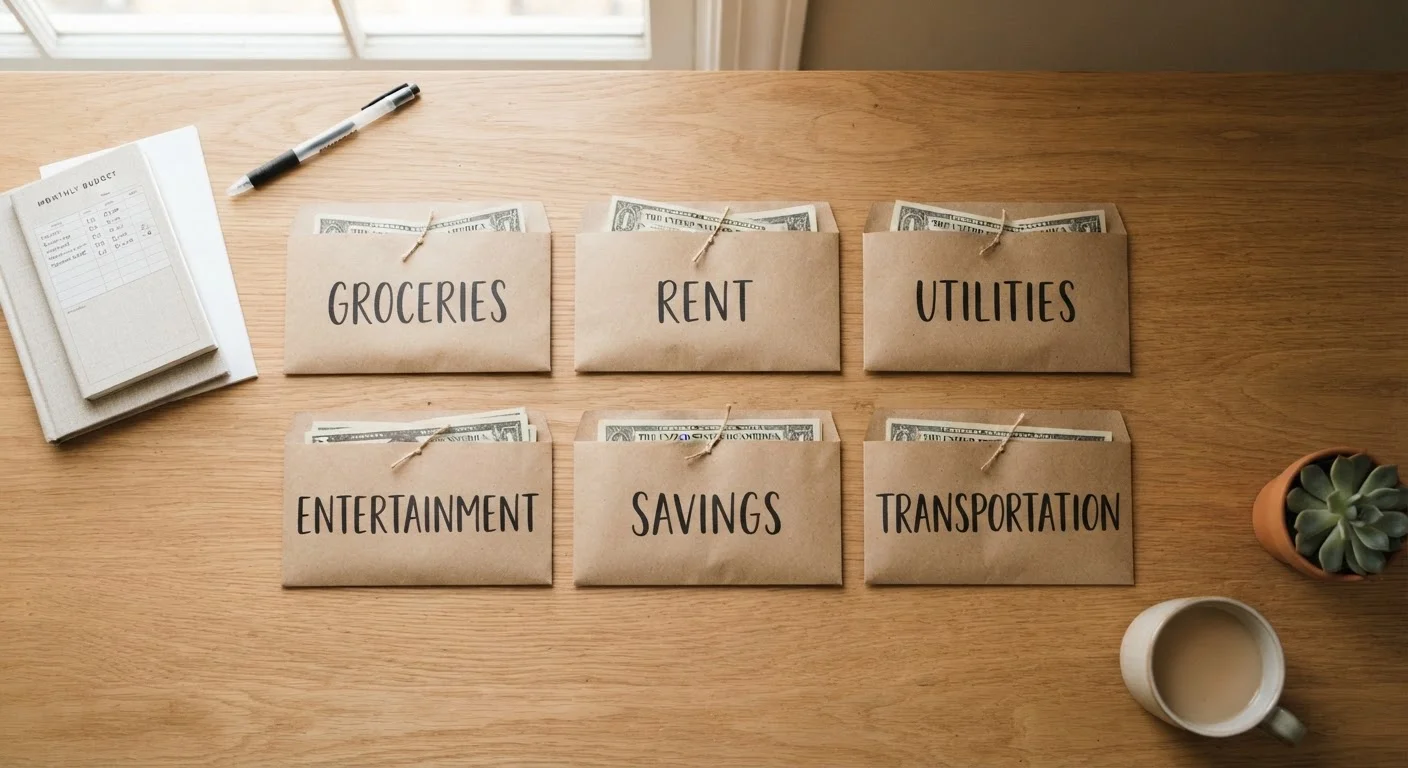
The Core Idea Behind Envelope Budgeting
At its foundation, envelope budgeting is about pre-commitment. You decide before the month begins how much money goes toward each spending category, and once that allocation is used up, you don't spend more in that area. Traditionally, this meant withdrawing your paycheck in cash and physically distributing it into labeled envelopes — one for groceries, one for gas, one for eating out, and so on.
The brilliance of the original method isn't complicated: it makes limits visible. You can't accidentally overspend on takeout if there's literally no more cash in that envelope. The constraint is real, physical, and immediate.
To set one up, most financial educators suggest starting by identifying your core spending categories — fixed expenses like rent, then variable ones like groceries, personal care, and entertainment. Each category becomes its own envelope, funded with a set dollar amount each pay period.
Start With Just Three or Four Envelopes
New to the method? Resist the urge to create an envelope for every conceivable category. Most financial educators recommend starting with three to four high-impact variable categories — such as groceries, dining out, and personal spending — and adding more only once the habit feels natural. Complexity is one of the most common reasons people abandon budgeting systems early.
Why It Still Works in a World of Debit Cards and Apps
The U.S. is increasingly cashless. Carrying physical envelopes to the grocery store is impractical for many people. Yet the envelope method hasn't disappeared — it has evolved. Today, the majority of people who use this system do so digitally, recreating the same principle with different tools.
Common digital adaptations include:
- Multiple checking accounts: Opening separate accounts for different spending buckets — one for groceries, one for discretionary spending — and funding each with a set transfer at the start of the month.
- Budgeting apps: Several apps are built specifically around envelope-style logic, allowing users to create virtual envelopes and track spending against each limit in real time.
- Spreadsheet tracking: A manually updated spreadsheet where each category has a running balance that decreases with every transaction.
The mechanics change, but the behavioral effect is similar: spending feels bounded. Knowing your dining envelope has $47 left creates a pause before booking a restaurant reservation that doesn't exist when you're simply watching a credit card balance.
65%
Americans without a detailed household budget
Gallup polling has consistently found that a majority of U.S. adults do not maintain a detailed monthly household budget, highlighting the gap the envelope method aims to close.
~$1,000
Average monthly discretionary spending per U.S. consumer
Bureau of Labor Statistics Consumer Expenditure data shows that discretionary categories — exactly where envelope budgeting is most impactful — represent a significant share of typical household outflow.
Strengths and Honest Limitations
Envelope budgeting is particularly effective for people who find abstract budget spreadsheets easy to ignore. The method's strength is its concreteness — every category has a hard stop, and running out of funds is immediately apparent rather than discovered on a statement weeks later.
It also pairs naturally with consistent spending tracking, since the system requires you to actively engage with where money is going.
Envelope Budgeting and Automation Don't Always Mix
If you rely heavily on automatic payments and transfers, the envelope method requires an extra layer of awareness. Automated spending can quietly drain a digital envelope without the same psychological friction the system is designed to create. Understanding what automation helps and what it obscures is worth exploring — see our piece on the pros and cons of automating your budget.
That said, envelope budgeting has real limitations worth acknowledging:
- Variable income: If your paycheck fluctuates, determining envelope amounts each cycle requires more effort and judgment.
- Irregular expenses: Annual costs like car registration or a dentist visit don't fit neatly into monthly envelopes. Many practitioners create a dedicated irregular-expenses envelope funded gradually throughout the year.
- Discipline required: The system only constrains spending if you honor the limits. Digitally, it's easy to transfer between accounts and rationalize exceptions.
For a broader look at how envelope budgeting compares to other structured approaches, exploring alternative budgeting frameworks can help you find the right fit for your habits and income structure.
This article is for general informational purposes only and does not constitute personalized financial advice. Consider consulting a qualified financial professional for guidance specific to your situation.