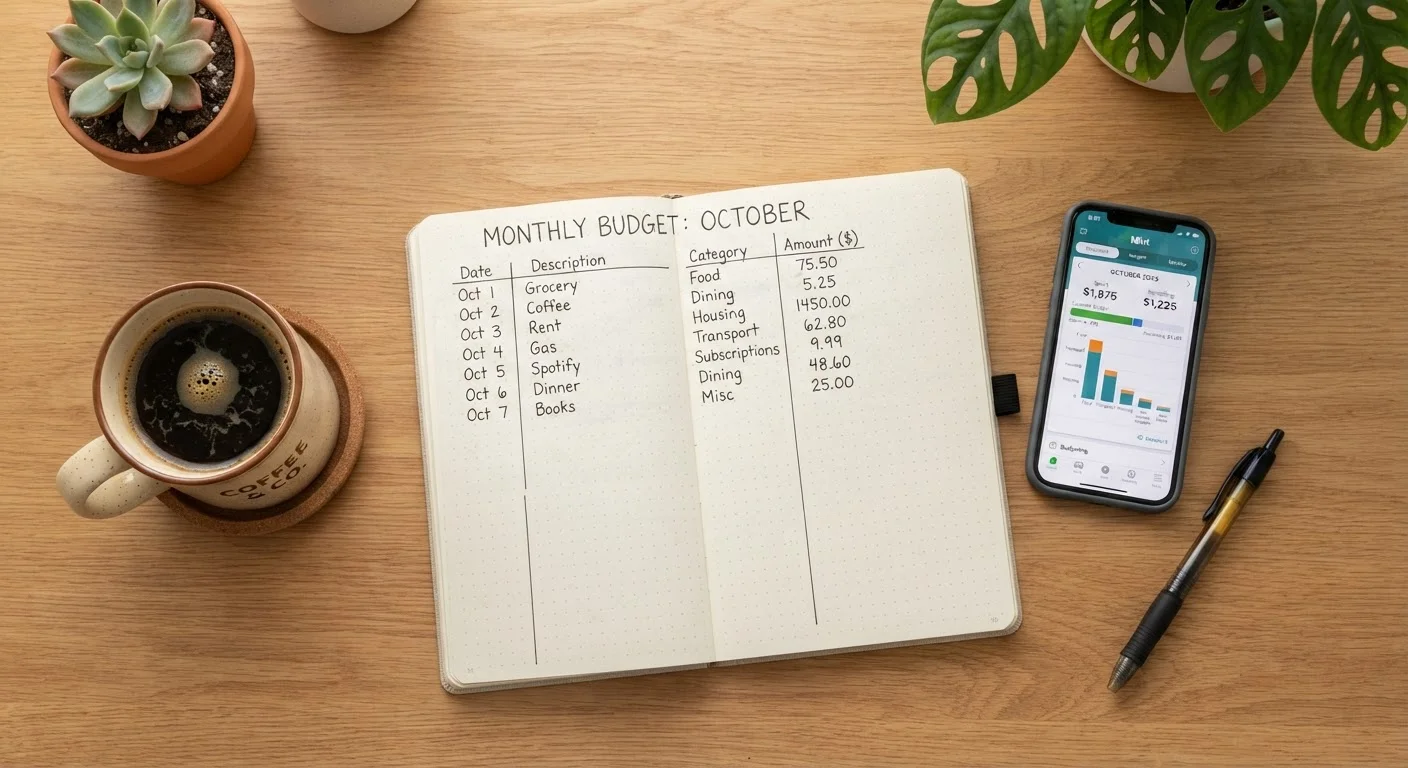
Why Spending Tracking Fails — and How to Avoid That
Most people who try to track their spending quit within a few weeks. The usual culprits: the system is too complicated, too time-consuming, or it makes every small purchase feel like a moral failure. None of that is necessary.
Effective spending tracking is simply the practice of recording where your money goes consistently enough to reveal patterns. It's the engine behind any working budget — without it, you're making decisions with incomplete information. If you've ever wondered why your account balance doesn't match what you thought you spent, tracking is the answer.
Before building your system, it helps to understand what you're categorizing. Our spending categories reference guide outlines how to group common expenses, from housing and groceries to subscriptions and irregular costs.
What you will need
Setting Up Your Tracking System
The right tracking method is the one you'll actually use. Below are the three most common approaches — pick one and commit to it for at least 30 days before evaluating whether it works for you.
Pen and notebook (or paper ledger)
Records expenses by hand at the moment of purchase — the highest-friction but most mindful option.
Spreadsheet (e.g., a free template in Google Sheets)
Allows flexible categorization, running totals, and month-over-month comparison with moderate effort.
Budgeting or expense-tracking app
Syncs with bank accounts to auto-import transactions, reducing manual entry — useful if you spend primarily on cards.
Choose one method and set it up in under ten minutes
Don't spend days evaluating tools. Pick a notebook, open a spreadsheet, or download a free budgeting app — whatever requires the least setup friction for you. Create a simple structure: columns or sections for date, amount, merchant, and category. That's enough to start.
Define five to eight spending categories that reflect your real life
Generic category lists rarely fit anyone perfectly. Use common anchors — housing, transportation, groceries, dining out, subscriptions, personal care, savings, miscellaneous — then adjust to match how you actually spend. Fewer broad categories are easier to sustain than many narrow ones. You can always split a category later if you need more detail.
Log every transaction as close to real time as possible
The biggest enemy of accurate tracking is memory. Receipts pile up, card statements blur together, and small cash purchases disappear. Make logging a micro-habit: record a purchase before you leave the parking lot, right after checkout, or during a two-minute daily log each evening. For card spending, setting up transaction alerts from your bank can serve as a real-time prompt to log.
Do a five-minute weekly check-in
Every week, total what you've spent in each category and compare it to your planned budget. This weekly pulse check stops overspending from snowballing — catching a category that's running hot with two weeks still left in the month gives you time to adjust. Note any unusual or irregular expenses that may not repeat next month.
Close out each month and carry the lessons forward
At the end of each month, total every category and compare actual spending to your plan. Identify the one or two categories that surprised you most — either over or under budget. Use those findings to refine your category allocations for the following month rather than restarting from scratch. Tracking improves with time because your data gets richer and your estimates get sharper.
Once you have a rhythm, you may wonder whether automating parts of the process makes sense. Automation can reduce friction — but it also creates blind spots. For a balanced look at that tradeoff, see our piece on the pros and cons of automating your budget.
Turning Records into Useful Insights
Logging expenses is only half the work. The other half is reviewing them often enough to act on what you find. A quick five-minute check at the end of each week — comparing what you've spent to what you planned — is far more effective than a once-a-month scramble.
When you do your monthly review, a structured checklist keeps the process from feeling overwhelming. Our monthly budget review checklist walks through exactly what to look for and why it matters.
Consistency Beats Perfection Every Time
A tracking system you use imperfectly for six months will teach you far more than a perfect system you abandon after three weeks. Missing a day or misclassifying a purchase isn't failure — it's normal. The goal is a sustainable habit, not a flawless ledger. Give yourself permission to keep going even when your records aren't pristine.
Don't Let Tracking Become a Source of Shame
Spending data is information, not a verdict. If your numbers reveal patterns you'd like to change, that awareness is useful — but approaching every review as a reckoning will make you dread the process and eventually stop. Treat your records the same way you'd treat a health journal: as neutral data that helps you make better-informed decisions going forward.
Spending tracking also travels well. If you're planning a trip, the same habits that keep your everyday budget honest will protect your travel budget too — see building a travel budget that actually holds up for a framework built around real costs.
This article is for general informational and educational purposes only. It does not constitute personalized financial advice. For guidance tailored to your individual situation, consider consulting a qualified financial professional.