What a Service Book Actually Contains
A vehicle service history is a running log of every scheduled maintenance visit a car has received. Whether it takes the form of a physical booklet with stamps and signatures or a digital record held by a dealership network, it answers one central question: has this car been cared for according to the manufacturer's schedule?
| Service book formats | Physical stamped booklet or digital manufacturer record |
| Typical service interval | Every 5,000–10,000 miles or 12 months (whichever comes first) (Varies by manufacturer and model) |
| Key data per entry | Date, mileage, work performed, stamp or signature |
| VIN lookup availability | Most franchised dealers can retrieve digital records by VIN |
| Independent garage records | Paper-based; invoices and receipts serve as supporting evidence |
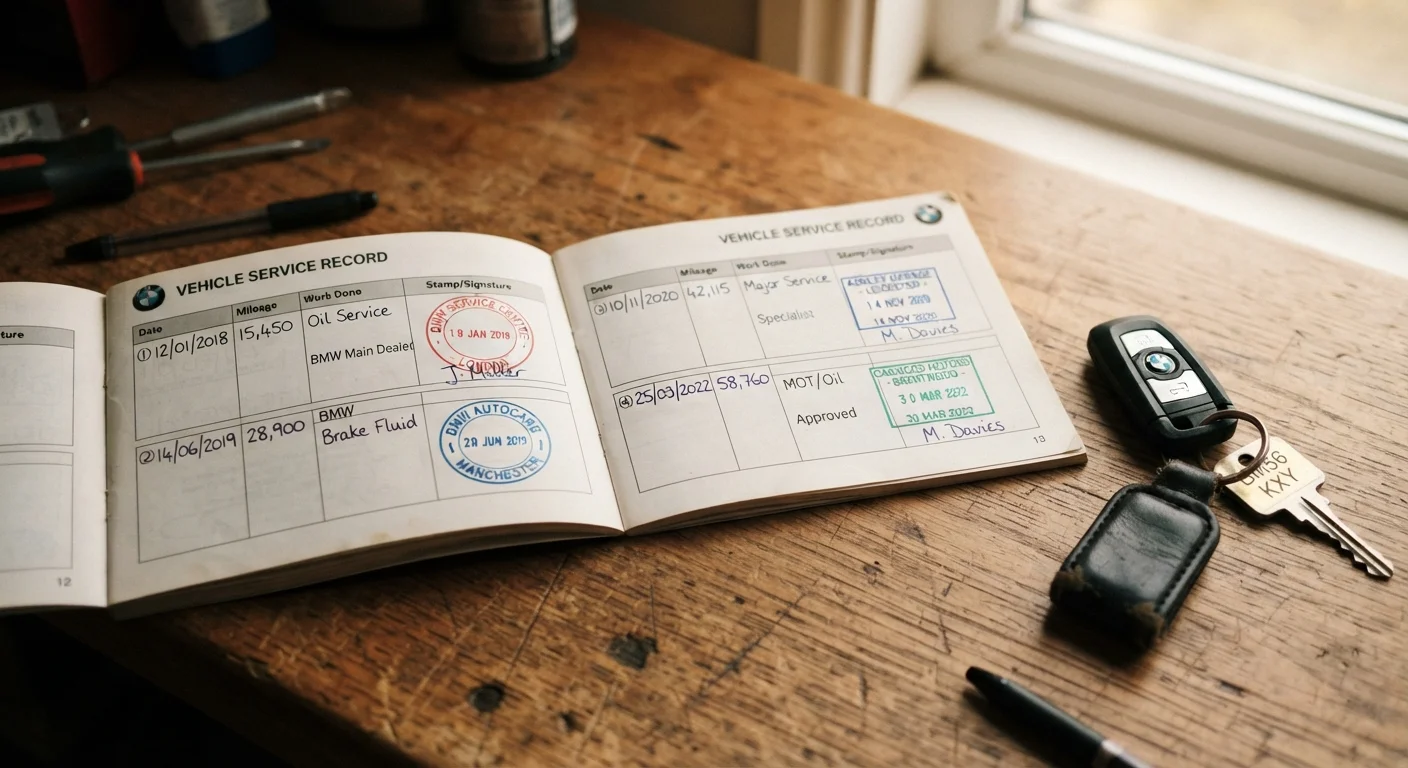
Each entry in a service book typically records the date of the service, the mileage at the time, and a stamp or signature from the workshop that performed the work. Some books also include checkboxes confirming which tasks were completed — oil change, filter replacement, brake inspection, and so on. Dealer stamps carry the garage's identity and are generally easier to verify, while independent mechanic stamps are equally valid but may require a phone call to confirm. For owners just building familiarity with vehicle paperwork, our first-time car owner guide covers the broader documentation picture.
Decoding Stamps, Intervals, and Gaps
Stamps tell you who serviced the car; intervals tell you how consistently. Most manufacturers specify service intervals in miles, months, or both — whichever comes first. A common pattern is every 5,000–10,000 miles or every 12 months. When stamps are spaced further apart than the manufacturer recommends, that gap matters. Oil left in an engine beyond its rated life can cause accelerated wear on internal components.
Full Service History (FSH)
A complete, unbroken record of all manufacturer-recommended services carried out at the correct intervals. FSH is generally considered the gold standard when evaluating a used vehicle's maintenance record.
VIN (Vehicle Identification Number)
A unique 17-character code assigned to every motor vehicle. It is used to look up digital service records, recall history, and ownership data.
Service Interval
The mileage or time threshold set by the manufacturer at which a scheduled service should be performed. Exceeding this interval without servicing can increase mechanical wear.
Franchised Dealer
An authorized dealership affiliated with a specific vehicle manufacturer. They typically have access to the manufacturer's digital service record system for that brand.
Pre-Purchase Inspection
An independent mechanical assessment carried out by a qualified technician before buying a used vehicle. It evaluates current condition and can flag issues not evident from paperwork alone.
Look for these red flags when reviewing a service history:
- Missing stamps: One or two absent entries may be explainable; a pattern of gaps is a warning sign.
- Mileage inconsistencies: Entries where mileage decreases or stays flat between services can indicate odometer tampering or recording errors worth investigating.
- Vague entries: Notes that say only "service carried out" without specifying work done offer little assurance.
- Mismatched dates and mileage: Very high mileage accumulated in a short time suggests heavy use; very low mileage over many years may mean the vehicle sat unused, which has its own maintenance implications.
A thorough service history also pairs naturally with other ownership documents. The vehicle title and registration guide explains how those records complement what you find in a service book.
Digital Records and Manufacturer Portals
Many vehicles sold in the last decade maintain service records electronically. Franchised dealerships log work against a vehicle's VIN (Vehicle Identification Number) within the manufacturer's own system. This means that even if the physical booklet is lost, a dealer of the same brand can often retrieve a full service history by running the VIN.
Lost the Physical Booklet?
If a service booklet has been lost, ask the selling dealer or previous owner to request a printout from the manufacturer's digital portal using the VIN. For independently serviced vehicles, gather all available invoices and receipts — these carry the same informational value as stamps when they clearly show date, mileage, and work completed. Keeping copies in a dedicated folder alongside your other vehicle documents is good practice going forward.
Independent garages generally do not feed into manufacturer portals, so a car serviced exclusively by independents will rely on paper records, receipts, and invoices to tell its story. Neither approach is inherently better — what matters is whether the evidence is consistent, complete, and verifiable. If you're building a structured maintenance plan going forward, the year-round maintenance calendar can help you stay on schedule so your own records never develop gaps.
What Incomplete History Really Means
No service history is not automatically a deal-breaker, but it does shift the risk calculation. Without documented maintenance, there is no way to confirm whether critical fluids have been changed, timing components replaced, or brake wear monitored. A pre-purchase inspection by a qualified, independent mechanic is strongly advisable in these cases — they can assess current condition and flag deferred maintenance, even if they cannot reconstruct the past.
Partial history — where records exist for some years but not others — deserves careful scrutiny of which periods are missing and why. A plausible explanation from the seller (a lost booklet, a change of country) is more reassuring than vague deflection. Always verify stamps where possible by contacting the listed garage directly.
Dashboard warning lights can sometimes reflect the consequences of neglected servicing. If you inherit a vehicle with patchy records, our article on car warning lights can help you assess its current health signals.