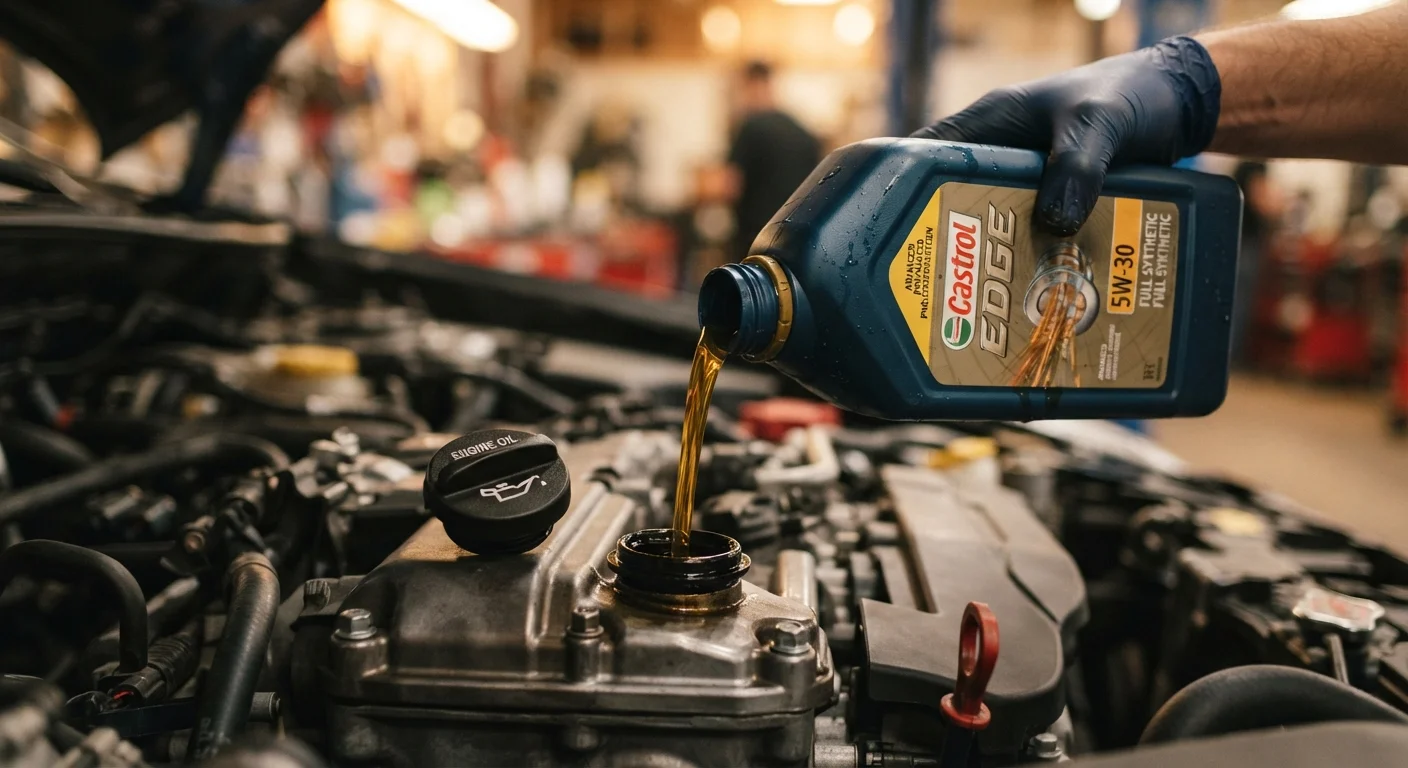
How to Read an Oil Viscosity Label
Pick up any bottle of motor oil and you'll see a code like 5W-30 or 10W-40 printed prominently on the label. These numbers follow a grading system developed by the Society of Automotive Engineers (SAE) and they tell you two distinct things about how the oil behaves.
The number before the W rates the oil's flow in cold conditions — specifically, how quickly it moves through the engine on a cold start before heat builds up. A lower number here means better cold-weather performance. Common ratings are 0W, 5W, and 10W.
The number after the W describes the oil's viscosity at normal engine operating temperature (around 212°F / 100°C). This rating tells you how thick the protective film is when your engine is fully warmed up. Typical values are 20, 30, 40, and 50.
So a 5W-30 oil flows like a thin 5-weight in the cold but maintains a 30-weight film once the engine is hot. This dual behavior is achieved through chemical additives called viscosity index improvers, which allow modern multi-grade oils to perform across a wide temperature range.
Multi-Grade Oils Are Now the Standard
Single-grade oils (like straight SAE 30) were common decades ago but required changing with the seasons. Today, virtually all passenger vehicle oils are multi-grade, engineered to perform reliably across a broad temperature range. Unless you're operating vintage or specialty equipment, a multi-grade oil is what your vehicle almost certainly requires.
Why Matching the Grade to Your Engine Matters
Engine tolerances — the tiny gaps between moving metal parts — are engineered with a specific oil viscosity in mind. When the wrong grade is used, those clearances are either flooded with oil that's too thin to maintain a protective barrier, or starved of oil that's too thick to reach them quickly enough at startup.
~40%
Of engine wear occurring at cold startup
Engineering studies suggest that a significant share of total engine wear happens in the first moments after a cold start, before oil fully circulates — making cold-flow viscosity ratings especially important.
5W-30
Most commonly specified grade in modern passenger cars
Industry data shows 5W-30 and 0W-20 are among the most frequently recommended grades in current passenger vehicle owner's manuals across North America.
The consequences aren't always immediate but they compound over time. Excess wear on bearings, camshafts, and cylinder walls accumulates gradually, ultimately shortening engine life. In some cases, using an unapproved oil grade can also void powertrain warranty coverage — something worth considering on a newer vehicle.
Fuel economy is also affected. An oil that's thicker than necessary creates more internal drag, meaning the engine works harder and burns slightly more fuel to maintain the same output. Over thousands of miles, that inefficiency adds up.
For a deeper look at how oil type affects performance beyond viscosity, see our guide on synthetic vs. conventional motor oil.
Always Check Your Owner's Manual First
Before purchasing engine oil, locate the viscosity specification in your owner's manual — it's typically listed under 'Lubrication' or 'Fluid Specifications.' The cap on your engine's oil filler port often shows the grade as well. When in doubt, a licensed mechanic can confirm the right specification for your vehicle.
Factors That Influence Which Grade You Need
Your owner's manual is the authoritative starting point — manufacturers test engines extensively to determine the optimal oil specification, and that recommendation factors in design tolerances, expected operating temperatures, and emissions targets.
Beyond the manual, a few real-world factors can also come into play:
- Climate: Drivers in cold northern states may benefit from a 0W or 5W cold-start rating, while those in consistently hot southern climates may see guidance toward oils with higher high-temperature ratings.
- Engine age and mileage: Older engines with more wear may develop slightly wider clearances. Some oil manufacturers offer higher-mileage formulations with different additive packages — though the base viscosity grade should still match what the manufacturer specifies.
- Driving conditions: Towing, extended idling, and frequent short trips all place different thermal demands on oil. If your driving involves any of these, it's worth reviewing whether your current grade and change interval are appropriate.
Understanding how your engine type shapes fuel and maintenance choices is covered in our related article on choosing the right engine for how you drive. For a broader look at keeping fluids in check, the car fluid checks every driver should know is a practical reference.