Why Brake Myths Are a Safety Problem
Brakes are the single most safety-critical system on any vehicle, yet a surprising number of drivers operate on outdated assumptions about how they work and when they need attention. These misconceptions aren't just harmless folklore — they can delay necessary maintenance, create false confidence, and in serious cases, contribute to accidents.
Understanding what's actually true about brake maintenance doesn't require mechanical training. It does require setting aside a few deeply ingrained myths. The following fact-checks draw on established automotive engineering principles and widely accepted service guidelines.
For a broader look at the maintenance tasks drivers most commonly overlook, see our guide on overlooked maintenance tasks that quietly shorten a car's life.
Myth
If my brakes aren't squealing, the pads are fine.
Fact
Squealing is just one possible warning sign — and some pads wear out without producing any audible alert.
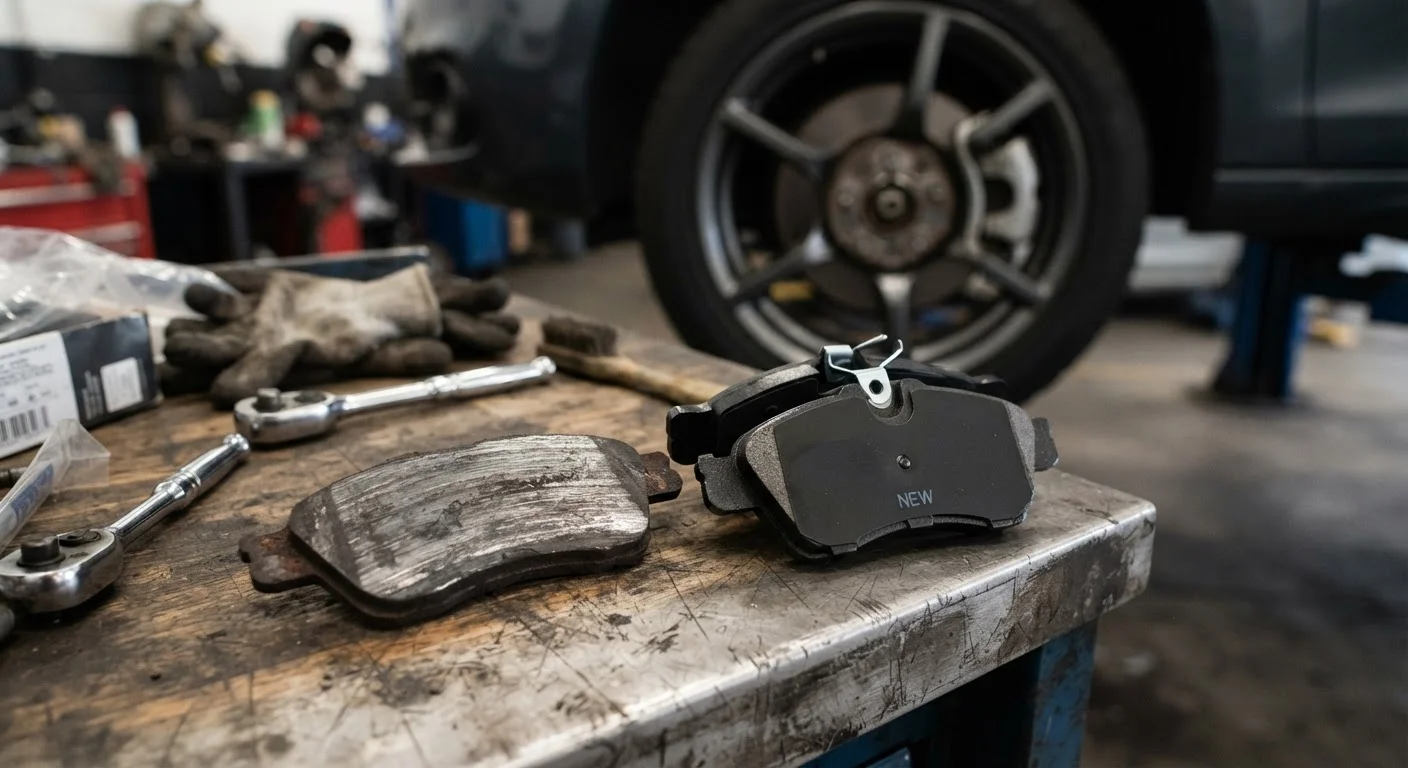
Many brake pads include a small metal wear indicator designed to squeal when the pad reaches a minimum thickness. However, the indicator can corrode, wear unevenly, or simply not make consistent contact, meaning the sound never occurs. Pads can also wear below safe limits on the inner face — the side facing the rotor — where a visual check is the only reliable way to detect the problem. Mechanics generally recommend inspecting brake pad thickness at every tire rotation, regardless of whether any noise is present.
Myth
Brake fluid never needs to be changed unless there's a leak.
Fact
Brake fluid is hygroscopic — it absorbs moisture from the air over time — which lowers its boiling point and can compromise braking performance.
As brake fluid absorbs moisture, its boiling point drops. Under heavy braking, fluid that has absorbed significant moisture can vaporize, creating compressible gas bubbles in the brake lines — a phenomenon called brake fade or vapor lock. This results in a spongy pedal and reduced stopping power. Most vehicle manufacturers recommend testing or replacing brake fluid on a defined schedule (commonly every two to three years, though this varies by vehicle and driving conditions). Checking the owner's manual or asking a mechanic to test the fluid's moisture content is the reliable approach.
Myth
New brake pads work at full effectiveness immediately after installation.
Fact
New brake pads require a break-in process — sometimes called bedding — before they deliver their rated stopping performance.
During the bedding process, a thin, even layer of friction material transfers from the pad surface onto the rotor face. This transfer layer is what allows the pad and rotor to make optimal contact. Without it, stopping distances can be longer than expected and braking may feel inconsistent. Many mechanics perform a basic bedding procedure after installation: a series of moderate stops from around 30 mph, allowing the brakes to cool between each one. Skipping this step — or immediately driving aggressively after a pad replacement — can reduce performance and cause uneven rotor wear.
Myth
Rear brakes do very little, so they're not a priority.
Fact
Rear brakes contribute meaningfully to total stopping power and vehicle stability, particularly under hard braking.
Under normal braking, front brakes handle a greater share of stopping force because weight shifts forward during deceleration. This leads some drivers to assume the rear brakes are nearly irrelevant. In reality, rear brakes provide balance and stability — especially in emergency stops, wet conditions, and when the vehicle is loaded. Modern vehicles with electronic brake-force distribution actively adjust the front-to-rear braking ratio based on conditions, making functional rear brakes essential to how the system performs as a whole. Neglecting rear brake maintenance can compromise this balance.
Myth
Stopping distance is roughly the same regardless of vehicle weight or speed.
Fact
Both speed and vehicle weight have a dramatic, non-linear effect on stopping distance.
The physics of kinetic energy means that doubling a vehicle's speed roughly quadruples the distance needed to stop — not doubles it. Similarly, a heavier vehicle carries significantly more kinetic energy at any given speed, requiring more braking force and distance to stop. A pickup truck towing a loaded trailer, for instance, needs substantially more stopping room than an unloaded passenger car at the same speed. This is particularly relevant as more drivers operate larger vehicles — SUVs, trucks, and vans — while applying stopping-distance assumptions formed behind the wheel of a smaller car. Adjusting following distance to account for actual vehicle weight and speed is a basic but frequently ignored safety measure.
Understanding the Real Risks
The through-line connecting these myths is a tendency to treat braking as a passive, self-regulating system — one that will always announce its own failures loudly and in plenty of time. In practice, brake degradation is often gradual and silent.
Don't Delay Inspection After a Grinding Noise
A grinding or metal-on-metal sound when braking is a strong indicator that brake pads have worn through completely and the caliper or backing plate is contacting the rotor directly. Continuing to drive in this condition can rapidly damage the rotor — turning a pad replacement into a more costly rotor replacement — and significantly reduces stopping ability. Have the brakes inspected by a qualified mechanic as soon as possible if this sound appears.
Driving habits also interact directly with brake wear. Frequent hard stops, riding the brakes on long downhill grades, and carrying heavy cargo all accelerate pad and rotor wear beyond what a standard mileage-based schedule accounts for. These factors are worth discussing with a qualified mechanic when determining your vehicle's service interval.
Tire condition and brake condition are closely linked — an underinflated or uneven tire can affect how braking force is distributed across all four wheels. Our article on why your tyre pressure matters more than you think covers that relationship in more detail.
Similarly, broader driving patterns can quietly accelerate wear on multiple vehicle systems at once. The habits that quietly shorten a car's life article is worth reading alongside this one.
Brake Safety Is Not a DIY Gray Area for Everyone
While some experienced home mechanics perform their own brake work, brake system repairs involve safety-critical components where errors can have severe consequences. If you are not confident in your ability to correctly diagnose, disassemble, and reassemble brake components, this is work best left to a licensed automotive technician. Incorrectly installed brake pads, improperly torqued caliper bolts, or air introduced into brake lines can all result in brake failure. Always verify that brake work meets the manufacturer's specifications.
If you're uncertain about your brakes' current condition, a visual inspection by a licensed mechanic is the most reliable first step — and in many cases it can be done during a routine tire rotation at no additional cost.