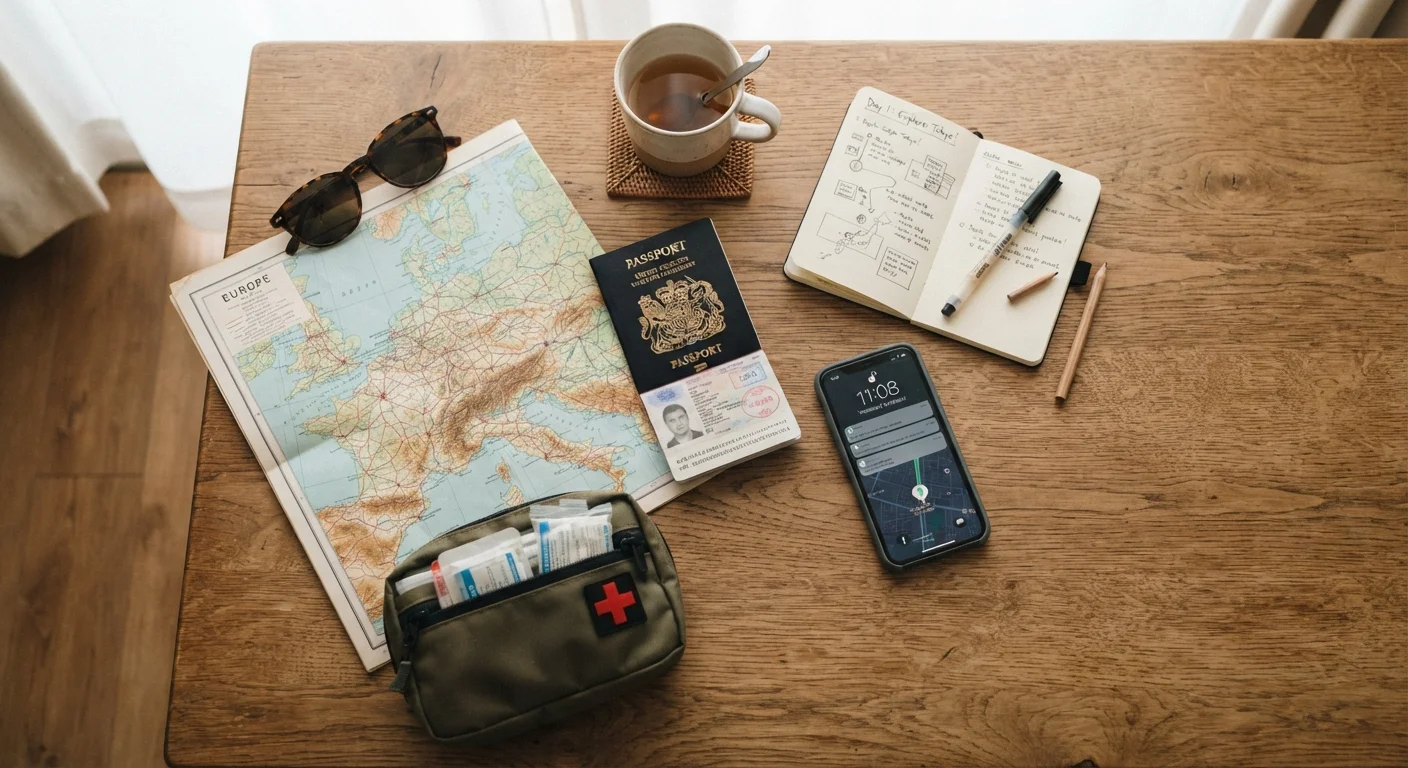
Before You Leave: Research and Risk Assessment
Safety begins long before you board a plane or hit the road. Thorough pre-trip research lets you anticipate risks rather than react to them. Start with your government's official travel advisory portal — in the US, that's travel.state.gov — which categorizes destinations by risk level and flags specific concerns like civil unrest, health outbreaks, or entry restrictions.
Beyond advisories, research local laws that may differ significantly from home. Some countries restrict medications that are legal in the US, require specific travel permits, or enforce dress codes in public spaces. Verify visa and entry requirements directly with the destination country's embassy or consulate, as rules change frequently.
Health preparation deserves its own checklist. Consult a travel medicine clinic or your physician well in advance — some vaccinations require multiple doses spaced weeks apart. Check whether your regular health insurance provides international coverage; many plans don't, which is where supplemental travel health insurance becomes relevant. Always consult a qualified healthcare professional for personal medical guidance before international travel.
For a detailed planning framework, see our complete trip planning reference, and if this is your first international journey, planning your first international trip covers passports, visas, and health prep in depth.
Verify Before You Travel
Travel advisories, entry requirements, visa rules, and vaccination recommendations change frequently and sometimes with little notice. Always consult official government sources — such as travel.state.gov for US travelers — and your destination country's embassy in the weeks immediately before departure, not just during initial planning. Do not rely solely on third-party travel sites for requirements that carry legal or safety consequences.
Packing for Safety, Not Just Comfort
Your bag is your safety kit as much as your wardrobe. At minimum, pack printed copies of your passport photo page, travel insurance policy, accommodation addresses, emergency contacts, and any critical prescriptions. Store these separately from the originals — if a bag is stolen or a device dies, paper backups remain accessible.
A compact first aid kit tailored to your destination makes a meaningful difference. For urban trips, basic wound care and pain relief may suffice. For remote or outdoor travel, include items for blisters, water purification, and altitude-related discomfort, and discuss specific supplies with your doctor ahead of time.
Before packing medications, check the destination country's controlled substances list — some common US prescriptions are classified differently abroad and may require documentation or be prohibited entirely.
Travelers have faced serious legal consequences for carrying medications that are routine at home. A brief check with the destination embassy or a travel medicine specialist prevents significant problems.
Take a photo of your packed bag's contents before closing it — this creates a quick inventory record that speeds up insurance claims if luggage is lost or stolen.
Insurance claims for lost or stolen belongings often require itemized lists. Having a visual record removes guesswork and reduces delays in reimbursement.
Distribute valuables across bags rather than concentrating them. Keep one card and some local currency accessible, another card and emergency cash stored separately in a hidden pouch or locked compartment. A portable door lock or door alarm adds a layer of security in accommodations where you're uncertain about room integrity.
On-the-Ground Habits That Reduce Risk
No destination is uniformly safe or uniformly dangerous — risk is situational. The habits that protect travelers tend to be consistent regardless of where they are. Travel safety habits that hold up across very different destinations explores this in depth, but the core principles are worth naming here.
Stay oriented. Know the neighborhood you're in, locate the nearest embassy or consulate when you arrive, and identify hospitals or urgent care facilities near your accommodation. Share your itinerary with someone at home who can raise an alarm if you go out of contact unexpectedly.
~2,000
Americans hospitalized abroad annually
The US State Department reports assisting thousands of American citizens with medical emergencies overseas each year, underscoring the value of pre-trip health and insurance preparation.
64%
Travelers who don't enroll in STEP
Surveys of American international travelers suggest a significant majority do not use the State Department's free Smart Traveler Enrollment Program before departing.
Be deliberate about digital security. Public Wi-Fi networks in airports, cafés, and hotels can expose your data. Use a VPN when connecting on unfamiliar networks, and avoid accessing banking or sensitive accounts on public connections. Keep your phone charged and consider a portable power bank — a dead phone eliminates your navigation, communication, and emergency contact options simultaneously.
Trust calibrated skepticism. Scams targeting travelers often rely on urgency or distraction. If something feels off — an unsolicited offer that seems too convenient, a stranger insisting you follow them — it's reasonable to disengage and move to a populated, public space. You can visit the Travel Essentials hub for additional practical guidance across these situations.
The Two-Phone Strategy
Consider carrying a basic unlocked secondary phone with a local SIM for calls and navigation. This keeps your primary device's data plan intact and gives you a working backup if your main phone is lost, stolen, or runs out of battery. Even an older retired smartphone can serve this purpose effectively.
Handling a Crisis While Traveling
Knowing what to do before a crisis occurs removes panic from the equation. If you're a US citizen abroad, enrolling in the State Department's Smart Traveler Enrollment Program (STEP) means the nearest embassy can contact you in an emergency and help locate you if needed. This free service takes minutes to set up and can be genuinely consequential in serious situations.
Medical emergencies are among the most stressful travel scenarios. If your travel insurance includes an emergency assistance line, save that number in your phone before you travel. These services can help coordinate care, arrange medical evacuation if necessary, and communicate with local providers — but their value depends entirely on you being able to reach them quickly.
Don't Wait to Report Theft or Loss
Delaying a police report after theft or document loss can jeopardize your insurance claim and complicate passport replacement through the embassy. File a report as soon as it is safe to do so, even if recovery seems unlikely. Most travel insurance policies have time-limited reporting windows that begin at the incident, not at your convenience.
In cases of theft or assault, file a local police report as soon as it is safe to do so. This report is typically required to make an insurance claim and to replace a stolen passport through the embassy. Photograph the report or request a copy. Contact your bank immediately to freeze compromised cards and arrange emergency funds if needed — most major banks have 24-hour international lines for exactly this purpose.
Returning Home Safely and Recovering Well
The return journey carries its own considerations. Fatigue impairs judgment — if you've been in transit for many hours, avoid making important decisions, driving long distances, or navigating unfamiliar transit systems when exhausted. Plan your arrival buffer time accordingly.
After visiting destinations with active health advisories or disease risks, monitor your health for several weeks. Some travel-acquired illnesses have delayed onset. If you develop fever, gastrointestinal symptoms, or a rash after returning, inform your healthcare provider that you've recently traveled and where — this context shapes diagnosis. Again, always follow the guidance of a qualified medical professional for any health concerns after travel.
Post-Travel Health Monitoring
Some travel-acquired illnesses — including certain vector-borne diseases — may not produce symptoms until days or weeks after you return home. If you visited a region with active health advisories, let your healthcare provider know your travel history during any post-return medical visit, even for seemingly unrelated symptoms. Early disclosure helps ensure accurate diagnosis.
Finally, reflect on what worked and what didn't. Which preparations proved most useful? Where did gaps appear? A brief post-trip debrief — even just notes in a travel journal — makes your next trip safer and smoother. Safe travel is a skill that compounds with practice and honest self-assessment.
This article provides general travel safety information for educational purposes. It is not a substitute for professional medical, legal, or financial advice. Always verify entry requirements, health recommendations, and safety conditions with official government and professional sources before traveling.