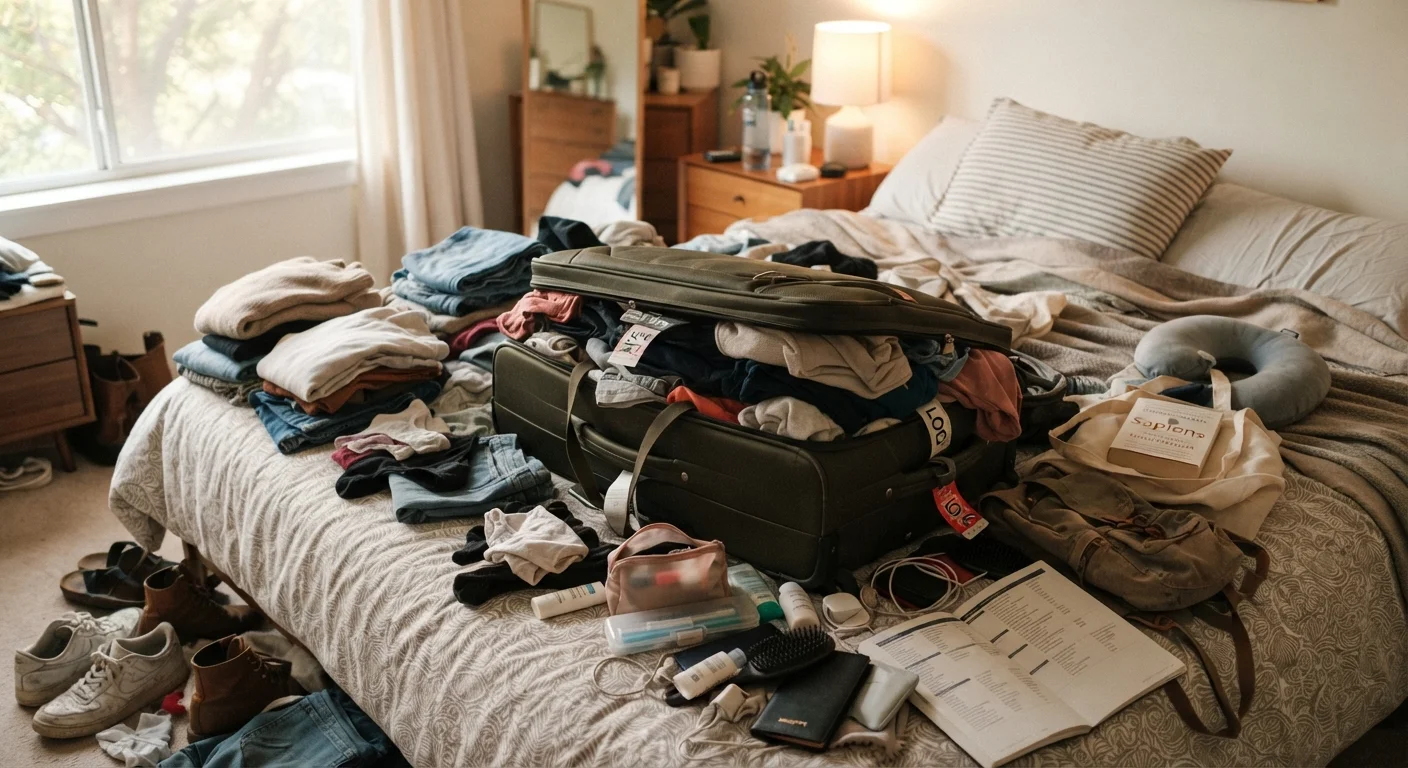
The Psychology Behind Overpacking
Overpacking isn't a matter of carelessness — it's a predictable response to uncertainty. When travelers face an unfamiliar destination, an unpredictable itinerary, or simply the anxiety of being far from home, the instinct is to prepare for everything. Every added item feels like insurance.
This tendency is reinforced by how we frame packing mentally. The question most travelers ask is "What might I need?" rather than "What will I realistically use?" The first question has an almost infinite answer. The second is far more tractable — and far more honest about how travel actually unfolds.
Research in behavioral psychology points to a related concept sometimes called projection bias: we imagine our future self as more uncertain and helpless than we actually will be. In practice, most travelers find pharmacies, laundromats, and stores abroad just as accessible as at home. Just as over-scheduled itineraries can create unnecessary stress, over-prepared bags create unnecessary burden.
~50%
Travelers who report overpacking regularly
Surveys by travel industry groups consistently find roughly half of leisure travelers say they pack more than they actually use on a typical trip.
$75–$150
Typical round-trip checked bag cost per traveler
Domestic US airlines commonly charge $30–$75 per checked bag each way, meaning a single overpacked bag can add over $100 to a round-trip fare.
Common Overpacking Mistakes and How to Break the Pattern
Understanding the specific habits that lead to overpacking makes them easier to interrupt. Most travelers repeat the same errors across every trip until they deliberately stop and reassess.
Packing for every possible scenario rather than the most probable ones.
Why it happens: Anxiety about being caught unprepared leads travelers to imagine edge cases — sudden formal events, extreme weather swings, obscure medical needs — and pack for all of them simultaneously.
Treating a suitcase's available space as space that should be filled.
Why it happens: Most travelers own luggage sized for long trips and use it regardless of trip length. Empty space feels wasteful, so the bag gets filled to capacity by default.
Packing duplicate or near-duplicate clothing items as a comfort buffer.
Why it happens: Travelers worry about running out of clean clothes or not having the right outfit for an unplanned situation, leading them to pack multiple versions of similar items.
Adding items to a bag in the final hour without reviewing the full list.
Why it happens: Last-minute packing triggers anxiety, and anxiety drives impulse additions. Travelers grab things "just in case" without weighing them against what's already packed.
Failing to account for what will be acquired or available at the destination.
Why it happens: Travelers default to the assumption that their home environment is uniquely well-stocked, even when heading to cities with comparable or better retail access.
Heavy Bags Carry Hidden Physical Costs
Overpacked luggage contributes to back, shoulder, and wrist strain — particularly when navigating stairs, uneven surfaces, or transit systems without elevators. Travelers with existing musculoskeletal concerns should be especially mindful of total bag weight. If you're managing a health condition that affects mobility, consult a healthcare professional before committing to a heavy carry load.
For travelers heading into variable conditions, building a smarter wardrobe is the single highest-leverage change. Our guide to packing for varied climates walks through how layering and fabric choice can replace half a suitcase's worth of single-use items.
It's also worth noting that overpacking has a financial dimension. Checked baggage fees, overweight charges, and the need for taxis instead of walkable transit all add up. Keeping a bag manageable is one of the more overlooked strategies covered in practical habits for keeping travel costs manageable.
How Experienced Travelers Think Differently About Packing
Frequent travelers tend to share a mindset shift rather than a single trick: they've tested their assumptions against reality enough times to stop trusting worst-case thinking. They know from experience that the formal dinner rarely materialized, the backup shoes stayed bagged the whole trip, and the "just in case" jacket spent two weeks at the bottom of a duffel.
The practical tools they use follow from that mindset. A written packing list — made days before departure, not the night before — allows for a cooler review. Returning to the list 24 hours later and asking "Would I genuinely miss this?" about each item routinely surfaces five to ten cuts.
The "Wear It or Leave It" Rule
A straightforward rule used by many experienced travelers: if you won't wear or use an item within the first two days of a trip, it almost certainly doesn't belong in the bag. Items packed for later in a trip are routinely the ones that return home unused. Apply this filter as a final pass before zipping up.
Overpacking is also connected to the broader pattern of over-preparing trips into rigidity. Travelers who over-schedule and over-pack often share the same underlying discomfort with uncertainty — something explored in depth in our piece on common myths about travel planning. Recognizing that flexibility is an asset, not a risk, changes how travelers approach both itineraries and luggage.