The Anatomy of an Exchange Rate
Every currency exchange involves two components: the rate and the fees. The rate determines how many units of foreign currency you receive per dollar. The fees are the costs layered on top of that conversion.
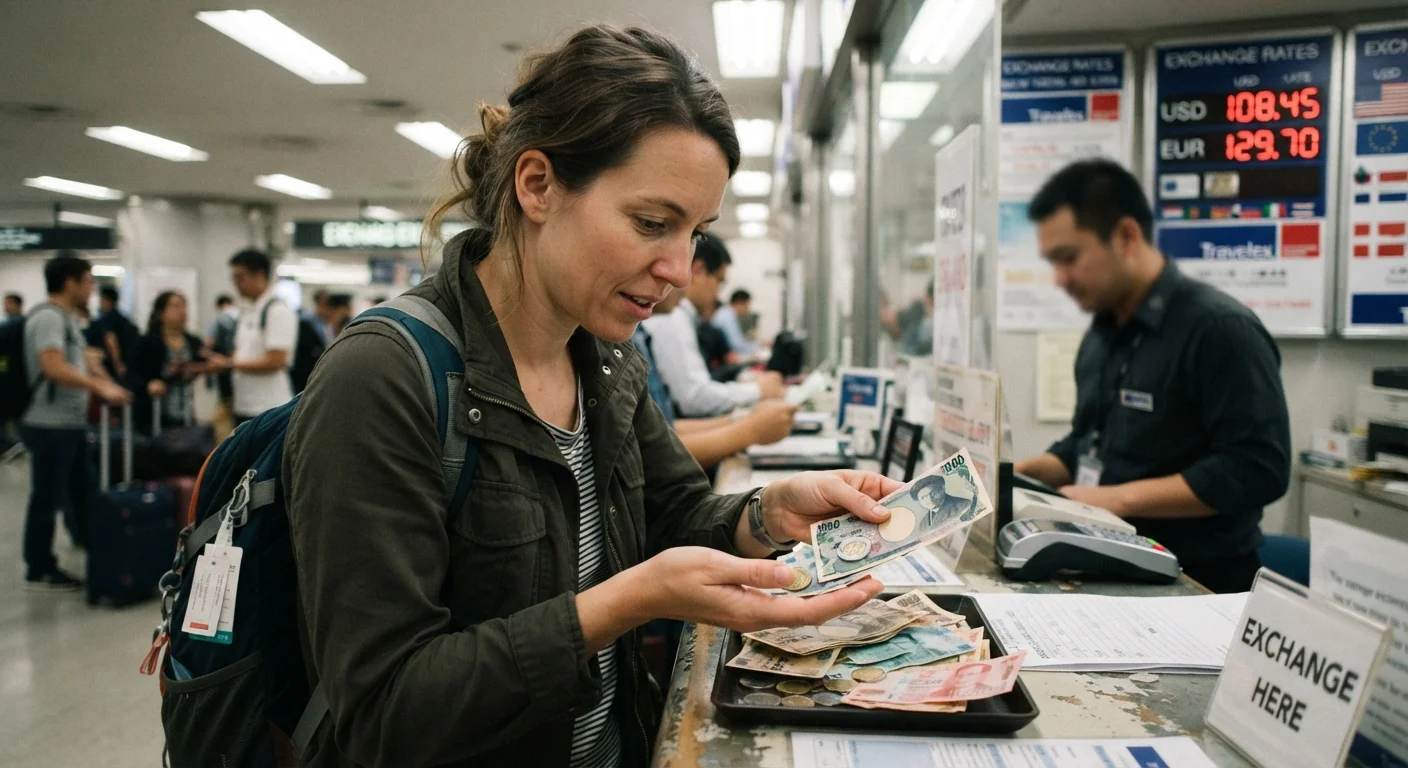
The benchmark that financial professionals use is the mid-market rate — the true midpoint between global buy and sell prices for a currency pair. This is the rate shown on financial data sites. No consumer-facing exchange — whether at an airport kiosk, a local bank, or an ATM — offers this rate directly. Institutions add a spread, a percentage markup built into the rate itself, before you ever see a number on a screen.
On top of the spread, some providers charge a flat transaction fee or a percentage-based commission. These can stack, meaning you pay both a poor rate and an explicit fee. When budgeting for international travel, accounting for these costs is essential — see our guide to building a travel budget that actually holds up for a fuller framework.
1–3%
Typical foreign transaction fee per card purchase
This percentage-based charge is applied by many standard bank and credit cards on purchases made in a foreign currency.
5–15%
Markup range at airport exchange desks
Airport currency exchange counters are widely documented as offering rates significantly above mid-market, often by a substantial margin.
$5–$10
Common flat ATM withdrawal fee abroad
US banks frequently charge a flat fee per international ATM transaction, on top of any percentage-based currency conversion markup.
Where You Exchange Money Matters
The location and method of exchange significantly affects how much local currency you walk away with.
- Airport exchange desks: Convenient but consistently offer wide spreads and high fees. Reserve for emergencies or small amounts.
- Hotel concierge desks: Similarly unfavorable rates; convenience is the only advantage.
- Local bank branches: Often offer more competitive rates, particularly if you already hold an account with an international bank that has local presence.
- ATMs abroad: Frequently the most practical option, drawing directly from your home account at rates close to mid-market — but your card issuer's foreign withdrawal fees apply. A flat fee per transaction, plus a percentage markup, can make small withdrawals expensive per dollar.
- In-country exchange bureaus: Quality varies significantly by destination and individual shop. In some countries, licensed exchange bureaus in city centers offer genuinely competitive rates; in others, they do not. Always compare the offered rate to mid-market before transacting.
Use Mid-Market Rate as Your Benchmark
Before exchanging any money, look up the current mid-market rate for your currency pair on a reputable financial data site. This gives you a realistic reference point against which to judge any rate you're offered. A difference of 1–3% is typical; anything significantly higher warrants looking for alternatives.
Cards, Fees, and Dynamic Currency Conversion
Using a debit or credit card abroad introduces a separate layer of costs. Most standard cards charge a foreign transaction fee — typically 1–3% — on every purchase made in a foreign currency. Over a multi-week trip, these small percentages accumulate into a meaningful sum.
A separate and often misunderstood charge is dynamic currency conversion (DCC). At many international point-of-sale terminals and ATMs, you'll be asked whether you want to pay in your home currency or the local currency. Choosing your home currency seems intuitive but activates DCC — the merchant's payment processor applies its own exchange rate, which is almost always less favorable than your card issuer's rate. Choosing to pay in local currency lets your card issuer handle the conversion, which is typically the better outcome.
Currency confusion can also make travelers vulnerable to overcharges. Recognizing common tourist scams — including those involving inflated bills and confusing change — becomes easier when you have a clear sense of local denominations and approximate values.
Practical Steps Before and During Travel
Understanding the system is the first step; adjusting your behavior is the second.
- Check your card's fee structure before departing. Contact your bank or review your card agreement for foreign transaction fees and international ATM withdrawal charges. Some travel-oriented cards are specifically designed to minimize or eliminate these costs.
- Notify your bank of your travel dates and destinations. Unexpected foreign transactions can trigger fraud holds, leaving you without access to funds.
- Carry some local cash for small vendors, markets, and destinations where card acceptance is limited.
- Withdraw larger amounts less frequently if your bank charges a flat ATM fee — this reduces the per-dollar cost of each withdrawal.
- Always decline DCC at terminals and ATMs when prompted to pay in your home currency.
Currency is just one of several financial variables travelers encounter. Understanding the full landscape — from exchange mechanics to hidden fees — is part of what makes travel planning effective rather than reactive.
“The single most expensive thing many travelers do is exchange money without understanding the fee structure in advance. The total cost of a transaction is almost never just the posted rate.”
— Consumer Financial Education Perspective, General principle in international personal finance education