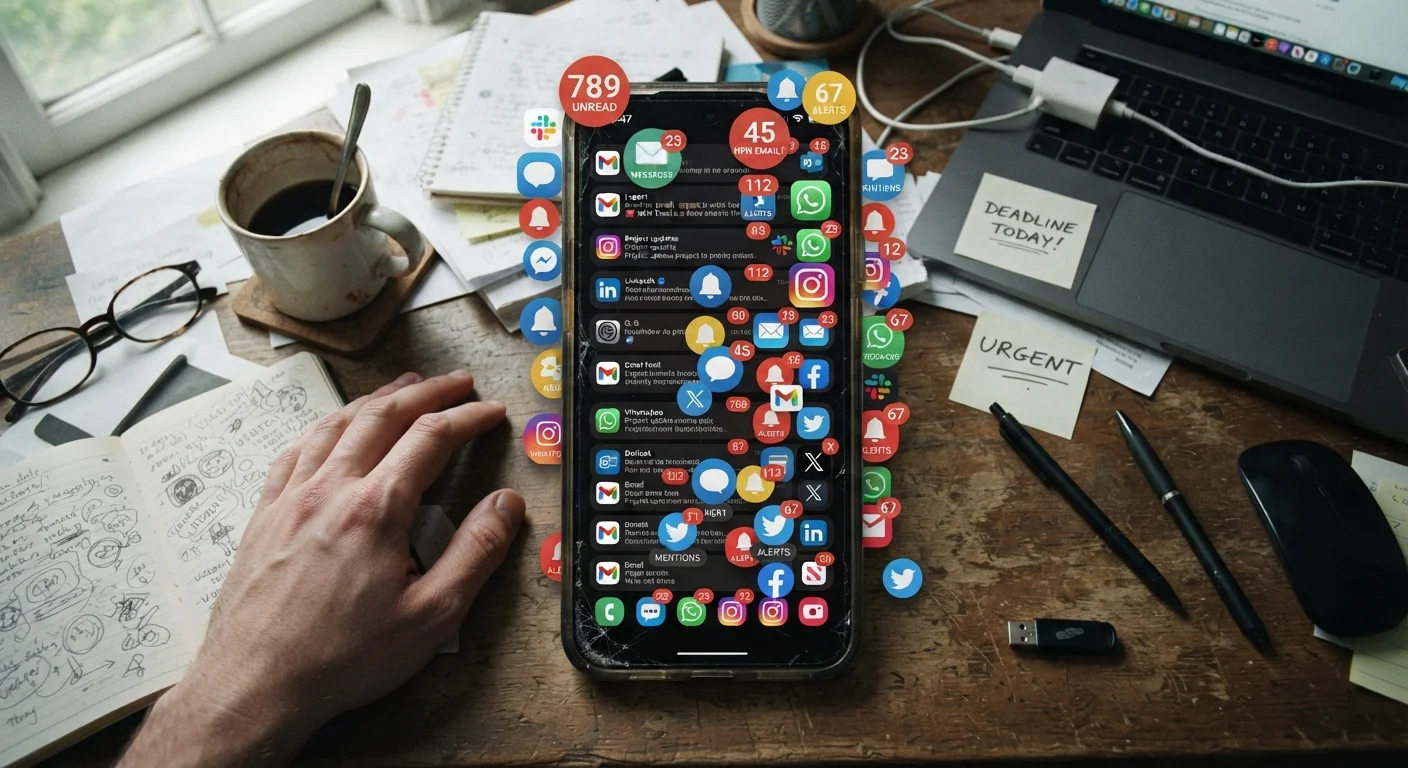
The Hidden Cost of Every Ping
It starts the moment the alarm goes off. Before most people have had coffee, they've already scanned a string of notifications — messages, news headlines, app badges, calendar reminders. By the time the workday begins, the brain has already switched contexts a dozen times.
This pattern has a measurable cost. Research from the University of California, Irvine, found that after an interruption, it takes an average of over 23 minutes for a person to fully return to a task. Applied across a day full of alerts, this isn't just inconvenient — it structurally undermines the ability to sustain deep, focused work.
What makes notifications especially disruptive is that the brain doesn't distinguish between a text from a friend and an urgent work message until it's already broken focus to check. The interruption happens first; the evaluation of importance comes second. That sequence is the core problem.
“Attention is the most valuable resource we have. Every notification is a bid for it — and each bid has a cost, whether or not you accept it.”
— Cal Newport, Computer science professor and author on digital minimalism and deep work
Stress Responses You Might Not Recognize
Notifications don't just eat time — they activate the body's stress system. Each unexpected alert triggers a small orienting response: a physiological reaction evolved to help humans detect threats in the environment. In the modern context, this response fires dozens of times a day in response to entirely non-threatening information.
Over time, this persistent low-level activation can contribute to elevated cortisol levels — the hormone associated with the body's stress response. Researchers have linked heavy smartphone notification habits to self-reported stress, sleep disruption, and reduced feelings of wellbeing. This isn't to say phones cause serious clinical conditions, but the cumulative load is real and worth understanding.
23+ min
Average recovery time after a single interruption
Research from the University of California, Irvine, found it takes more than 23 minutes on average to fully return to a task after being interrupted.
65–80+
Estimated daily notifications per smartphone user
Industry analyses and academic studies estimate that typical smartphone users receive dozens to over 80 notifications per day, varying widely by app configuration.
Measurably lower
Cognitive performance with phone in view
A University of Texas at Austin study found that the visible presence of a smartphone — even powered off — reduced participants' available cognitive capacity on tested tasks.
There's also a subtler effect: anticipatory anxiety. The expectation that a notification might arrive at any moment keeps the nervous system in a mild state of readiness, making full mental relaxation harder to achieve — even when the phone is face-down. As explored in this overview of technology and wellbeing, notification habits are just one thread in a wider pattern of how connected devices shape mental health.
Cognitive Load: What's Actually Happening in the Brain
Cognitive load refers to the total amount of mental effort being used at any given moment. The brain has a finite capacity for processing information, and notifications compete directly with whatever task is already in progress.
Each alert generates what researchers call a 'task-unfinished' cue — a mental reminder that something may need attention. Even when people choose not to act on a notification immediately, that cue occupies a small portion of working memory, reducing the mental bandwidth available for other things. Multiply this by dozens of daily alerts and the cumulative drain becomes significant.
Try a 24-Hour Notification Inventory
For one day, keep a simple running log of every notification you receive and whether you actually needed it in real time. Most people discover that fewer than 20% of their daily alerts required immediate attention. That data makes it far easier to make confident decisions about which apps to silence or batch — turning a vague intention into an informed action.
There's also the phenomenon known as 'phone presence effect,' studied by researchers at the University of Texas at Austin, which found that having a smartphone visible on a desk — even switched off — measurably reduced participants' performance on cognitive tasks. The device itself had become a distraction cue, pulling a portion of attention simply by being present.
Understanding why stepping away is harder than it sounds is important here. Behavioral design and variable reward loops are built into many apps specifically to sustain engagement — meaning the pull toward checking notifications isn't simply a willpower issue.
Practical Ways to Reduce the Load
Reducing notification overload doesn't require abandoning technology. It requires being deliberate about which alerts earn access to your attention in real time.
- Conduct a notification audit. Review every app with permission to send alerts. Ask whether each one has delivered a genuinely time-sensitive notification in the past week. If not, disable or batch it.
- Use scheduled delivery or notification summaries. Many operating systems now allow non-urgent notifications to be grouped and delivered at set times rather than in real time. This preserves awareness without constant interruption.
- Designate focus blocks. Setting specific periods — even just 90 minutes — where notifications are silenced allows for meaningful stretches of uninterrupted cognitive work.
- Move the phone out of the room. For tasks requiring sustained attention, physical distance from the device removes the ambient distraction cue that even a silent phone creates.
If you suspect notifications are part of a broader stress pattern, the structured self-reflection in a personal stress audit can help you identify which digital habits are contributing most. Similarly, mindfulness practices — whether app-guided or unassisted — offer evidence-supported ways to rebuild the capacity for calm attention that notification overload erodes.
The goal isn't a phone-free life. It's a phone life that you're directing, rather than one that's directing you.