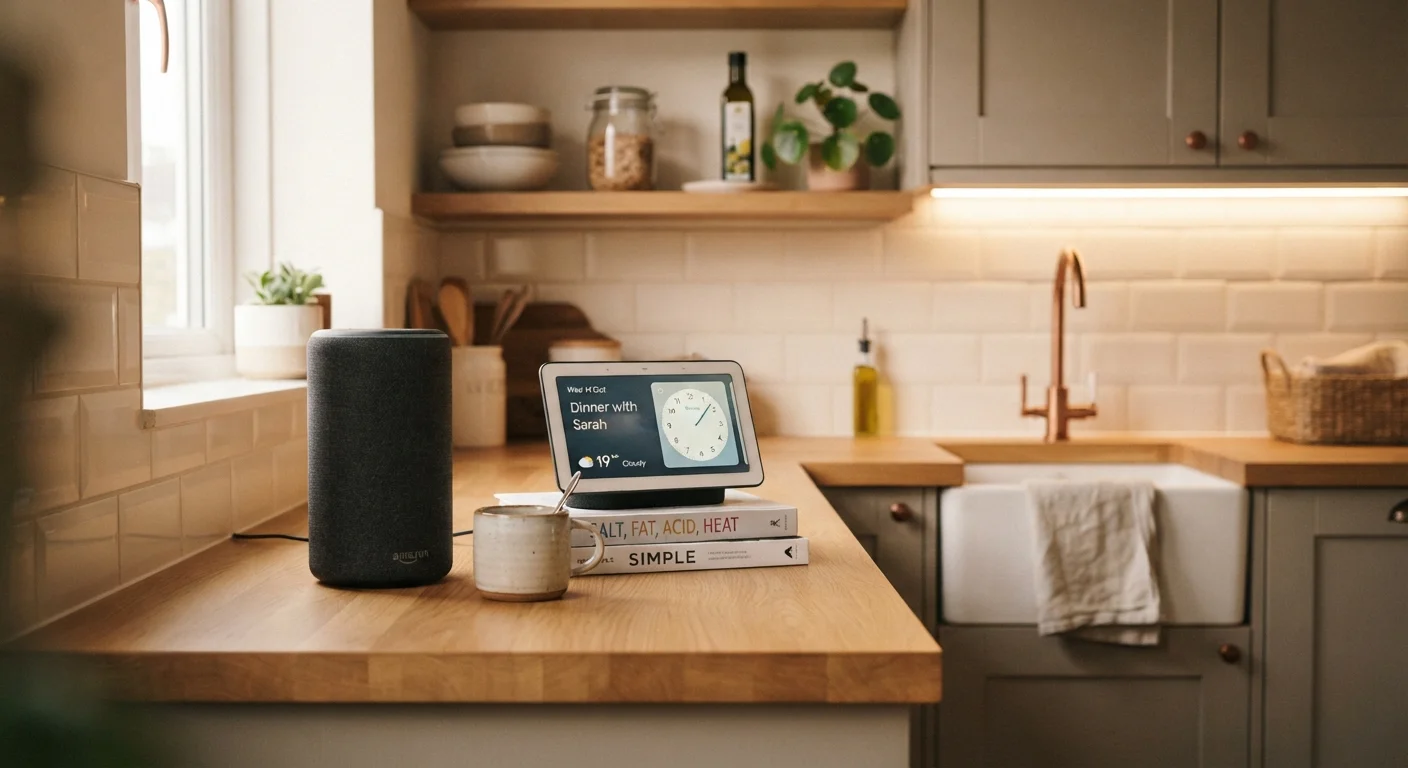
What Each Device Actually Does
Smart speakers and smart displays both serve as voice-activated hubs that connect to your Wi-Fi network and integrate with a broader smart home ecosystem. The core difference is output: a smart speaker communicates entirely through audio, while a smart display pairs that same voice interaction with a touchscreen interface.
A smart speaker listens for a wake word, processes your request through a cloud-based voice assistant, and responds through its built-in speakers. It can answer questions, play music, set timers, control compatible smart lights or thermostats, and trigger automations — all without you touching anything. If you're curious about what these ecosystems really include, our article on what 'smart home' actually means is a useful starting point.
A smart display does all of that and adds a screen — typically ranging from five to fifteen inches — that can show weather forecasts, calendar events, video call participants, security camera footage, recipe steps, and smart home device controls in a visual dashboard. The screen also responds to touch, giving you an alternative to voice for moments when speaking isn't practical.
| Criterion | Smart Speaker | Smart Display |
|---|---|---|
| Primary output | Audio only | Audio + touchscreen |
| Video calls | Not supported | Supported natively |
| Camera feed viewing | Not supported | Supported on screen |
| Physical footprint | Compact, cylindrical | Larger, requires display space |
| Power consumption | Lower (typically 5–15W) | Higher (typically 15–30W) |
| Bedroom suitability | High — no ambient light | Moderate — screen emits light |
| Recipe / visual guides | Audio step-by-step only | Full visual + audio |
| Touch interaction | Not available | Available as alternative to voice |
| Typical price range | Lower entry point | Higher due to display hardware |
Practical Differences That Actually Matter Day-to-Day
The real-world gap between these two devices becomes clearest in specific household scenarios. Consider the kitchen: a smart speaker can read out a recipe step by step if you ask, but a smart display shows you the full ingredient list while narrating — a meaningful difference when your hands are covered in flour. For families, a smart display's ability to make and receive video calls without reaching for a phone is a convenience many don't anticipate until they have it.
Home monitoring is another area where the screen earns its place. When a doorbell or indoor camera is connected to your ecosystem, a smart display can show you the live feed on-demand or automatically when motion is detected. A smart speaker can only tell you there's motion — it cannot show you anything.
That said, smart speakers have their own advantages. They're physically smaller, quieter in presence, typically draw less power, and — because they lack a screen — suit environments like bedrooms where ambient light could be disruptive. They also tend to carry a lower price point, which matters if you're considering placing a hub in multiple rooms. For a broader look at device trade-offs worth knowing before you commit, see our practical overview of smart home devices.
35%
US adults with a smart speaker at home
According to Pew Research Center survey data, roughly one-third of US adults reported owning a smart speaker as of recent years, reflecting widespread mainstream adoption.
2x
Typical power draw of a display vs. speaker
Smart displays commonly consume around twice the wattage of comparable smart speakers due to their screen backlighting and processing requirements.
Ecosystem Fit and Integration Considerations
Both device types connect to the same major voice assistant platforms — broadly, Amazon's Alexa, Google Assistant, and Apple's ecosystem — and function as control hubs for compatible smart home devices. Your choice of device type doesn't lock you into a different compatibility universe; rather, the ecosystem you're already in (or planning to join) should guide which platform's hardware you pick within that device category.
What does vary is how each device surfaces ecosystem controls. A smart display can present a visual panel of your connected lights, locks, and thermostats — letting you tap to adjust without speaking. A smart speaker requires either a voice command or a companion app on your phone for that same adjustment. For households building out routines and automations, the visual dashboard on a display can make management more intuitive. Our guide to automations, routines, and scenes breaks down how those controls actually work beneath the surface.
It's also worth noting that neither device type can do everything marketing suggests. The limitations of smart home tech are real — device compatibility gaps, connectivity dependence, and privacy considerations apply equally to speakers and displays. Understanding those boundaries before choosing helps set realistic expectations for either hub.
Privacy Applies to Both Device Types
Smart speakers and smart displays both use always-on microphones to listen for a wake word, which raises similar privacy considerations regardless of form factor. Most devices offer a physical microphone mute button and the ability to review or delete stored voice activity through the companion app. Smart displays add a camera for video calls, which typically includes a physical shutter or mute control as well. Reviewing the privacy settings on whichever device you choose is a worthwhile step before placing it in a frequently used room.