Why a Child May Fear the Pet They Live With
It can be genuinely puzzling — and heartbreaking — when a child becomes frightened of the animal they share a home with. Parents often wonder what they did wrong, or whether their pet suddenly became dangerous. In most cases, neither is true.
Fear in children can arise from a variety of sources. A dog that jumped up unexpectedly, a cat that scratched during play, or even the sound of a bark in a quiet house can be enough to tip a child's sense of safety. Toddlers and preschoolers are especially susceptible because their nervous systems are still learning to calibrate what is genuinely threatening versus simply surprising.
Developmental changes also play a role. A baby who was indifferent to the family cat may become a two-year-old who is acutely aware of its size and unpredictability. Older children who have heard a frightening story about an animal bite — even one that happened to someone else — can internalize that anxiety and apply it to their own pet.
Fear Can Coexist With Love
Many children who fear the family pet also love that animal and feel guilty about being scared. Acknowledging both feelings openly — "It's okay to love Biscuit and still feel nervous around him" — can reduce the shame that sometimes makes fear harder to work through.
For broader context on navigating these everyday dynamics, see what actually makes living with kids and pets work.
What Fear Actually Looks Like — and What It Doesn't
It helps to distinguish between healthy caution and a fear response that needs attention. A child who moves carefully around a large dog or asks to be picked up near an excited puppy is demonstrating awareness — a useful skill. A child who refuses to enter a room the pet occupies, experiences nightmares, or becomes physically distressed at the sound of the animal is showing something that deserves a more deliberate response.
~9%
Children with specific animal phobia
Research estimates that animal phobias affect roughly 9% of children at some point, making them among the most common specific phobias in childhood.
Age 2–6
Peak window for new pet fears
Child development experts note that toddler and preschool years are when fear sensitivity spikes, partly because children are newly aware of the world's unpredictability.
Fear responses in children often look like: clinging to a parent, crying, freezing in place, or fleeing. Some children become controlling — insisting the pet stay out of specific rooms — which is their way of managing an environment that feels unpredictable. Understanding the behavior as a coping strategy, rather than defiance, helps parents respond with patience instead of frustration.
Related perspectives on building a child's confidence with pets can also offer useful complementary insight.
How to Help: A Gradual, Child-Led Approach
The most important rule is deceptively simple: never force it. Physically placing a frightened child next to an animal, or insisting they pet the dog to prove they are fine, nearly always deepens the fear and erodes trust in the parent.
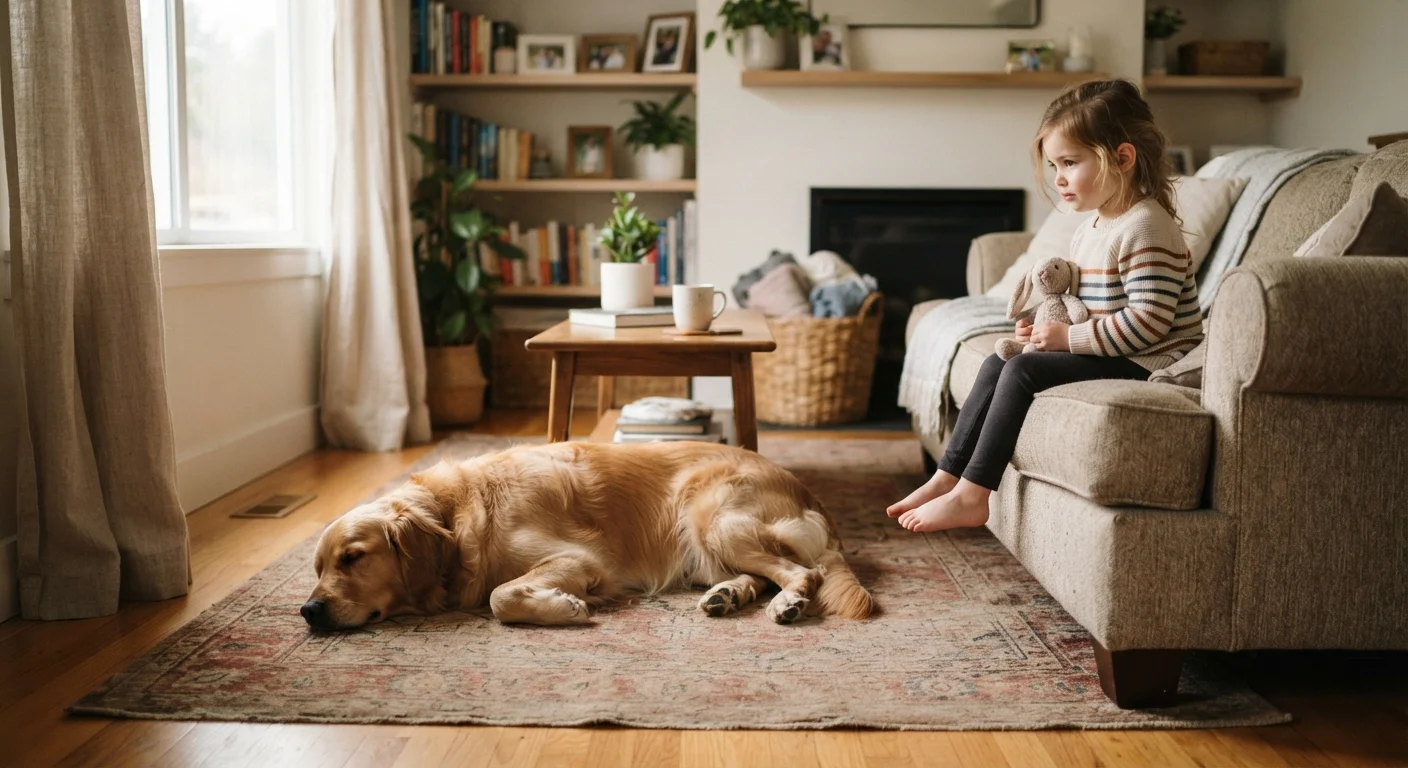
Instead, begin with distance and control. Let your child decide how close they want to be. Start by simply being in the same room while the pet rests calmly across the space. Narrate what the animal is doing in a calm, matter-of-fact tone: "The dog is just sleeping over there. She looks pretty comfortable." This helps the child build a new, low-stakes association with the pet's presence.
Let Your Child Set the Pace
Resist the urge to engineer breakthrough moments. Progress with fear is rarely linear, and a session that goes well one day may feel like too much the next. Keep interactions short, positive, and entirely on your child's terms. Consistency over weeks matters far more than any single interaction.
Over time, small steps accumulate: watching the pet eat, tossing a treat from across the room, eventually touching the animal while a parent holds it. Celebrate each milestone without pressure to jump ahead. For safety foundations that support this process, explore safety habits every pet-owning family should build early.
If progress stalls or the fear intensifies, a pediatric psychologist who works with anxiety can offer structured, evidence-based approaches. This is general guidance — always consult a qualified professional for concerns specific to your child's wellbeing.
This article is for informational purposes only and is not a substitute for professional mental health or medical advice. If your child's fear is severe or persistent, please consult a qualified healthcare provider.