How Compound Interest Actually Works
At its core, compound interest is the process of earning — or owing — interest on interest. Start with $1,000 at a 5% annual interest rate. After year one, you have $1,050. In year two, the 5% applies not to the original $1,000 but to the full $1,050, producing $52.50 in interest instead of $50. Each cycle, the base grows, and so does the interest it generates.
This self-reinforcing loop is often called the snowball effect. Early on, the gains feel modest. But over a decade or two, the difference between compounded and simple interest becomes substantial — and that gap widens with time. The key variables driving the outcome are the interest rate, the compounding frequency, and how long the money remains in place.
For a broader grounding in the vocabulary around this topic, see our personal finance glossary.
Rule of 72
Years to double money at a given rate
Divide 72 by your annual interest rate to estimate how many years it takes to double a balance — e.g., 72 ÷ 6% = roughly 12 years. This is a widely used mental math shortcut in personal finance education.
~20%+
Typical credit card APR in the U.S.
According to Federal Reserve data, average credit card interest rates in the U.S. have exceeded 20% APR in recent years, making compounding debt on revolving balances especially costly.
Daily
How often most credit cards compound interest
Most major U.S. credit card issuers apply a daily periodic rate to your outstanding balance, meaning interest accrues every single day a balance is carried.
The Savings Side: Why Time Is Your Biggest Asset
When compound interest works in your favor, the most powerful lever you can pull is time. Consider two people who each invest $5,000 at a hypothetical 6% annual return. One starts at age 25 and stops contributing after 10 years. The other starts at age 35 and contributes for 30 years. Despite contributing more money over a longer period, the later starter often ends up with a smaller balance — because the early starter's money had more years to compound.
This illustrates why financial educators frequently emphasize starting early over starting large. Even modest, consistent contributions to a retirement or savings account can grow meaningfully given sufficient time — not because of any special strategy, but because of the mathematics of compounding.
Start Early, Even With Small Amounts
You don't need a large lump sum to benefit from compounding. Even small, regular contributions to a savings or retirement account can grow substantially over a long time horizon. Delaying by even a few years can meaningfully reduce the final balance, so starting as soon as you're financially able is generally worthwhile.
Automating your contributions can help ensure you never miss a compounding cycle. Our article on automating your savings covers the mechanics and pitfalls worth knowing before you set it up.
The Debt Side: When Compounding Works Against You
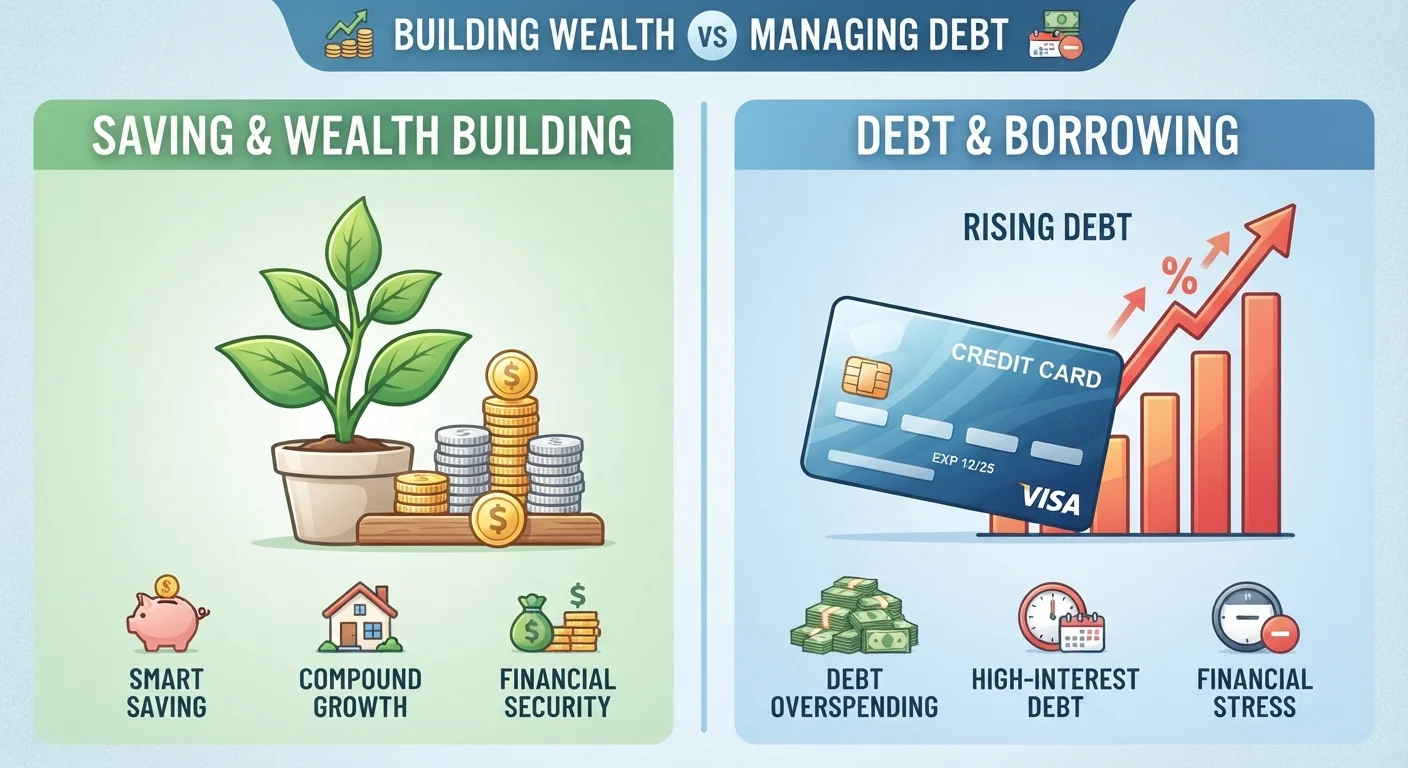
The same mathematics that builds wealth in a savings account can erode it when applied to debt. Credit cards are a particularly sharp example: most issuers calculate interest daily using your outstanding balance, then add that interest to what you owe. Tomorrow's interest is then calculated on the new, slightly higher balance. Carrying even a moderate balance at a high annual percentage rate (APR) can cause the amount you owe to grow faster than minimum payments reduce it.
This is why paying only the minimum on a credit card often results in the principal barely moving for months or years. The true cost of carrying a credit card balance — including the compounding dynamic — is frequently underestimated by cardholders.
APR vs. APY: Know the Difference
APR (Annual Percentage Rate) reflects the nominal yearly interest rate without accounting for compounding within the year. APY (Annual Percentage Yield) includes the effect of compounding and gives you a more accurate picture of what you'll actually earn or owe annually. When comparing savings accounts or loan offers, APY is usually the more useful figure for understanding real cost or return.
Mortgages and auto loans also involve interest, though they are typically structured as amortizing loans, meaning each payment is designed to reduce principal on a fixed schedule. Credit card debt and some personal loans are revolving or non-amortizing, which is where compounding risk tends to be highest.
Using This Knowledge to Make Better Decisions
Understanding compound interest on both sides of your personal balance sheet helps you weigh trade-offs more clearly. If your savings account earns 4% annually but you carry credit card debt at 20% APR, the math generally favors paying down the high-interest debt first — because compounding is working against you at a faster rate than it's working for you.
That said, this is general financial education, not personalized advice. Individual situations — emergency fund needs, employer retirement matches, loan terms — all affect the right approach. A qualified financial adviser can help you work through your specific circumstances.
For a structured way to think through the debt-versus-savings question, our guide on paying off debt or building savings first walks through the key considerations. And if you're ready to build a comprehensive plan, the saving and debt framework offers an end-to-end approach.
This article is for general informational and educational purposes only and does not constitute personalized financial, investment, or tax advice. Consult a licensed financial professional before making decisions based on your individual situation.