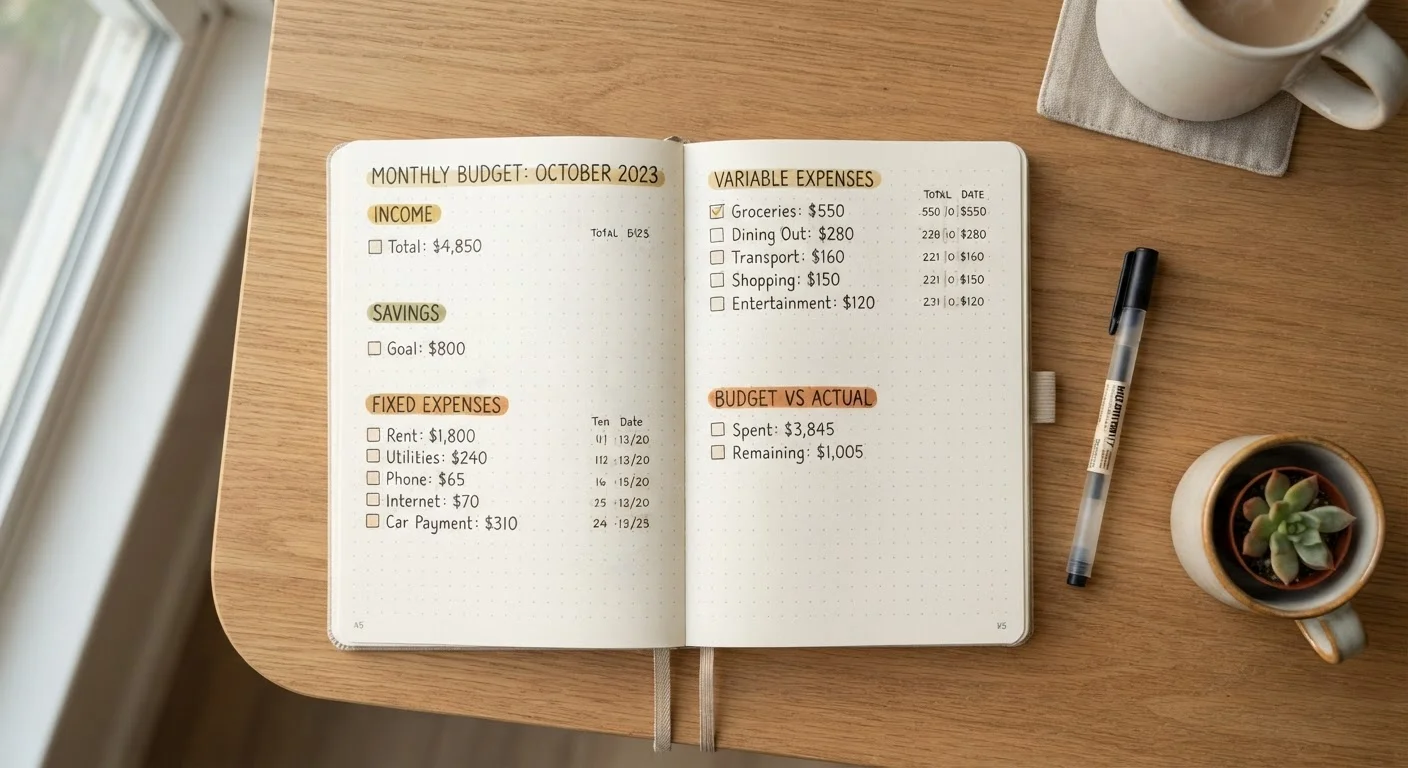
The Core Misunderstanding About Budgets
Ask ten people what they think of when they hear the word "budget" and most will describe something uncomfortable: a list of things they are no longer allowed to buy. This association — budget as restriction — is probably the single biggest reason so many people avoid making one.
But a budget does not restrict spending. It directs spending. The difference is significant. When you restrict spending without a plan, you are reacting to a balance getting low or a bill arriving. When you direct spending through a budget, you are making active decisions about what matters to you before the money hits your account — and then following through on those decisions.
Framing a budget as a "no" document misses the point entirely. It is a "yes" document: yes to rent, yes to groceries, yes to a weekend trip you have been saving toward, yes to building an emergency fund. The constraint is not moral — it is mathematical. You have a fixed amount of income, and a budget is simply the plan for how all of it gets used.
Reframe the Word Before You Start
If the word "budget" feels discouraging, try replacing it mentally with "spending plan." The mechanics are identical, but the framing shifts from restriction to intention. You are not cutting spending — you are deciding in advance where it goes. That mindset shift makes it easier to stick with the process.
What a Budget Actually Does, Step by Step
A well-made budget performs three distinct functions that most people overlook when they think of it as just a spreadsheet.
1. It makes trade-offs visible
Every dollar you spend on one thing is a dollar not spent on something else. That trade-off exists whether you budget or not. A budget just makes it explicit. When you can see that an extra $200 a month on dining out is the reason your savings account isn't growing, you are equipped to make a real choice — cut back, or accept the trade-off knowingly. Either answer is valid.
2. It replaces anxiety with information
Many people feel a low-grade financial stress they can't quite name. Often, it comes from not knowing whether they can afford something — so they either avoid spending entirely or spend and feel guilty afterward. A budget answers the question "can I afford this?" with data rather than guesswork.
3. It captures irregular costs before they surprise you
Car registrations, annual subscriptions, holiday gifts — these expenses don't appear every month, but they are entirely predictable. A budget that accounts for them in advance avoids the cycle of being blindsided. See how irregular expenses fit into a monthly budget for a deeper look at this often-missed layer.
~1 in 3
U.S. adults who follow a detailed household budget
According to Gallup polling data, only around one-third of American households maintain a detailed monthly budget, despite widespread awareness that budgeting supports financial stability.
65%
Americans who say they would struggle with a $1,000 emergency
Bankrate surveys have consistently found that a majority of U.S. adults lack adequate emergency savings, a gap that structured budgeting directly addresses by making savings a planned line item.
Why Your Budget Needs to Match Your Actual Life
One of the most common budgeting failures isn't a lack of discipline — it's a budget built around an aspirational version of a person's life rather than their real one. Someone who budgets $200 for groceries when they consistently spend $380 hasn't made a budget; they've made a wish list.
A realistic budget starts with your actual income and your actual recurring costs. Understanding which of those costs are fixed every month and which fluctuate is foundational. Fixed vs. variable expenses behave very differently, and a budget that treats them the same tends to break down quickly.
Once you have an honest picture of your baseline, you can make intentional decisions about the flexible parts of your spending. That's where a budget becomes genuinely empowering rather than just a numbers exercise.
No Single Budgeting Method Is Universal
Common frameworks like the 50/30/20 rule (needs, wants, savings) or zero-based budgeting (every dollar assigned a job) are starting points, not mandates. The right method is the one that reflects how you actually think about money and is simple enough that you'll actually use it. If a method feels impossible to maintain, it may be the wrong fit — not a sign that budgeting itself doesn't work.
Budgets Are Meant to Be Adjusted
A budget is not a contract you sign and never revisit. It is a living document that should be reviewed — and revised — regularly. If your expenses shift, your income changes, or your priorities evolve, your budget should reflect that.
Most people who abandon budgeting do so because they feel they "failed" when their actual spending didn't match the plan exactly. But divergence between the plan and reality is not failure — it is feedback. It tells you something about your real spending patterns or your original estimates that you can use to build a more accurate plan next month.
A structured end-of-month budget review is one of the most practical habits you can build. It transforms budgeting from a one-time exercise into an ongoing, self-correcting system. And if you're worried about hitting a wall after the initial motivation fades, it helps to understand why budgets tend to falter around month three — and what to do differently before you get there.
“A budget is telling your money where to go instead of wondering where it went.”
— Dave Ramsey, Personal finance author and radio host
This article is for general informational and educational purposes only. It does not constitute personalised financial advice. For guidance specific to your financial situation, consider consulting a qualified financial professional.